
The Bridge of a Thousand Stories (B1 Reading Story)

B1 · INTERMEDIATE Reading practice · ~3,000 words · 18-min read
This is an original folk tale for intermediate learners. Nobody has read it before — it was written just for you. First, study the ten key words below. Then read the story, one chapter at a time. At the end, there is a quiz to check what you understood.
Before you read — 10 key words
- flood — a lot of water that covers land which is usually dry.
- merchant — a person who buys and sells things to make money.
- bargain — an agreement between two people: you do this for me, and I do that for you.
- greedy — wanting more money or things than you need.
- carve — to cut wood or stone carefully to make a shape or picture.
- whisper — to speak very, very quietly, almost without sound.
- honest — telling the truth; not lying or cheating.
- creak — the small sound old wood makes when you step on it.
- mist — thin cloud close to the ground that makes it hard to see.
- fade — to slowly become weaker or disappear little by little.
The story
1 · The village with two hearts
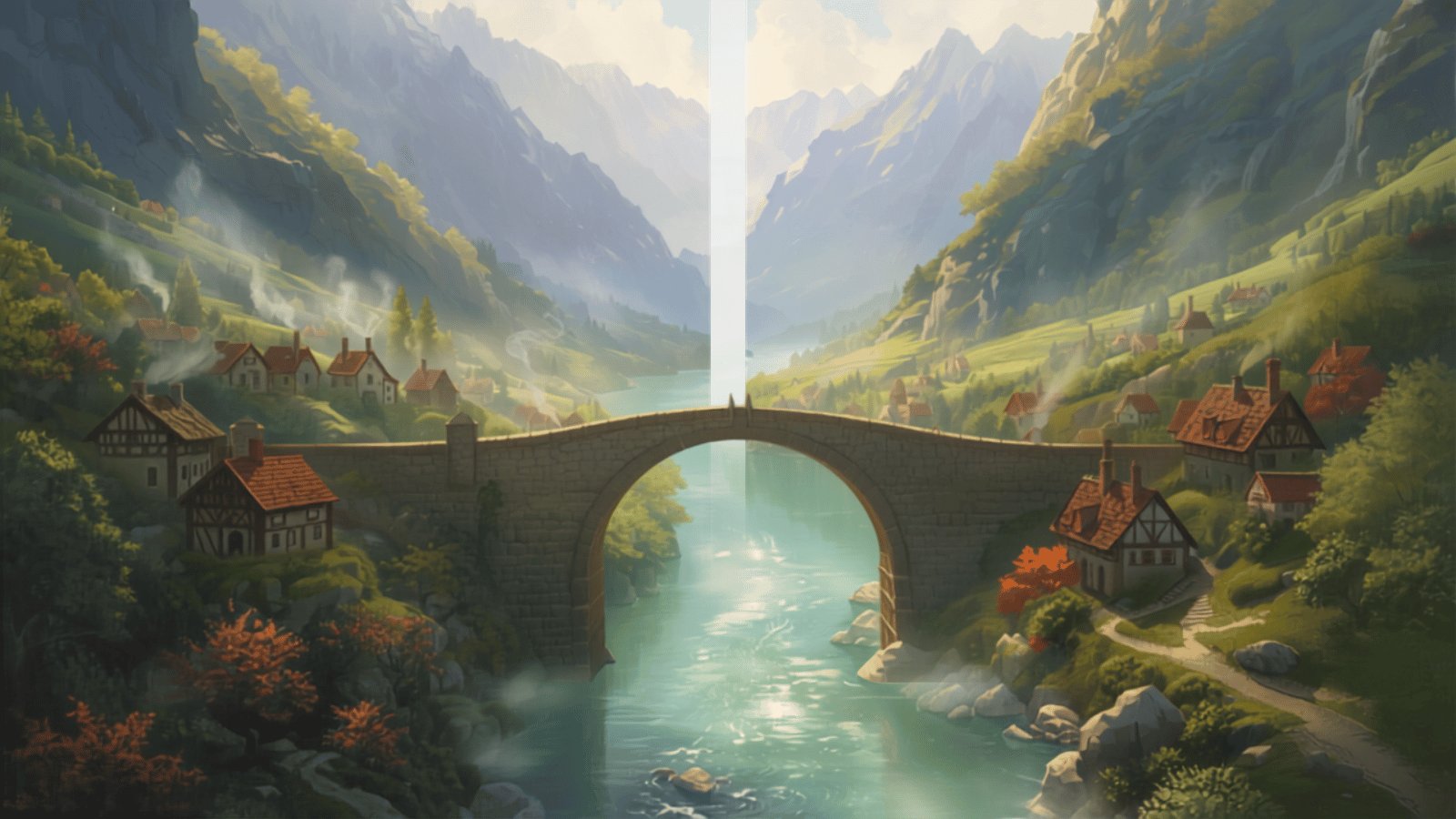
A long time ago, in a green valley between two mountains, there was a village called Two Banks. It had this name because a wide river ran through the middle of it. Half of the village stood on the east bank, and half stood on the west bank.
For three hundred years, an old stone bridge had joined the two halves together. The bakers lived on the east side, and the fishermen lived on the west side. The school was in the east, and the market was in the west. Every morning, hundreds of feet crossed the bridge — children going to school, farmers carrying vegetables, old friends looking for a cup of tea and a long conversation.
People said that Two Banks was really one village with two hearts, and the bridge was the road between them.
Then, one terrible night in autumn, the rain began. It rained for nine days and nine nights without stopping. The river grew fat and angry. On the tenth morning, a great flood came down from the mountains. The water covered the fields, filled the streets, and pushed against the old stone bridge with the weight of a thousand horses.
The bridge, which had stood for three hundred years, fell in one hour.
When the flood finally went down, the people of Two Banks stood on their two banks and looked at each other across the brown water. There was nothing between them now except broken stones.
At first, everyone said, “We will build a new bridge soon.” But the village was poor after the flood. Houses needed roofs. Fields needed seeds. The years passed, and the bridge was never built.
Slowly, quietly, the village began to change. Children on the east side stopped learning the names of children on the west side. The fishermen sold their fish in another town. The bakers baked less bread. An old ferryman carried people across the river in his small boat, but he charged a silver coin for every trip, and in winter, when the water was wild, he did not go out at all.
Worst of all, the two sides began to tell unkind stories about each other. “The east siders think they are better than us,” said the west. “The west siders are rude and lazy,” said the east. None of it was true. But when people cannot talk to each other, they start to imagine things — and imagined things grow in the dark.
Ten years after the flood, Two Banks was not one village with two hearts. It was two small, cold villages with no heart at all.
2 · The stranger and the bargain
One grey morning in spring, a stranger walked into the village. She was an old woman with silver hair, a long brown coat, and a wooden box of tools on her back. Mist lay on the river that morning, thick and white, and she seemed to walk straight out of it.
She stood at the place where the old bridge had been, and she looked at the broken stones for a long time. Then she went to find the head of the village, an anxious little man named Mayor Peck.
“I am a bridge builder,” she said. “I have built bridges in more countries than you have pots in your kitchen. I will build you a new bridge, and I will finish it in seven days.”
Mayor Peck’s face went from white to pink to white again. “We have no money,” he said sadly. “We cannot pay you.”
“I did not ask for money,” said the old woman. “I ask for a different price. Here is my bargain: every person who crosses my bridge must pay with one true story. They must stop in the middle of the bridge and tell it out loud — a true story from their own life. That is the toll. Not gold. Not silver. A story.”
The mayor blinked. “That’s all? Just… talking?”
“A true story is never just talking,” said the woman. “Do we have a bargain?”
The mayor thought it was the strangest offer he had ever heard. But a free bridge is a free bridge, so he shook her hand and signed his name in her little black book.
The old woman worked alone. Nobody understood how she did it. Each morning, the villagers found more of the bridge finished — tall wooden legs standing in the water, long smooth boards, handrails that curved like waves. When the wind blew through the new wood, it creaked softly, and the creak sounded almost like a voice.
On the seventh day, the bridge was complete. It was beautiful — golden-brown wood, wide enough for two carts, strong enough for a hundred people. And along both handrails, the builder had carved small pictures: a fish, a loaf of bread, a boat, a mountain, a rising sun.
“The bridge is ready,” the old woman told the crowd that gathered by the river. “Remember the bargain. One crossing, one true story. The bridge will listen.” She smiled in a way that nobody quite understood. “And believe me — it will know the difference between a true story and a false one.”
3 · The toll of true stories
The first person to cross was a nine-year-old girl called Mina, who wanted to see her grandmother on the west side. She had not seen her since the winter, because the ferryman’s boat cost too much.
Mina walked to the middle of the bridge, held the handrail, and said in a small clear voice: “Last year I found a baby bird that had fallen from its nest. I kept it in a shoe box and fed it for three weeks. When it flew away, I cried, but I was happy too. That is my story.”
The wood under her feet gave a warm, gentle creak, as if the bridge was saying thank you. Mina laughed and ran the rest of the way to her grandmother’s house.
And the next morning, the villagers noticed something strange. On the handrail, next to the carved fish, there was a new carving that had not been there before: a tiny bird flying out of a box.
Nobody had seen anyone carve it. The old woman had already packed her tools.
After that, everyone wanted to cross the bridge. People crossed to buy fish and stayed to listen. People crossed to sell bread and stayed to talk. And every crossing meant a story, spoken out loud in the middle of the bridge, where anyone standing near could hear it.
An old fisherman told how he had once been saved from a storm by a light that nobody else ever saw. A young teacher told how she had failed her first exam, cried for a week, and tried again. A quiet farmer told how he still sang to his cows because his wife, who had died, always used to sing to them.
With every story, a new small picture appeared on the handrails, carved by no visible hand. A boat in a storm. A book with a torn page. A singing cow — which made all the children laugh.
Not every story was happy, and not every story was easy to tell. Some people stood in the middle of the bridge for a long time before they found the courage to speak. A woman who had moved to the village thirty years before finally told everyone how lonely her first winter had been, and how one neighbour’s small kindness — a basket of eggs left at her door — had kept her from leaving. Two sisters who crossed together told the same story from two different sides, and laughed until they cried when they discovered that each of them had been secretly jealous of the other since childhood.
Something else happened too, something bigger than carvings. The baker from the east side heard the story of the fisherman from the west side — the man he had not spoken to for twenty years because of an old, silly argument about a broken fence. When the baker heard how the fisherman had almost died in that storm, the argument suddenly seemed very small. That evening, the baker crossed the bridge with a warm loaf of bread under his arm and knocked on the fisherman’s door.
The unkind stories that the two sides had told about each other began to fade. They faded the way mist fades in the morning sun — slowly at first, then all at once. It is difficult to believe that people are rude and lazy when you have heard them speak honestly about their broken hearts and their small, brave hopes.
Within one summer, Two Banks was becoming one village again.
4 · The man who was too busy for stories
But there was one man in the village who hated the bridge, and his name was Goran.
Goran was the richest merchant in the valley. He owned three shops, two warehouses, and the biggest house on the east bank. He wore rings on his fingers and never smiled unless he was counting money. People said that if Goran ever gave you something for free, you should check your pockets afterwards.
He was greedy in a deep, quiet way. He did not steal, and he did not cheat — not exactly. But he always paid his workers as little as possible, he always charged his customers as much as possible, and he had never once in his life given a coin away. He had been greedy for so long that he could not remember being anything else.
Goran needed the bridge more than anyone. Every day, his carts had to cross the river to reach the market. But the toll made him furious.
“A story?” he shouted at Mayor Peck. “I am a busy man! Time is money! If I stop to tell stories every time I cross, I will lose an hour a day. Do you know how much an hour of my time costs?”
“The bargain is the bargain,” said the mayor, who was secretly a little pleased. “One crossing, one true story.”
So Goran decided to cheat.
The next morning, he marched onto the bridge, stopped in the middle, and said quickly: “Once I found a bag of gold and gave it all to the poor. The end.” It was a lie, of course. Goran had never given anything to anyone.
He took ten more steps — and stopped. Something was wrong. Thick white mist had risen from the river, so thick that he could not see his own boots. He kept walking, and when the mist cleared, he found himself standing exactly where he had started. On the east bank. The bridge had turned him around, and he had not even felt it.
“Impossible,” Goran whispered.
He tried again with a better lie: a long, detailed story about saving a child from the flood ten years ago. The mist rose again, white and silent, and again the bridge quietly put him back where he had begun.
He tried a third time, almost screaming a story about his kindness to animals. The mist swallowed him a third time. When it cleared, he was on the east bank, and he heard — he was sure he heard — the wooden boards give a long, low creak that sounded exactly like laughter.
Goran stood by the river, shaking with anger, while a seven-year-old boy walked past him onto the bridge, told a true little story about losing a tooth, and crossed without any trouble at all.
For three weeks, Goran paid the ferryman to row him across the river. It cost him a silver coin every trip, and every trip, he watched the whole village walk across the bridge for the price of a few honest words. For a greedy man, this was a special kind of pain. The other merchants began to smile behind their hands. Even the ferryman smiled — Goran was now his only customer.
5 · The story Goran never told
One cold night in October, Goran could not sleep. He got up, put on his coat, and walked down to the river alone. The village was dark. The moon hung over the mountains like a silver coin that nobody could spend.
He stepped onto the bridge and walked slowly to the middle. The wood creaked under his feet — softly, patiently, like an old friend who has been waiting. Far below, the black water moved without a sound. Somewhere on the west bank, a dog barked once and was quiet.
Goran had told himself that he was only going for a walk. But a man does not walk to the middle of a magic bridge at midnight for no reason, and deep down, he knew why he had come.
“I know why you will not let me cross,” he said quietly to the empty air. “It is not because my stories are false. It is because I have a true one, and I have never told it.”
The river said nothing. The bridge said nothing. Goran held the handrail with both hands, and after a long silence, he began.
“When I was eight years old, I was poor. Not poor like people say today. Really poor. My father was gone. My mother was sick. One winter morning I was so hungry that I stole a loaf of bread from the baker’s window. I did not even run. I was too weak to run. The baker’s mother caught me in the street with the bread still warm in my hands.”
His voice shook, but he continued.
“I thought she would call for help. Instead, she took me inside, sat me by the fire, and gave me a second loaf to take home to my mother. She said: ‘Eat, boy. But promise me one thing. Never be hungry in silence again. Hunger is not shameful. Silence is.’ I promised. And then I broke my promise for fifty years. I became rich so that I would never be hungry again — and I never told anyone why. I was ashamed of that hungry little boy. I have spent my whole life trying to bury him under gold.”
Goran wiped his eyes with the back of his hand, the hand with all the rings.
“She died before I could thank her. Her son is the baker I buy my bread from every week. He has no idea. That is my story. That is my true story.”
For a moment, nothing happened. Then the mist on the river — and there is always mist on that river at night — began to fade, until the water shone clear and black under the moon. The bridge gave one long, warm creak. And Goran walked across to the west bank without any trouble, though he no longer remembered why he had wanted to go there.
In the morning, the villagers found a new carving on the handrail, in the very centre of the bridge: a small boy holding a loaf of bread, and behind him, a woman with kind eyes.
Nobody knew whose story it was. But that week, someone quietly paid the baker to give free bread to every schoolchild in the village, every morning, forever. The baker never discovered who it was. The children called it “the bridge bread”. Goran, when he heard the name, smiled — and this time he was not counting anything.
6 · The builder moves on
The old bridge builder stayed in the village for one year and one day. Then, one spring morning, she put her wooden box of tools on her back and walked to the bridge, where Mayor Peck was waiting to say goodbye.
“Must you go?” he asked. “The village has changed because of you. People talk to each other now. People listen.”
“People have changed because of their own stories,” said the old woman. “I only built the place where the stories could be told. There is a difference.” She looked back at the handrails, which were now covered from end to end with hundreds of tiny carved pictures. “Besides, there are other rivers. There are other villages that have forgotten they are one village. My work is never finished.”
“Will the bridge still work when you are gone?” asked the mayor. “Will it still… know?”
The old woman smiled that smile that nobody quite understood.
“The bridge has heard more than a thousand true stories,” she said. “It has held every one of them. A thing that is so full of truth cannot be fooled by a lie — not now, not in a hundred years. And one day, when it is very old and very full, the bridge will begin to give the stories back.”
“Give them back? How?”
But she was already walking away into the morning mist, and she did not answer.
That was long ago. The bridge of Two Banks still stands today, golden-brown and strong, and people still stop in the middle to pay the toll. The carvings now cover the handrails, the legs, and the boards under your feet.
And the children of the village whisper a secret, which they tell only to people they trust. If you cross the bridge completely alone, at night, when the mist is thick on the river — and if you stop in the middle and stay perfectly silent — the wood will begin to creak. Softly at first. Then more clearly. And the creaking will start to sound like voices, hundreds of quiet voices, whispering the true stories of everyone who ever crossed.
Some children say that on one night of the year, the voices go quiet, all except one — a voice that tells a story nobody in the village has ever heard before, about the old woman with the silver hair, and where she came from, and why she builds her bridges.
But that is a story the bridge has not finished telling yet.
Check your understanding
Read each question. Think about your answer. Then click “Show answer” to check.
Words to remember
Here are the key words again, in new sentences. Say each one out loud, then try to make your own sentence with it.
- flood — After the heavy rain, a flood covered the whole valley.
- merchant — The merchant travelled from town to town, selling cloth and spices.
- bargain — We made a bargain: I cook the dinner, and you wash the dishes.
- greedy — Don’t be greedy — leave some cake for the others!
- carve — My grandfather can carve beautiful little birds out of wood.
- whisper — The library was silent, so we had to whisper.
- honest — Be honest with me: did you really like my cooking?
- creak — The old stairs creak every time somebody walks up them at night.
- mist — Early in the morning, white mist hangs over the fields.
- fade — Old photographs fade if you leave them in the sun.
Grammar in this story: the present perfect
This story is told mostly in the past simple, but listen to how the characters speak. When they talk about life experience — things that happened at some time before now — they use the present perfect (have/has + past participle). Look:
“I have built bridges in more countries than you have pots in your kitchen.”
“I have a true story, and I have never told it.”
“The bridge has heard more than a thousand true stories.”
The exact time is not important — what matters is the experience itself and its connection to now. That is exactly what the present perfect is for. Compare: “She built a bridge in 1990″ (finished time, past simple) vs “She has built many bridges” (life experience, present perfect).
👉 Learn the full rule here: Understanding the Present Perfect Tense.
Talk about it · Write about it
Talk about it: Imagine your town had a bridge like this one. Would you like it or hate it? What true story would you tell to cross? Is there a story from your life that you have never told anyone — and why not?
Write about it: Write 8–10 sentences about a time when hearing someone’s true story changed the way you thought about them. Use the past simple for the events and the present perfect for at least two sentences (for example, “I have never forgotten it”).
🎉 Well done — you have just read a complete folk tale in English, about 3,000 words! And notice: you now know all ten key words, because you met them again and again inside the story.
But one question stays open, doesn’t it? Who was the old woman with the silver hair? Where does she come from, and why does she build her bridges? The children of Two Banks say the bridge itself will tell that story, one night a year… Perhaps another story will pick up the thread.
Next story: Read another B1 story →
About this story: This is an original B1 graded reader (~3,000 words) written in the style of a folk tale. The vocabulary is controlled for intermediate learners, so you should understand about 98% of the words. The grammar uses past simple narrative, the present perfect, relative clauses, and simple conditionals — all B1-level structures. Any harder word is explained before the story and used at least twice inside it.

I’m Khamis Maiouf. I’m studying Health and Social Care and have completed Functional Skills Level 2 in English and Level 3 Hairdressing. I have taught ESOL in my community and helped students with GCSE English. I run English Teacher Site to help people learn and practise English.