
Out of Order (B2 Reading Story)

B2 · UPPER-INTERMEDIATE Reading practice · ~3,200 words · 22-min read
This is an original story for upper-intermediate (B2) learners. It is about ordinary people in an ordinary building — and what happens when one small machine stops working. First, study the ten key words below. Then read the story. At the end, there are questions to check your understanding, plus a grammar focus.
Before you read — 10 key words
- tenant — a person who pays rent to live in a flat or house.
- landlord — the person or company that owns a building and receives the rent.
- maintenance — the work of checking and repairing something regularly so that it keeps working.
- out of order — (of a machine) not working.
- stairwell — the tall space inside a building where the stairs are.
- petition — a written request, signed by many people, asking someone in power to do something.
- council — the local government of a town or city.
- inspection — an official visit to examine something carefully.
- deadline — the date or time by which something must be done.
- compensation — money given to someone because they have suffered a loss or a problem.
The story
1 · The ninth floor
Priya Sharma had lived at Wren Court for two years before she learned the names of more than three of her neighbours. That was not unusual. Wren Court was a tall, tired building of fifty-four flats on the edge of town, and the people who lived there passed one another in the entrance hall with polite nods and lowered eyes. They collected their post, glanced at a noticeboard that nobody ever updated, and disappeared behind their own doors. It was not an unfriendly building. It was simply a building full of strangers, which is a different thing.
Priya lived on the ninth floor, the top one. She was a nurse at St Saviour’s Hospital, where she worked long night shifts on the respiratory ward. Her whole life was organised around sleep: she came home at eight in the morning, slept until four in the afternoon, ate something quick, and went back to work at half past seven. The lift at Wren Court was a small but essential part of that routine. It was old — considerably older than Priya — and it complained constantly about its job. It groaned between the third and fourth floors, paused thoughtfully at the sixth, and opened its doors with a shudder, as if it were surprised to have arrived at all. But it worked. Every morning it carried her, half asleep, up to the ninth floor and delivered her to her bed.
The one neighbour Priya knew well lived two floors below her. Mr Okafor was eighty-one, a retired railway engineer with silver hair, beautiful manners, and knees that had, in his own words, “gone on strike several years before the rest of me”. He walked slowly, with a stick and with dignity. Most mornings he took the lift down to the courtyard, bought a newspaper from the corner shop, drank one small coffee at the counter, and rode back up. It was, he told Priya, the engine of his day.
“A day needs a shape,” he said once, while the lift groaned its way upward with both of them inside. “When you work, your job gives you the shape. When you stop working, you must build your own — or the days fall over each other like dominoes.”
Priya liked him enormously. They had met two years earlier, on her first exhausted morning in the building, when she had pressed the wrong button and travelled to the seventh floor by mistake. Mr Okafor had been waiting on the landing. Instead of pointing out her error, he had welcomed her to Wren Court so warmly that she was halfway through a conversation before she realised she was on the wrong floor.
There were others she knew by sight. Dele, who was fifteen and lived on the third floor, practised basketball moves in the courtyard every evening, narrating his own performance under his breath. Mrs Anand, on the fifth, cooked on Sunday afternoons with her door propped open, and the smell of her kitchen travelled up the stairwell like good news. A serious man on the second floor appeared to work from home and was rarely seen before six. These people were the furniture of Priya’s life: familiar, comfortable, and almost entirely unknown.
That autumn, the lift’s complaints grew deeper. Twice in September an engineer was called. Twice he arrived, tightened something in the machinery, signed a sheet of paper in the small glass case on the wall, and went away again. The groan between the third and fourth floors returned within days, lower than before, like a warning nobody wanted to translate.
2 · Out of order
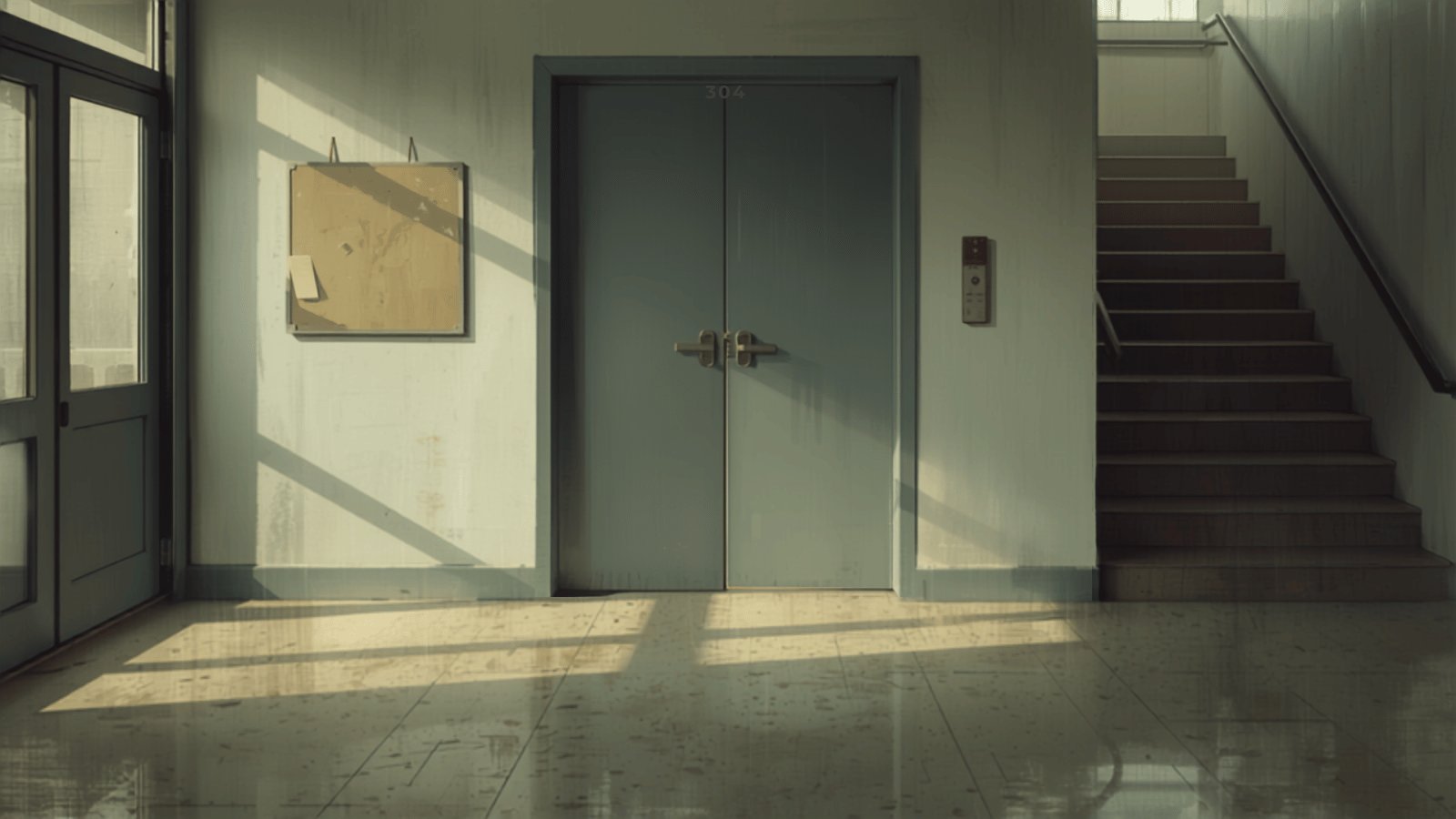
On the second Tuesday of October, Priya came home from a twelve-hour shift to find a piece of cardboard taped to the lift doors. On it, in tired handwriting, were three words: OUT OF ORDER.
She stood in front of the sign for a long moment, the way people do when they are too exhausted to accept new information. Then she picked up her bag and climbed nine floors to bed. One hundred and seventy-six steps. She counted them, that first morning, because counting was easier than thinking.
Wren Court was owned by a company called Halloway & Vine, whose office was in another city and whose telephone number led mostly to a recorded voice. The voice thanked callers for their patience in a tone that suggested it had never needed patience for anything. When Priya finally reached a human being, the receptionist was pleasant and vague in equal measure. She said that the engineer had already been contacted, that the fault was being investigated, and that the lift would be repaired within ten working days. Priya wrote the promise on the back of an envelope, added the date, and pinned it to the neglected noticeboard where everyone could see it.
Two days later, an official letter appeared beside her envelope. We apologise for any inconvenience caused, it said. The situation is being monitored. Your patience is appreciated. Priya read it twice and noticed something curious: the letter did not contain a single “we will”. Everything was being done, apparently, but no one in particular was doing it. The sentences had been written so that they contained no people at all.
Ten working days passed. The lift stayed dead behind its cardboard sign. Then a second letter was pinned up, shorter than the first. The fault, it explained, was more serious than had first been thought. Parts had to be ordered from abroad. A further update would be provided in due course. There was no date on this letter, which everyone understood was the whole point of it.
In the entrance hall that evening, for the first time in Priya’s memory, the tenants of Wren Court actually talked to one another. A young mother from the sixth floor described carrying her baby, her pram and her shopping upstairs in three separate journeys. The students on the eighth had begun doing their shopping in small, frequent trips, because a rucksack was the only bag worth carrying up so far. Dele announced, with a teenager’s honesty, that the stairs were fine for him but that his grandmother would never have managed them. People nodded, complained, shrugged, and went their separate ways. Complaining together, Priya thought, was not the same as acting together. But it was, perhaps, how acting together begins.
3 · Eight flights
For Priya, the stairs were a punishment. There is a particular mathematics to a night shift: twelve hours on your feet, three hundred small decisions, one long bus ride home — and then, now, one hundred and seventy-six steps between her and sleep. She learned to climb slowly, pausing at the fifth floor like a swimmer turning at the end of a pool. Some mornings, on the final flight, she felt her legs vote against her.
But for Mr Okafor, the stairs were not a punishment. They were a wall. Seven floors might as well have been a mountain range. In the first week he attempted the journey down, resting on each landing, and reached the fifth floor before his knees refused absolutely to continue. A stranger found him sitting in the stairwell, apologising to nobody, and helped him back up to his flat. After that, he stopped trying. The corner shop, the newspaper, the small coffee, the engine of his day — all of it now belonged to a world seven floors below him, as distant as another country.
The building responded the way decent people respond: quietly and without a plan. Dele carried Mr Okafor’s shopping up twice a week, taking the stairs two at a time and pretending it was training. Mrs Anand cooked extra on Sundays and sent portions upstairs. Priya collected his newspaper every morning after her shift and, instead of the corner shop, drank the coffee with him at his kitchen table, surrounded by forty years of railway photographs — bridges, signal boxes, and one enormous black-and-white locomotive that he spoke about the way other men speak about old friends.
She watched, week by week, as the shape went out of his days. He was washed, dressed and courteous, always. But he had stopped shaving every morning, because, as he put it, “the audience has been cancelled”. He asked her twice what day it was. He laughed at his own jokes a half-second late, like a radio losing its signal.
“I am grateful, you understand,” he told her one morning, turning his coffee cup in slow circles. “To you, to the boy, to Mrs Anand. Everything is brought to me. I want for nothing.” He looked out of the window, seven floors down, at the courtyard he had not stood in for a month. “But I do not want to be delivered to, Priya. I want to press a button and go down, like everybody else. It is not the coffee I miss. It is the going.”
That was the morning Priya understood something clearly. Kindness was holding Wren Court together — a rota of shopping bags and Sunday portions and borrowed newspapers — but kindness could not repair a motor. If the tenants waited politely for Halloway & Vine to act, they would be waiting until spring. The building did not need more patience. It needed pressure.
4 · The petition
Priya wrote the petition at five o’clock in the morning, at the end of a night shift, on a ward computer during her break. It was short and it was cold, in the way that angry documents are best kept cold. The lift at Wren Court had now been out of order for five weeks, it said. Elderly and disabled tenants were effectively trapped in their homes. Rent was being paid in full for a building that was not being maintained in full. The undersigned tenants required a firm date for the repair, in writing, within seven days.
On Saturday, she and Dele knocked on every door in the building. It took the whole weekend, and it turned out to be something neither of them expected: a guided tour of their own home. The serious man on the second floor, who worked from home and had barely noticed the crisis, read the petition twice and signed it with a fountain pen, then offered them coffee and apologised for two years of not saying hello. The young mother on the sixth signed while rocking the pram with her foot. One of the students on the eighth read the text aloud to his flatmate in a dramatic voice, and then both of them signed it and stuck a note on their door that said ASK US ABOUT THE STAIRS.
A few people refused, politely. One man said that signing things only caused trouble. An elderly woman on the fourth floor said the landlord had never listened before and would not listen now, but she wished them luck through a half-open door, which Priya chose to count as encouragement.
By Sunday evening they had forty-seven signatures from fifty-four flats. Several tenants had added comments in the margin. My mother cannot visit me any more, one said. I am asthmatic. Nine floors, said another. Mr Okafor signed last, slowly and beautifully, like a man signing a treaty.
The petition was posted to Halloway & Vine by recorded delivery, with a copy sent by email. Ten days later — three days past Priya’s deadline — a reply arrived. It was a masterpiece of its kind. If the necessary parts became available, the works would be scheduled at the earliest opportunity. A survey of the equipment had been arranged. The company took the wellbeing of its tenants extremely seriously. One tenant had asked, in the covering letter, about compensation for the weeks without a working lift; that question was not answered at all, as though it had been asked in a language the company did not speak.
Mrs Anand read the reply on the noticeboard and delivered her verdict to the entrance hall in general. “They are waiting for us to get tired,” she said. “Companies like this have only one strategy. They are patient the way a wall is patient.”
It was Dele who found the next move. He mentioned, one evening in the courtyard, that his geography teacher had told the class about private renting — and that if a landlord failed to keep a building safe, the council had legal powers to force a repair. “She said they can send an inspector,” he reported, spinning the basketball on one finger. “And if the landlord ignores the inspector, it gets expensive. Like, seriously expensive.”
Priya rang the council the next morning before she went to bed.
5 · The inspection
The housing officer arrived on a wet Thursday. Her name was Ms Whitfield; she was small and brisk, and she carried a grey folder the way a soldier carries a shield. She asked short questions and wrote long notes. She photographed the cardboard sign, which by now had curled at the corners and on which somebody — Dele denied everything — had drawn a small sad face.
She interviewed tenants for two hours. She climbed the stairwell all the way to the ninth floor, timing herself, and stood on the seventh-floor landing for a long moment outside Mr Okafor’s door, saying nothing, writing. Then she requested the maintenance records for the lift, which the landlord was legally required to keep, and went away with her folder.
What the inspection uncovered surprised even Priya. The lift at Wren Court had not been properly serviced for almost three years. The maintenance sheets in the little glass case had been signed, but the visits they recorded were brief and cosmetic — a tightened bolt here, an oiled hinge there. The last full service had been carried out thirty-four months earlier. The machine had not broken suddenly at all. It had been failing, slowly and publicly, in front of a signature that said everything was fine.
“If the lift had been serviced properly,” Ms Whitfield told Priya on the phone, in the flat voice of someone controlling a strong opinion, “it would almost certainly never have failed. You may quote me.”
The council acted quickly after that. An improvement notice was issued to Halloway & Vine — a legal document with a deadline in it, which is the only kind of document such companies truly understand. The lift was to be restored to safe working order within twenty-eight days. If the deadline was missed, the work would be carried out by the council itself, and the full bill would be sent to the landlord, together with an administration charge described by Ms Whitfield as “motivational”.
“In my experience,” she added, “landlords discover a sense of urgency at exactly this point in the process.”
She was right. Within a week, a van appeared in the courtyard with an engineering company’s name on the side. Then a second van. Men in orange jackets carried pieces of machinery in through the entrance hall, whistling, and the sound of serious work — drilling, hammering, the language of repair — echoed up the stairwell for the first time in nine weeks. Dele gave the engineers a round of applause on their first morning, which they accepted with a bow.
6 · Going down
The work took two weeks. The old motor was removed and replaced; new doors were fitted; the button panel, with its worn numbers polished away by forty years of thumbs, was exchanged for a bright new one that lit up. On a Thursday morning the lift passed its final safety inspection, and a printed certificate was placed in the glass case where the false signatures used to live.
Nobody organised what happened next; it organised itself. It was agreed, without any vote being taken, that the first ride belonged to Mr Okafor. He appeared on the seventh-floor landing in his good coat, leaning on his stick, freshly shaved, and found an audience waiting for him. Priya was there, still in her uniform after a night shift. Dele was there with his basketball under one arm. Mrs Anand had come up two floors specially.
The new doors opened without a shudder. Mr Okafor stepped in, studied the bright panel for a moment, and pressed the button for the ground floor with great ceremony, as if launching a ship.
“Going down,” he announced.
Six of them rode down together while others ran down the stairwell to meet the lift at the bottom, cheering it past every floor. When the doors opened on the ground floor, the entrance hall was full of tenants, and Mr Okafor stepped out into a building that was applauding him — or the lift, or itself; nobody was sure, and it did not matter. He walked out of the front door, across the courtyard, and into the corner shop, where he bought a newspaper and drank one small coffee at the counter, exactly as he had done a thousand mornings before, while half of Wren Court pretended not to watch him through the window.
That evening there was a party in the courtyard, of the improvised kind that is better than the planned kind. Mrs Anand’s cooking appeared on a folding table. The serious man from the second floor brought chairs and turned out to be extremely funny. Dele provided music. The students from the eighth floor taught everyone a card game. People who had nodded at each other for years finally exchanged names, and were embarrassed at how easy it was.
There was one more letter from Halloway & Vine, some weeks later. Following the council’s involvement, the tenants were informed that, by way of compensation, the rent for the nine weeks would be reduced, and the difference was quietly returned the following month. The letter contained no apology. “The apology is in the mathematics,” said Mr Okafor, folding it away.
On the ward that night, in the quiet hour before dawn, Priya found herself turning the whole story over. If the lift had been maintained properly, it would never have broken down, and every tenant of Wren Court would have been spared nine hard weeks. And yet, if it had never broken down, the building would still be a tower of strangers — no rota, no petition, no party in the courtyard, no card game, no names. She could not decide whether the lift had been the worst thing to happen to Wren Court that year, or secretly the best. Perhaps, she thought, a machine had failed and a building had been repaired, and those were simply two different events.
The next Saturday morning, Mr Okafor was waiting for her by the noticeboard, wearing his good coat and an expression she had not seen before — somewhere between shy and determined.
“Priya,” he said. “Are you free today? There is a place I go every year in November. This year, for obvious reasons, I could not get there — and it has been sitting in my mind for nine weeks like a stone in a shoe. Now I can go anywhere I like.” He tapped the new lift button with his stick, almost affectionately. “I would like you to come with me. Because you, of all people, will understand what it is.”
Priya looked at him — the good coat, the careful shave, the determined eyes — and realised she had absolutely no idea where he wanted to take her.
Check your understanding
Read each question. Think about your answer. Then click “Show answer” to check.
Words to remember
Here are the ten key words again, in new sentences. Try covering the sentence and making your own before you read each one.
- tenant — The tenants on the top floor have complained about the noise from the roof.
- landlord — Our landlord raised the rent but still hasn’t repaired the heating.
- maintenance — Regular maintenance is cheaper than an emergency repair — ask any engineer.
- out of order — The ticket machine was out of order, so we had to queue at the counter.
- stairwell — Their voices echoed up the stairwell all the way to the top floor.
- petition — Over two hundred residents signed a petition against closing the library.
- council — The council has promised to fix the streetlights before winter.
- inspection — The restaurant failed its hygiene inspection and closed for a week.
- deadline — We missed the deadline, so our application wasn’t considered.
- compensation — The airline offered passengers compensation for the twelve-hour delay.
Grammar in this story: the passive voice
This story is full of the passive voice — and that is not an accident. We use the passive when the action matters more than the person doing it, or when nobody wants to say who is responsible. Look at how the landlord’s letters use it:
The situation is being monitored. Parts had to be ordered from abroad. A further update would be provided in due course.
Priya notices that these sentences contain “no people at all” — the passive lets the company promise action without naming anyone who will act. But the passive is also used honestly, when the doer is obvious or unimportant: An improvement notice was issued. The old motor was removed and replaced. A printed certificate was placed in the glass case.
Form: be (in the right tense) + past participle. As you re-read the story, try to find five more passive sentences and ask each time: who is being hidden here — and why?
👉 Learn the full rule here: Active vs Passive Voice Explained.
Talk about it · Write about it
Talk about it: Mr Okafor says, “I do not want to be delivered to. I want to press a button and go down, like everybody else.” What is the difference between helping someone and giving them back their independence? Have you ever experienced a problem in your building or street that brought neighbours together?
Write about it: Write a formal letter of complaint (120–180 words) from the tenants of Wren Court to Halloway & Vine, written in week four of the breakdown. Use at least three passive sentences (for example: the lift has not been repaired, no date has been given, rent is being paid in full) and finish with a clear deadline.
🎉 Excellent work — you have just read a complete 3,200-word story in English. At B2 level, that is no small thing. And notice what you did along the way: you followed a nine-week plot, read between the lines of two very slippery company letters, and met ten useful words in action.
But one question is still hanging in the air. Where does Mr Okafor go every year in November — and why will Priya, “of all people”, understand what it is? Write your own ending, using details from the story to explain your choice.
More reading: Read another B2 story →
About this story: This is an original B2 graded reader (~3,200 words). The vocabulary is controlled for upper-intermediate learners, and the grammar uses the full B2 range — passives, conditionals, reported speech and relative clauses — so you should understand about 98% of the words. Any harder word is explained before the story and reused inside it.

I’m Khamis Maiouf. I’m studying Health and Social Care and have completed Functional Skills Level 2 in English and Level 3 Hairdressing. I have taught ESOL in my community and helped students with GCSE English. I run English Teacher Site to help people learn and practise English.