
Aid vs Aide: Understanding the Correct Usage

Quick Answer
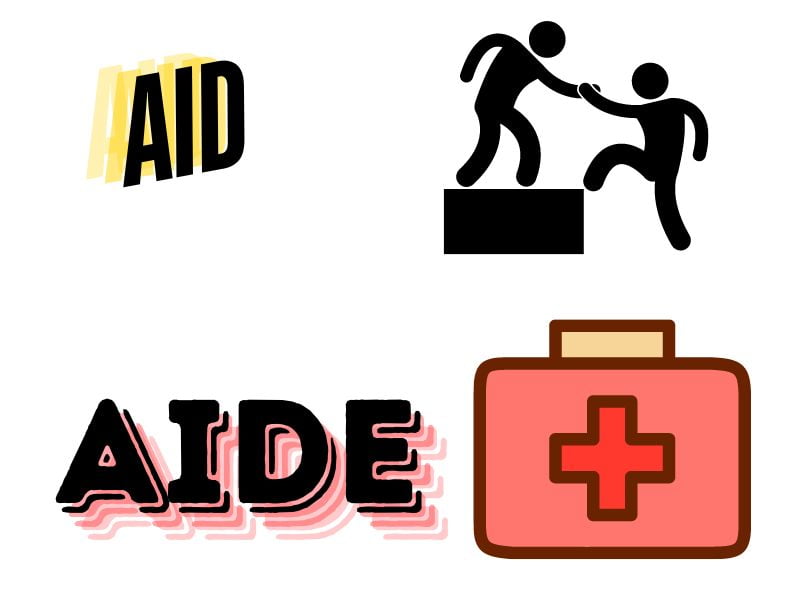
Aid means help — the thing you give or the act of helping. Aide is a person whose job is to help someone important.
“The country sent aid after the flood.” “The president’s aide answered the phone.”
Aid and Aide — See the Difference
These two words sound exactly the same when you say them, but they are not the same thing. Look at these sentences:
- The charity gave aid to families after the storm. (Help — food, money, or blankets.)
- Her aide booked all her meetings. (A person who helps her at work.)
- Nurses aid patients every day. (They help — used as a verb.)
- The senator’s aide wrote the speech. (A person who works for the senator.)
Did you see the pattern? One word is about help itself — the action or the thing given. The other is about a person who helps.
| Word | What It Means | Example |
|---|---|---|
| Aid | Help (a noun) or to help (a verb) | “They sent aid to the village.” |
| Aide | A person whose job is to help someone | “The general’s aide gave the message.” |
When to Use Aid and When to Use Aide
Use aid when you mean help — either the help itself, or the act of helping. It works as a noun and a verb:
- As a noun — “The Red Cross brings aid to war zones.” (Aid = the help itself.)
- As a verb — “Volunteers aid the doctors at the clinic.” (Aid = to help someone.)
- In a set phrase — “first aid kit”, “financial aid“, “hearing aid“. (Aid = a thing that helps.)
Use aide when you mean a person. An aide has a job title — they work for someone else and support them every day:
- “The teacher’s aide helps the young students.” → A person who helps the teacher in class.
- “A nurse’s aide takes the patient’s food.” → A person who helps the nurse.
Easy way to remember: Aide ends with an “e” — think of “e” for employee. An aide is a person who is employed to help. Aid has no “e” — it is not a person, just help.
The Rule in One Line: Aid = help. Aide = a person who helps.
Real-Life Examples With Aid and Aide
- My grandfather wears a hearing aid in his left ear. (A small device that helps him hear.)
- The prime minister’s aide gave a short statement. (A person who works closely with the prime minister.)
- I applied for financial aid to pay for university. (Money to help students.)
- A teaching aide helps the class read every morning. (A person who supports the teacher.)
- Please pass me the first aid kit — he cut his finger. (A box with plasters and medicine.)
You are doing great. Now let’s look at the mistakes many learners make.
The Most Common Mistake With Aid and Aide
Even native speakers mix these two up in writing — because the words sound the same, the fingers just type whichever version comes first. If you have done this, you are in very good company.
✗ The senator’s aid answered the door.
✓ The senator’s aide answered the door.
✗ She needs a hearing aide.
✓ She needs a hearing aid.
How to remember: If you can put “the” and a job in front of the word — the teacher’s ___, the general’s ___ — you need aide, because it’s a person. If it’s a thing you give, receive, or use, you need aid.
Other confusing word pairs like this: principle/principal, complement/compliment, cite/site/sight.
Test Yourself: Aid or Aide?
Choose an answer to see your feedback immediately. Your first answer counts towards your score.
1. The country sent food and medicine as _______ after the earthquake.
2. The mayor’s _______ answered every question at the meeting.
3. My grandmother uses a hearing _______ every day.
4. A nurse’s _______ carried the tray into the room.
5. Volunteers _______ the doctors during the emergency.
Keep Going — You Are Building Something
You just learned the difference between aid and aide. That is another homophone pair you will never mix up again.
But here is another set that trips up almost every learner. Do you know the difference between principle and principal? One is a rule you live by. The other is the head of a school — or something very important. Can you guess which is which?
Next lesson: Principle and Principal — What Is the Difference?
Source
- Definition of aid, Oxford Learner’s Dictionaries.
- Definition of aide, Oxford Learner’s Dictionaries.

I’m Khamis Maiouf. I’m studying Health and Social Care and have completed Functional Skills Level 2 in English and Level 3 Hairdressing. I have taught ESOL in my community and helped students with GCSE English. I run English Teacher Site to help people learn and practise English.