
The Paper Boat Race (A2 Reading Story)

A2 · ELEMENTARY Reading practice · ~1,800 words · 10-min read
This is a short story for elementary learners. It uses the past simple tense and everyday words. First, read the ten key words in the green box. Then read the story. At the end, there is a small quiz so you can check what you understand.
Before you read — 10 key words
- festival — a special day when many people meet to celebrate something together.
- celebrate — to have a happy time for a special day or a good thing.
- wish — a strong hope for something good to happen.
- fold — to bend paper (or cloth) into a new shape.
- lantern — a small light in a case, often hung outside on a tree or a wall.
- bakery — a small shop that sells fresh bread and cakes.
- bridge — a road or a path built over a river or a road.
- crowd — a large group of people together in one place.
- stuck — not able to move.
- winner — the person (or the thing) that comes first in a race or a game.
The story
1 · The little town by the river
Maya moved to a small town called Little Rill in the spring. The town had one bakery, one school, and one small river that ran through the middle of it. She did not know anyone in Little Rill. Her new job was at the town’s small library. Her flat was above a shoe shop on Green Lane. Every morning, she opened her window and looked out at the quiet street, and she felt lonely inside.
One Saturday, Maya went for a walk. The streets were busier than normal. Small children ran past her, laughing. Old women carried baskets of coloured paper. On every door, there was a small blue flag. She stopped a young girl.
“Excuse me,” Maya said. “What is happening today?”
The girl smiled a big smile. “It’s the festival!” she said. “The Paper Boat Race. Everybody in the town joins in. It is tonight!” Then she ran off to her friends.
A festival is a special day when many people meet to celebrate something. To celebrate means to have a happy time for a special day. Maya had never heard of a Paper Boat Race before.
She walked to the little bridge over the river. A bridge is a road or a path built over water. From the bridge, she could see people already hanging lanterns from the trees on both sides of the river. A lantern is a small light in a case. In the evening, the lanterns would shine like little stars over the water.
An old woman was tying a red lantern to a tree. Maya stopped and watched her for a minute.
“How does the race work?” Maya asked, after a while.
“Ah, it is very simple,” the woman said. “You take a small piece of paper. You write a wish on it. A wish is a strong hope for something good. Then you fold the paper into a small boat. To fold means to bend paper into a new shape. Tonight, when the bell rings, we all put our boats in the river together. The boat that goes the farthest is the winner. And people in this town say the winner’s wish comes true.”
The woman smiled kindly at her. “Are you going to enter?”
Maya looked down at her feet. “I don’t have any paper,” she said. But really, she was thinking something different. She was thinking: I don’t have any friends here. I don’t want to stand alone in a big crowd of people I do not know.
2 · The old man in the bakery
That afternoon, Maya went to the bakery to buy some bread. A bakery is a small shop that sells fresh bread and cakes. The bakery in Little Rill was warm, and it smelled of fresh bread and lemon. Behind the counter stood an old man with white hair and a soft, tired smile.
“Good afternoon,” he said. “You are new here. I do not know your face.”
“Yes,” Maya said. “My name is Maya. I moved here last month.”
“I am Rafiq,” he said. “But everybody calls me Baba Rafiq. What bread would you like today?”
While he put a loaf of bread into a paper bag, Maya looked around. On the wall behind him, there was a small photograph. In the photograph, a woman was standing by the river, and she was holding a paper boat. Her eyes were full of laughter.
“Who is that?” Maya asked.
Baba Rafiq turned and looked at the photo. For a moment, his eyes were sad. Then he smiled again.
“That is my wife, Layla,” he said. “She loved the Paper Boat Race more than anyone in this town. She won the race three times. Three times! Nobody else has ever done that.”
“Where is she now?” Maya asked, and then she wished she had not.
“She died four years ago,” Baba Rafiq said quietly. “I have not made a boat since then. Every year, on the night of the festival, I stay here in the bakery. I listen to the sound of the crowd by the river. But I do not go down there. It is too hard.”
A crowd is a large group of people together in one place.
Maya felt very sorry. She wanted to say something kind, but she did not know what. She just gave him a small, quiet smile.
Baba Rafiq looked at her carefully. “You are going to the race tonight, yes?”
“I don’t know,” Maya said. “I don’t have any paper. And I don’t really know anyone here.”
The old man walked slowly to a small cupboard behind the counter. He opened it and took out a piece of thin blue paper. It was old, but it was clean and beautiful.
“This was Layla’s favourite paper,” he said. “She always used the blue kind. Take it. Make a boat tonight. Write a good wish on it.”
He put the paper gently into Maya’s hand.
“But — this is Layla’s,” Maya said. “I can’t take it.”
“Please,” Baba Rafiq said. “It will make me happy. And Layla too, I think.”
3 · A wish on blue paper
Back in her small flat, Maya sat by the window. The blue paper was on the table in front of her. The sun was going down, and the sky was pink over the roofs.
She thought about her wish for a long time.
She thought about her family, who lived far away in another city. She thought about her old friends, who sent her funny messages but were not really here with her. She thought about the quiet street outside her window every morning, and about the empty chair at her small kitchen table.
Slowly, she picked up her pen. She wrote just one line on the blue paper:
I hope to make one real friend in this town.
Then, very carefully, she began to fold the paper. Fold one corner. Fold the other corner. Turn it. Fold it again. Her mother had taught her how to make paper boats when she was a little girl, so her hands still remembered the shape. Soon, a small blue boat sat in the middle of the table.
Maya looked at it. It was not perfect, but it was hers.
She looked at the clock. It was almost time to go. She put on her coat and she held the little blue boat gently in both hands, like a small bird.
“All right,” she said out loud, to nobody. “Let’s go.”
4 · The night of the race
When Maya reached the river, she could not believe her eyes.
The whole town was there. Hundreds of lanterns hung from the trees, and their soft yellow light fell on the dark water. Children ran between the legs of the adults. Somebody was playing slow, warm music on a guitar. Old people sat on chairs by the river bank, smiling. The big crowd talked and laughed together, like one warm family.
Maya held her boat tight and walked to the bridge. This was the place where everybody put their boats in the water.
The bridge was full of people. Maya found a small empty spot near the middle. Next to her stood a young man in a green jacket. He looked at his boat, and then at the river, and then at his boat again. He looked very nervous.
“Are you all right?” Maya asked.
He turned. “Sorry?”
“You look worried,” Maya said, with a small smile.
He laughed. “I am worried! I made a very bad boat this year. Look — one side is bent. I think it is going to sink very fast.”
Maya looked at his boat. It was big and green, but yes — one side was bent. She laughed too.
“I am Maya,” she said. “I moved here last month. This is my first race.”
“I’m Sami,” he said. “I have lived here all my life, and I still cannot make a good boat. What was your wish?”
“That is a secret,” Maya said.
“That is fair,” Sami said. “Mine too.”
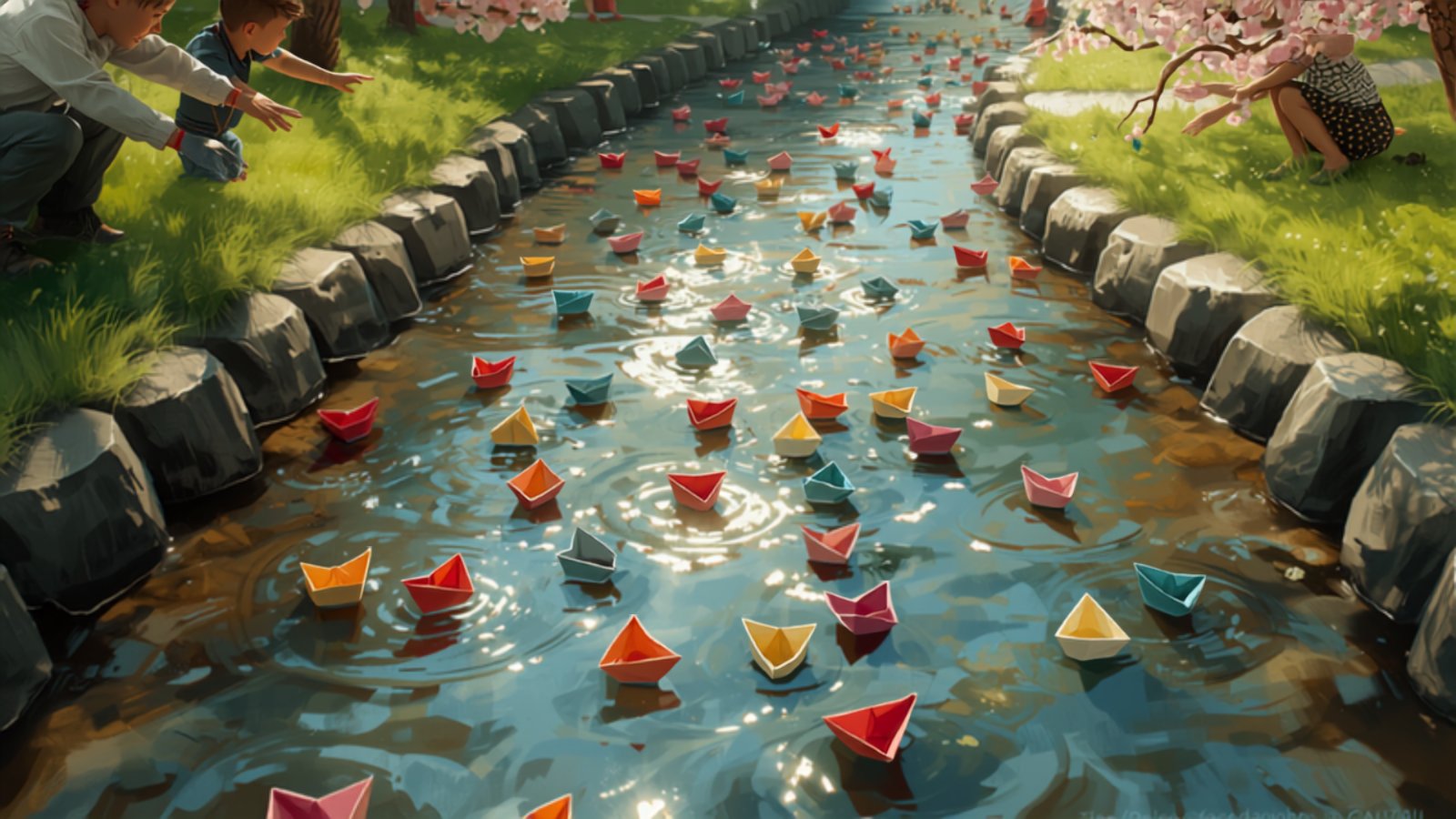
Just then, the big town bell rang. The crowd went quiet. Then, all together, hundreds of hands went over the side of the bridge. Hundreds of tiny paper boats fell softly onto the dark water. Each boat had a small candle inside it. Suddenly, the river was a long road of light.
Maya let her blue boat go. It sat on the water for one second. Then, slowly, it began to move.
“Look!” Sami said. “Yours is going well!”
The two of them watched their boats float down the river together. Sami’s green boat did not sink after all. Maya’s blue one moved faster. It passed the first tree. It passed the second tree. Then, suddenly, it stopped.
It was stuck. Stuck means not able to move. Her little blue boat had caught on a small rock in the middle of the water. The candle was still burning, but the boat was not going anywhere.
“Oh no,” Maya said.
Sami looked at her. He looked at the river. Then, without a word, he sat down on the river bank and took off his shoes.
“Sami!” Maya said. “The water is cold!”
“It is not too deep,” he said. “I will be quick.”
He stepped into the river. The water only came up to his knees. He walked slowly to the rock. Very carefully, he touched Maya’s boat with one finger and gave it a soft push. The boat came free. It began to move again, down the river, with all the other little lights.
By the time Sami came back to the bank, his feet were red and wet, but he was smiling. Maya was laughing.
“You didn’t have to do that!” she said.
“It was fun,” Sami said. “And now your wish has a chance.”
Later, an old woman with a long list read out the name of the winner. It was not Maya. It was not Sami. It was a nine-year-old boy from the school, and his boat had gone the farthest of all. Everybody clapped for him. He turned very red.
Maya did not mind at all. She was still standing by the river with Sami, drinking hot tea from a paper cup.
Then a soft voice said, “Maya?”
She turned. It was Baba Rafiq. He was in his old brown coat, and he had walked all the way from the bakery to see the end of the race.
“You came!” Maya said.
“Yes,” he said quietly. “Tonight, I decided something. Next year, I am going to make a boat again. Two boats — one for Layla, and one for me. It is time.”
He looked at Sami. He looked at Maya. He smiled a small, warm smile.
“I see your wish is coming true already,” he said.
Maya did not say anything. She just held her warm cup of tea and watched the last little lights float slowly down the river, into the soft dark night.
Check your understanding
Read each question. Think about your answer. Then click “Show answer” to check.
Words to remember
Here are the ten key words again, in new sentences. Read each one out loud.
- festival — Every summer, our village has a music festival in the park.
- celebrate — We celebrated my sister’s birthday with a big cake and ten friends.
- wish — Before she cut the cake, she closed her eyes and made a wish.
- fold — Please fold the letter carefully before you put it in the envelope.
- lantern — At night, small lanterns shine in the garden like yellow stars.
- bakery — I bought a warm loaf of bread from the little bakery on the corner.
- bridge — We walked over the old wooden bridge to the other side of the river.
- crowd — A big crowd stood outside the shop, waiting for the doors to open.
- stuck — My key was stuck in the door, and I could not open it.
- winner — The winner of the race got a small silver cup.
Grammar in this story: the past simple
This story uses the past simple tense. We use it for a finished action in the past — something that started and ended before now. Look at these sentences from the story:
Maya moved to a small town. She walked to the little bridge. Sami stepped into the river.
For most verbs (called regular verbs), we just add -ed: walk → walked, move → moved, laugh → laughed.
But some very common verbs are different (they are called irregular verbs): go → went, run → ran, take → took, have → had, see → saw, say → said.
👉 Learn the full rule and see the 4 main forms of the past tense here: The Past Tense: The 4 Main Forms.
Talk about it · Write about it
Talk about it: Is there a festival in your town or your country? What do people do? What do they eat? Do you like it, or not? Tell a partner about it in a few sentences.
Write about it: If you could send one paper boat down a river with a wish inside, what wish would you write? Write 5 sentences in the past simple about the last time you felt happy, and then finish with “So my wish is…”.
🎉 Well done — you finished a whole story in English! That is a big step at A2 level. And did you notice? You now know ten new words too, and you saw the past simple tense in real, natural sentences.
But one big question is still open: the nine-year-old boy won the race. So what wish did he write on his paper? And did his wish come true too? That is another story, for another night…
Maya works in her grandmother’s bakery. Read about the bread festival and practise words for food and traditions. Next story: The Bread Festival (A2 Reading Story)
About this story: This is an original A2 graded reader (~1,800 words). It uses the past simple tense and controlled elementary vocabulary (~700 headwords), so learners at A2 level can understand about 98% of the words. Any harder word is explained before the story and then used again inside it, so you learn it in a real context.

I’m Khamis Maiouf. I’m studying Health and Social Care and have completed Functional Skills Level 2 in English and Level 3 Hairdressing. I have taught ESOL in my community and helped students with GCSE English. I run English Teacher Site to help people learn and practise English.