
The Little Green Friend (A1 Reading Story)

A1 · BEGINNER Reading practice · ~1,300 words · 9-min read
This is a short, easy story for beginners. The sentences are simple. First, read the eight key words. Then read the story. At the end, there is a small quiz to check what you understand.
Before you read — 8 key words
- caterpillar — a small animal, like a worm, with many small legs.
- butterfly — a small pretty animal with big wings. It flies from flower to flower.
- leaf — the flat green part of a plant or a tree. (Two or more: leaves.)
- jar — a small glass pot with a lid. You can keep things inside it.
- grow — to get bigger, day by day.
- wing — the part of a bird or a butterfly it uses to fly.
- chrysalis — a small hard bed. A caterpillar sleeps in it, and then a butterfly comes out.
- surprise — something new that you do not know before. It makes you smile.
The story
1 · In the garden
Mia is seven years old. She lives with her mother and her grandma in a small house. Behind the house, there is a garden. It is not a big garden. But it has flowers, and it has one tree. Mia loves the garden.
Every day after school, Mia goes to the garden. She looks at the flowers. She smells them. She watches the small brown birds. Sometimes she talks to the tree.
Today is a warm day in May. The sun is high. Mia sits on the grass. She looks at a big green leaf. A leaf is the flat green part of a plant.
“Oh!” Mia says.
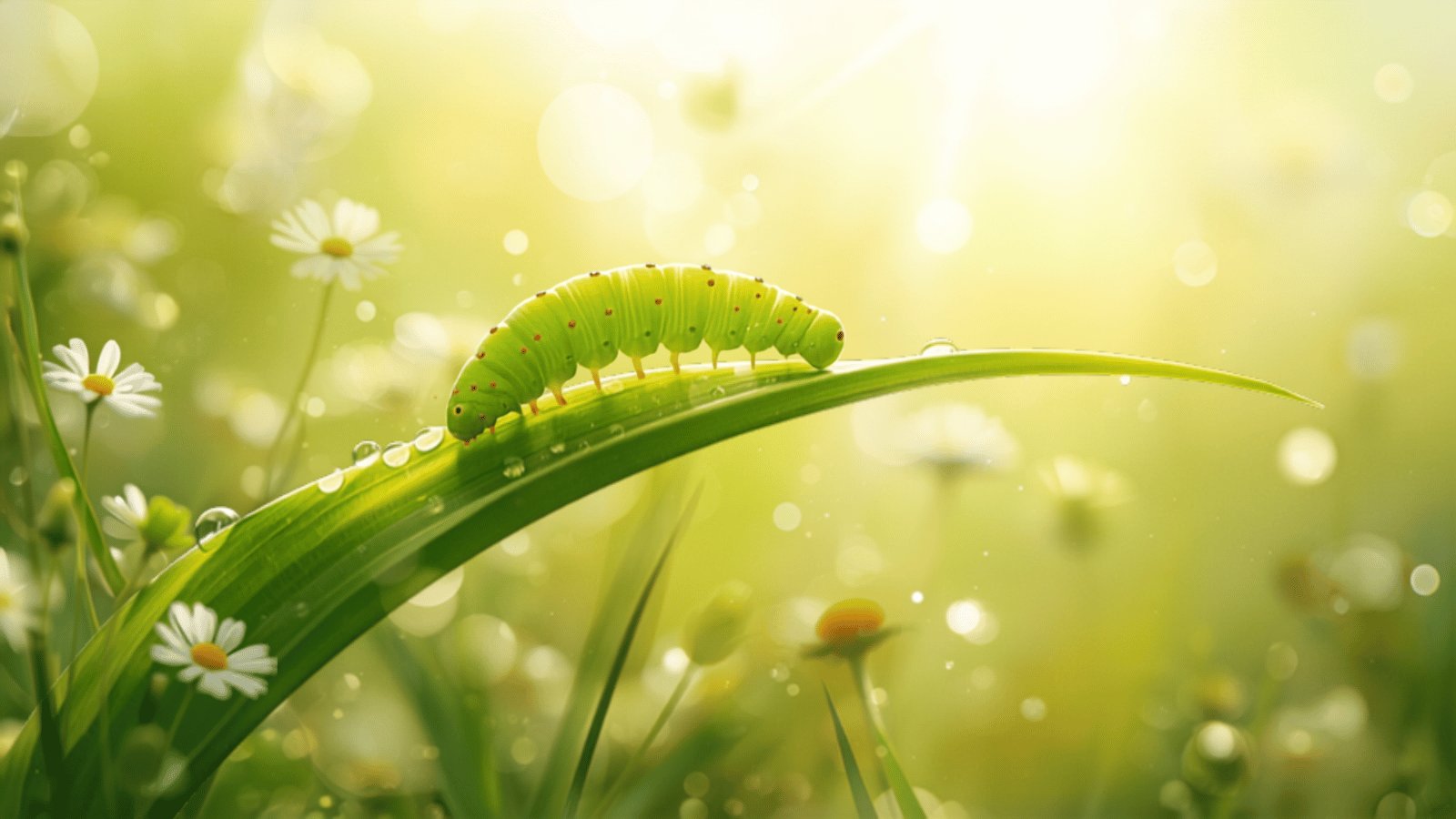
There is something on the leaf. Something small. Something green. She looks close. It is not a stone. It is not a flower. It moves! It moves very, very slowly.
“Grandma!” Mia calls. “Come and look!”
Grandma comes to the garden. She has grey hair and kind eyes. She sits down next to Mia.
“What is it, my dear?” Grandma asks.
Mia points to the leaf. “This little green thing. What is it?”
Grandma smiles. She looks at the leaf. “That is a caterpillar,” she says. “A caterpillar is a small animal, like a worm. Look — it has many small legs.”
Mia counts the legs. There are many. She cannot count them all.
“It is beautiful,” Mia says. “Is it a baby?”
“In a way, yes,” Grandma says. “It is a baby of something.”
“Of what?” Mia asks.
Grandma smiles again. “That is a surprise,” she says. “A surprise is something you do not know now, but you see it soon. Watch the little green thing every day. And you find the surprise for yourself.”
2 · The jar
“But grandma,” Mia says, “what if a bird comes? What if the wind takes it away?”
Grandma thinks. “Then we make a small home for it,” she says. “Come inside with me.”
They go into the kitchen. Grandma takes a jar from the cupboard. A jar is a small glass pot with a lid. It is clean and empty.
“We put small holes in the lid,” Grandma says. “The caterpillar needs air, like you and me.”
Mia’s mother helps. She makes small, small holes in the lid with a needle.
Then Mia and Grandma go back to the garden. Very, very carefully, Mia takes the leaf. The caterpillar sits on it. It does not run away. It is too slow for that.
Mia puts the leaf inside the jar. She puts two more leaves inside too — fresh green ones from the same plant.
“What does it eat?” Mia asks.
“Only the leaves of this plant,” Grandma says. “It is a fussy eater. Bring it a fresh leaf every day.”
Mia puts the jar on her window. Now she can see her little green friend from her bed. That night, she does not want to sleep. She wants to watch it and watch it.
3 · Day by day
The next morning, Mia jumps out of bed. She runs to the jar.
The caterpillar is on the leaf. It is eating! Mia sees small bites on the edge of the leaf. She smiles.
“Good morning, little friend,” she says.
Every day, Mia looks at the caterpillar. Every day, she brings a fresh leaf. Every day, the caterpillar eats and eats. It grows a little bigger.
To grow means to get bigger, day by day. Children grow. Flowers grow. And this little green friend grows too.
After one week, the caterpillar is not small any more. It is fat and long. It is a lovely green colour.
After two weeks, Mia sees something strange.
The caterpillar does not eat today. It sits on the top of the jar. It does not move.
“Grandma!” Mia says. “My friend is ill! It is not eating.”
Grandma comes and looks. “Watch,” she says quietly.
The caterpillar makes something. It makes a hard shell around its body. The shell is brown and green. It is like a very small, hard bed.
“That is a chrysalis,” Grandma says. “A chrysalis is a small hard bed. The caterpillar sleeps in it. Now we wait.”
“How long?” Mia asks.
“Maybe two weeks,” Grandma says. “Sometimes more. Sometimes less.”
To wait is hard for a small child. Mia looks at the jar every day. But nothing happens. The little chrysalis just sits there. It does not move. It does not eat.
After one week, Mia is worried. “Grandma, is my friend dead?”
“No, my dear,” Grandma says. “Something is happening inside the chrysalis. Something big. But you cannot see it now.”
Mia looks at the jar again. It is quiet. But maybe — maybe Grandma is right.
4 · The morning
Ten days go by. Then twelve. Then thirteen.
On the fourteenth morning, Mia opens her eyes. She looks at the jar.
“OH!” she says.
The chrysalis is open. It is empty now. And on the top of the jar, there is something new.
Something with wings.
A wing is the part of a bird or a butterfly it uses to fly. Mia knows this word from her books. But she never sees wings so close, and so beautiful.
The wings are orange and black. They are a little wet. They open very slowly, and then they close. Open. Close. Open. Close.
“Grandma!” Mia calls. “Come now! Come now!”
Grandma and Mia’s mother run into the room. They stand near the jar. Nobody says a word.
The butterfly is small. Its wings are still a little wet, but they get stronger and stronger.
“It is a butterfly,” Grandma says softly. “This is the surprise. Your little green friend is a butterfly now.”
Mia looks at Grandma. Her eyes are big. “But… how, Grandma? How?”
Grandma smiles. “Inside the chrysalis, the caterpillar changes. It is a very slow, very special change. Now it can fly. Now it can drink sweet things from the flowers. It is not a caterpillar any more.”
Mia looks at the butterfly for a long time.
“It is a real surprise,” she says.
Grandma laughs. “The best surprise in nature,” she says.
They wait for a few minutes. The wings get bigger and stronger. The butterfly moves them faster. Open, close. Open, close.
“Now?” Mia asks.
“Now,” Grandma says. “It is ready. Take it to the garden.”
Mia takes the jar in her hands. Very slowly, she walks to the garden. She sits on the grass, in the same place where she finds the caterpillar many days before.
She opens the lid of the jar.
For one long moment, the butterfly stays. Then it opens its wings — big and orange and black. It flies up. It flies over the flowers. It sits for a second on a red flower.
Then it flies over the garden wall, and it is gone.
Mia does not cry. She smiles.
“Bye bye, little friend,” she says.
Grandma sits next to her. “You do a good thing, Mia. You take care of it, and now it is free.”
Mia looks at the empty jar. Then she looks at the sky.
“Grandma,” she says slowly, “look at the tree. Look at the big leaves.”
Grandma looks. And she smiles a very big smile.
Check your understanding
Read each question. Think about your answer. Then click “Show answer” to check.
Words to remember
Here are the key words again, in new sentences. Say each one out loud.
- caterpillar — I see a small green caterpillar on a leaf. It has many small legs.
- butterfly — A butterfly is very pretty. It has orange and black wings.
- leaf — The big tree in my garden has many green leaves in the summer.
- jar — I put some flowers in a small jar of water on the table.
- grow — My little sister grows so fast! She is bigger every week.
- wing — The bird opens its wings and flies up into the sky.
- chrysalis — The caterpillar sleeps in a chrysalis for about two weeks.
- surprise — On my birthday, my mother gives me a surprise. I am so happy!
Grammar in this story: the present simple
This story uses the present simple tense. We use it for things that are true every day, or that happen again and again. Look:
Mia lives with her mother and grandma. She goes to the garden every day. The caterpillar eats the leaves and grows a little bigger.
See how the verb adds -s for he, she, and it: live → lives, go → goes, eat → eats, grow → grows.
👉 Learn the full rule here: Present Simple for Beginners.
Talk about it · Write about it
Talk about it: Do you have a garden or a park near your home? What small animals or insects do you see there? What do they do?
Write about it: Write 5 simple sentences about one small animal you like (a bird, a cat, a fish, an insect). Where does it live? What does it eat? Why do you like it? Use the present simple.
🎉 Well done — you read a whole story in English! That is a big step. And now you know eight new words about nature too.
But wait — why does Grandma smile at the tree at the end? What does she see on the big leaves? What happens next? Write your own ending in five short sentences.
Choose Your Next Story
This is the last story in the gardens and animals group. Choose another A1 story from the reading collection when you are ready.
Other Story in This Group: The Old Man and the Little Bird (A1 Reading Story)
About this story: This is an original A1 graded reader (~1,300 words). It uses simple, controlled vocabulary and the present simple tense, so beginners can understand about 98% of the words. Any harder word is explained before the story and used again inside it.

I’m Khamis Maiouf. I’m studying Health and Social Care and have completed Functional Skills Level 2 in English and Level 3 Hairdressing. I have taught ESOL in my community and helped students with GCSE English. I run English Teacher Site to help people learn and practise English.