
The Wireless in the Back Room (C1 Reading Story)

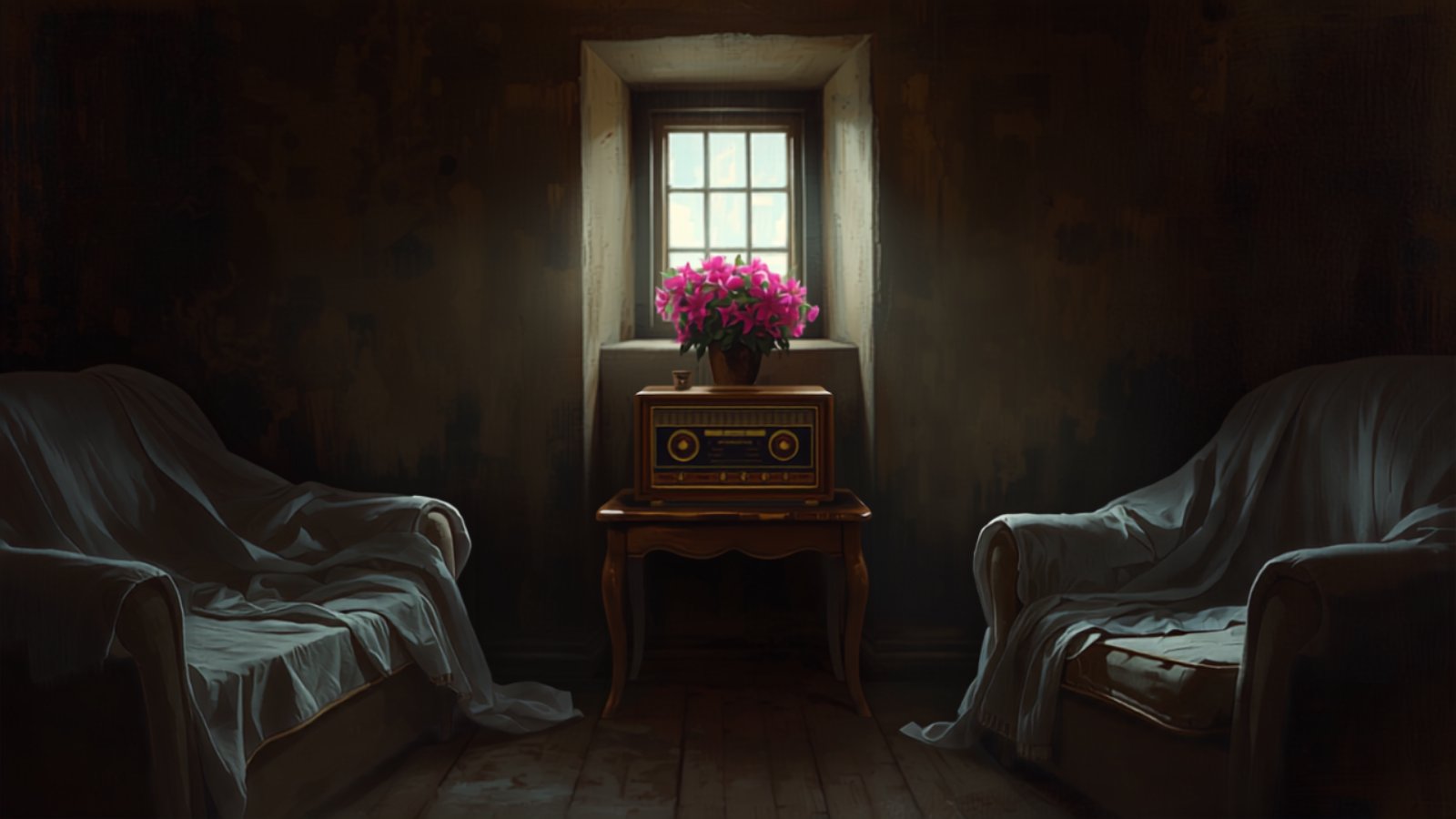
C1 · ADVANCED Reading practice · ~3,200 words · 16-min read
This is a quiet, character-driven story at C1 level — advanced enough to stretch you, but written so that the trickier words are all glossed before you start. The setting is a small Welsh coastal town; the theme is grief, inheritance, and the slow re-entry into ordinary life. Read the nine key words first, then let yourself sink into the story. A short comprehension check waits at the end.
Before you read — 9 key words
- valve — a glass tube inside older electronics that once did the job a modern chip now does. A “valve radio” is any radio built before roughly 1970.
- Bakelite — one of the first hard plastics, popular from the 1920s to the 1960s. Warm brown or coloured, with a distinctive smooth-but-slightly-rough feel.
- soldering iron — a hand tool that heats up and melts a soft metal (solder) to join two wires together.
- capacitor — a small component inside electronics that stores and releases a tiny amount of electricity. It “dries out” and stops working after decades.
- static — the hissing, crackling background noise you hear when a radio is not perfectly tuned.
- shipping forecast — a famously calm British radio broadcast, four times a day, warning boats at sea about the weather. Many British people find its rhythm oddly soothing.
- archive — a large, organised collection of recordings, documents or old photographs, kept for reference.
- reticent — quiet by nature; not saying more than is needed. A reticent person is not shy — they simply do not fill silences.
- melancholy — a soft, thoughtful kind of sadness. Not sharp pain — more like a low, steady note that runs underneath everything else.
The story
1 · A stranger at the door
The stone cottage stood at the top end of Bay Road, half-hidden by a hedge of fuchsia that had never quite learnt to behave itself. Owen Aldridge stopped at the gate and checked the number on his phone for the third time. Number seventeen. He had come all the way from Bristol by two trains and a bus for this — a woman he had never met, a name pencilled in soft lead on the inside of his grandfather’s bedside drawer. N. Pritchard. Radios. Aberdyfi.
He shifted the parcel under his arm. It was heavier than it looked. Wrapped in a tea towel, it was, and then in a plastic bag, and then in the canvas satchel he had used at school. A Bush TR82, valve model, 1954. His grandfather had listened to it every evening for as long as Owen could remember, and often long after everyone else in the house had gone to bed.
Six months on from the funeral, and Owen still hadn’t quite worked out where to put anything.
He pushed the gate open and walked up the short path. The door was painted a chapel green, faded almost to grey by decades of salt wind. He knocked twice — softly, then a little less softly, in case she was hard of hearing.
A voice called from inside. “It’s open. Come through.”
Owen stepped in and closed the door behind him. The hall smelled of tea, warm dust, and something faintly metallic — solder, perhaps, and the ghost of a soldering iron left too long on its rest. From the back of the cottage came the tinny sound of a Radio 3 broadcast, badly tuned. He followed the sound.
The room he came into wasn’t so much a workshop as a room that had given up pretending to be anything else. Two long benches ran under the windows. On them sat radios — dozens of them — in every stage of undress. Some had their wooden cases off. Some had their metal chassis exposed like the ribs of small animals. A tall, thin woman in a green cardigan was bent over one of them, a soldering iron held steady in her hand, its tip glowing a dull orange.
“You’ll be young Aldridge,” she said, without looking up. “Sit. I’ll be with you in a minute.”
Owen sat on the only chair not covered in components. He put the parcel on his knees and tried not to stare.
She was older than he had expected — mid-seventies, perhaps — but there was nothing frail about her. Her hair was cropped short and grey, and her hands moved with the sort of quiet certainty that made you trust her before she had said a word. On the bench in front of her, a small bright bead of solder cooled slowly to silver.
“Right,” she said finally, laying the iron down on a small ceramic stand. “Nerys Pritchard. And you must be Owen. Your email said you’d inherited a wireless from your grandfather.”
“Yes.”
“May I see?”
He handed her the parcel. She took it in both hands and set it, very carefully, on the empty bit of bench beside her. Then she peeled away the layers as if she were unwrapping a sleeping child.
The Bush TR82 emerged pale blue in the afternoon light, its curved Bakelite casing scuffed at the corners but otherwise intact. Nerys let out a long, slow breath.
“Well,” she said. “Hello, old friend.”
“You know this one?”
“Everybody in this business knows this one. It’s the model that started portable listening in this country. Most were black; the blue was rarer.” She turned it gently between her palms. “There’s a chip on the case here, and the handle needs restitching, but she’s had a good life.”
“Can you fix her?”
Nerys straightened up. She looked at Owen properly for the first time — a long, unhurried look. He was suddenly aware that his eyes were red, that he had not slept much on the train, and that he was gripping the strap of his empty satchel a little too tightly.
“I don’t know yet,” she said. “I can promise to try. That, arguably, is as far as any of us can go with an inheritance.”
Owen nodded. He didn’t quite trust himself to speak.
2 · What the machine remembered
Nerys worked in silence for the first fifteen minutes, and Owen was grateful for it. She unscrewed the back of the radio with a small brass screwdriver, one screw at a time, laying them in a neat row on a piece of white cloth. When the back came off, she held it up to the window as if she were examining an x-ray.
“Have you had a look inside before?”
“No. Nan told me not to open it. She said Granddad would come back from the grave.”
Nerys smiled — the first proper smile since he had arrived. “Sensible woman, your gran. Modern electronics are a doddle to poke about in. A valve radio, on the other hand, can hold a charge in its capacitors for days after the plug’s been pulled. You could have given yourself a nasty jolt.”
She turned the chassis so he could see. Four glass valves stood up in a row, their bases dark with old dust. Behind them sat a forest of copper wires and small paper-brown cylinders.
“These,” she said, tapping one of the cylinders with the tip of the screwdriver, “are the capacitors. Half of them will have dried out by now. The valves themselves — those glass tubes at the front — those are usually fine; the Second World War taught us how to make valves that lasted. What kills a radio of this age is nearly always the capacitors and the volume potentiometer. Dull things. Unglamorous. But without them, no sound.”
“And the crackling?”
“That’s static, for the most part. Some of it comes from outside — atmospheric — and some from inside, the components themselves getting old. We can quieten it. We can’t kill it altogether, and to be honest, I wouldn’t want to. That soft crackle is half the character.”
Having laid out the tools she would need in a straight line beside the chassis, she set to work. Owen watched. There was something almost soothing about it — the small tap of the screwdriver, the gentle wisp of smoke when solder met copper, the way she talked to the radio under her breath as she worked. He hadn’t realised he’d been holding his shoulders around his ears until they began, slowly, to come down.
“You’ve been quiet,” she said, without turning. “That’s fine. Most people who bring me a radio talk too much, if anything. They want to explain the person it belonged to. They imagine, I think, that if they explain enough, I’ll fix it better.” She paused. “It doesn’t work like that. But if you want to talk, you can. I’m not asking.”
Owen looked at his hands. He turned them over and looked at them again.
“He used to sit in his chair every night with a cup of tea,” he said eventually. “This on the sideboard. Not too loud — Nan didn’t like it loud. And then at half past midnight he’d turn the dial to Long Wave, and we’d hear the shipping forecast. Even when I was a small boy staying over on holidays. Half past midnight, without fail. Sailing by Sailing By first, then that voice reading through the sea areas.”
“Merchant Navy?”
Owen looked up sharply. “How on earth did you know?”
“Nobody else listens to the shipping forecast every night unless they used to be out there. Or unless they loved somebody who was.” She tightened a screw. “I recorded oral histories for the BBC for the best part of thirty years — mostly with old seamen, up and down the west coast. I’ve heard the phrase ‘half past midnight’ more times than I can count.”
“Oh.”
“What was he — Deck? Engine? Radio?”
“Radio,” Owen said quietly. “For thirty-two years. He said the wireless was the only thing that ever made him homesick in a good way.”
Nerys was still for a moment. Then she went back to her work, and Owen was grateful, again, for her silence. He had discovered, in the six months since the funeral, that most people wanted to fill his silences for him. Nerys, evidently, did not.
Later she made tea, in mugs that didn’t match, and they sat with the radio between them like a small blue pet.
“There’s another thing,” she said. “It’s not really a fix, and I don’t want to promise it, in case I can’t manage it in time. But I think you might want it. Come back in a week. I’ll need at least that long for the capacitors — I’ll have to order what I can from a chap in Cardiff who still stocks the old paper ones.”
“A week’s fine. I can come Saturday.”
“Saturday, then.” She handed him back the empty tea towel, folded now into a neat square. “Ten o’clock. And Owen —”
“Yes?”
“Try to eat something before you get on that train back.”
3 · The half past midnight tape
He didn’t eat much on the way home, of course, but Nerys’s tea had steadied something in him that hadn’t been steady in a while. He rang his mother from Shrewsbury station. He hadn’t rung her in eleven days.
The week passed slowly. He went to two lectures out of six. He rewrote the same paragraph of his dissertation seven times without ever quite moving it forward. He walked along the harbour at night in Bristol and watched the ships that weren’t going anywhere in particular. More than once, he caught himself listening for the shipping forecast at half past midnight, and remembering, with a small dip in the chest, that he had left the radio in Wales.
Saturday came grey and blustery. He got the same train, the same bus. When he pushed the gate open at Number Seventeen, the fuchsia hedge was heavy with rain, and Nerys was already at the door, drying her hands on a cloth.
“Come in, come in. Kettle’s on.”
The workshop looked different — tidier, somehow — and there in the middle of the bench sat the TR82. Reassembled. Blue Bakelite polished to a soft shine. A new leather handle stitched onto the top.
“You did it,” Owen said, and his voice came out smaller than he’d meant.
“I did some of it. She did the rest. She wanted to work.” Nerys wiped her hands again on the same cloth. “Sit. Before you switch her on, I want to say two things.”
He sat.
“One: she’ll sound a bit thin at first. Warm her up ten minutes each time before you judge her. Two —” she hesitated, “— I took a small liberty. If you don’t like it, I can undo it in five minutes. I’ve had a rummage in the archive.”
“The archive?”
“Thirty years of tapes I recorded for the BBC — sitting in a wall of shoeboxes in the spare room upstairs. Also a few things I recorded off-air, at home, just for myself. That sort of thing.” She pointed to a small cassette player wired to the back of the radio with a length of red flex. “I’ve routed a cassette in through the aux input. So when you press this button here — this one, marked with the small piece of green tape — the radio plays what’s on the cassette, sounding, as far as I could manage it, like it did on Long Wave in 1978. Static and all.”
“What’s on the cassette?”
“Have a listen. Then you can tell me what to do with it.”
She pressed the button and stepped back.
The radio hummed, warmed, coughed once. Then the static crackled and, out of it, a man’s voice arrived — calm and steady and very English.
“…And now the shipping forecast, issued by the Met Office on behalf of the Maritime and Coastguard Agency at zero-double-oh-thirty on Saturday the fourteenth of October. There are warnings of gales in Viking, North Utsire, South Utsire, Forties, Cromarty, Forth…”
Owen sat very still. The voice went on, running through the sea areas the way his grandfather used to whisper them under his breath — Rockall, Malin, Hebrides, Bailey — as if they were the names of old friends turning up in the doorway one after another. It was not the same broadcast his grandfather had listened to. But it was, in every way that mattered, the same sound.
The forecast finished. The static held for a moment, then faded. Nerys reached over and switched the radio off.
Owen didn’t say anything for a good while. When he did, his voice was steadier than he’d expected.
“You didn’t have to do that.”
“No,” she said. “I didn’t.”
“How did you know?”
“I didn’t know. Not for certain. I guessed. Had you told me he was Deck, I might have put on the shanty tapes from the Isle of Man collection instead. Had you told me he was Engine, I’d have found something with the right sort of hum in the background. But you said Radio. And you said half past midnight. I thought, well, at worst he’ll ask me to take it off.” She sat down opposite him, hands folded on the bench. “It’s a small thing, Owen. Twelve minutes on a cassette. You can wipe it, or record something else over it. It’s your machine.”
“I don’t want it wiped.”
“Good.”
4 · The offer
The kettle whistled from the kitchen and Nerys got up. Owen sat with his hands flat on the top of the radio, feeling the warmth of the Bakelite where the valves had heated it from the inside. He had never, until that moment, quite understood why his grandfather had liked to sit with one hand on the case at the end of an evening. Now he did.
Nerys came back with a fresh pot of tea and a plate of digestive biscuits. It was, Owen decided, one of the least melancholy afternoons he had spent in six months. Melancholy — the word came into his head in his grandfather’s voice. Granddad had liked long, quiet words for feelings. Not sad. Melancholy. Not angry. Aggrieved.
They talked about the town for a while, in the round-about way of two people finding out whether they liked each other’s company. About the university, and about why Owen had chosen it (he wasn’t entirely sure). About the fuchsia hedge outside, which had been planted, Nerys said, in the year she was born. She had lived in the cottage all her life. Her husband had died fourteen years earlier. The workshop had originally been his — televisions, mostly, until televisions stopped being repairable — and after he’d gone, she had gutted it and turned it into what it was now. “Not so much a business,” she said, “as somewhere to keep my hands busy.”
“How much do I owe you?” Owen asked eventually.
“For the radio? Forty pounds for the parts and the cassette work. That’s it.”
“That can’t be right.”
“It is right. I’m not a garage. I don’t count the hours.” She sipped her tea. “Besides — I enjoyed her.”
Owen took out his wallet and put two twenty-pound notes on the corner of the bench. He didn’t want to insult her by pressing more on her than she’d asked for. His eyes wandered to the row of unfinished radios on the far bench — the ribcages of small animals, still open, still waiting.
“Can I ask you something,” he said, “that isn’t about mine?”
“Go on.”
“How did you learn to do this? Really learn it, I mean. Not the theory. The hands.”
Nerys considered him for a long moment. She had a way of looking at people, Owen was beginning to notice, that felt like being weighed. Not judged — weighed. Reticent people, his grandfather used to say, were the only ones worth listening to, because when they finally spoke, the words had been sitting in there for a reason. Nerys, on the evidence of a single Saturday, was very reticent indeed.
“An apprenticeship,” she said. “Two years, with an old boy in Machynlleth who cursed a great deal and taught me almost nothing except by making me watch. And then thirty years of my own mistakes.”
“Do you take anyone on now?”
“No.”
“Oh.”
“I stopped a few years back. There isn’t the demand, and — I say this without meaning any offence — most people your age want to fix things with a phone app, not a soldering iron. Nothing wrong with that. It just isn’t the sort of teaching I’m any good at.” She paused. “Why?”
Owen looked at the radio. He didn’t quite know how to explain it — that having sat here for two Saturdays now, in his own head, he had already begun to want to know how the thing worked, not out of vague curiosity but out of something closer to hunger. That grief, he was starting to understand, wasn’t a thing you talked your way through so much as a thing you had to put your hands to. Not knowing how to say any of that out loud, he simply nodded at the row of ribcages on the far bench.
“I’d like to learn,” he said. “Not for money. I could come up on weekends. Do the boring bits. Watch, mostly, if that’s what you want.”
Nerys didn’t answer at once. She got up, walked to the far bench, and picked up one of the unfinished sets — a small Roberts from, Owen guessed, the mid-sixties. She turned it in her hands. Then she put it down again, precisely where she had picked it up.
“There would be rules,” she said.
“Yes.”
“You’d come every fortnight, not every week. I need my own Saturdays. You’d bring your own screwdriver by the third visit. You’d read what I gave you between visits. And if you dropped out after two months, you wouldn’t simply stop replying to messages — you’d tell me straight. That, more than anything.”
“All right.”
“And you’d bring the wireless up now and again. She’ll want checking on.”
“I can do that.”
She held out her hand. “Fortnightly, then. Starting the Saturday after next. Ten o’clock. Don’t be late.”
He shook her hand. Her grip was warmer, and stronger, than he’d expected.
At the door, with the TR82 back in its layers of tea towel and canvas, he paused.
“Nerys — the cassette. Can I ask what else you have in that archive? Not to use. Just to know.”
She smiled that small smile again.
“Oh, all sorts. Come back on the second Saturday. I’ll have a shelf of things ready.”
Owen walked down the path to the gate. He didn’t look at his phone. He didn’t check the bus times, though he knew he’d cut it fine. He just walked, holding the wireless carefully against his chest, and it occurred to him — for the first time in six months — that he was walking towards something, rather than away from it.
Behind him, on Bay Road, the fuchsia hedge shifted in the wind. What Nerys would have waiting on the shelf when he came back a fortnight later, he had no way of knowing.
But he would come back. And she would be waiting.
Check your understanding
Read each question and answer it in your head before clicking “Show answer”. Some answers ask you to think about the story, not just to find a line in it.
Words to remember
Here are the nine key words again, each in a fresh sentence. Read them aloud once — the sound is half the meaning.
- valve — Collectors still pay good money for a working set of vintage valves, particularly the wartime military grades.
- Bakelite — The old telephone in the hallway had a Bakelite handset that was heavier than any modern phone.
- soldering iron — He hadn’t touched a soldering iron since his GCSE electronics class, and yet the movement came back to him at once.
- capacitor — Nine times out of ten, when a valve radio has gone quiet, it’s the capacitors that need replacing, not the valves.
- static — The signal from the mountain lodge was buried in static, but you could just about make out the presenter’s voice.
- shipping forecast — Millions of Britons who have never set foot on a boat fall asleep to the shipping forecast every night.
- archive — The BBC has begun digitising its regional radio archive, so recordings that once sat in shoeboxes can now be streamed online.
- reticent — She was reticent in meetings — not shy, exactly, but unwilling to speak until she had something worth saying.
- melancholy — There is a soft, autumn melancholy about the harbour on Sunday evenings, once the day-trippers have gone.
Grammar in this story: participle clauses
Advanced writers often lean on participle clauses — short phrases beginning with an -ing or -ed form of a verb — to add information about a main sentence without starting a new one. They give writing a lighter, more elegant rhythm. Look at these three examples from the story:
👉 “Having laid out the tools she would need in a straight line beside the chassis, she set to work.”
The Having laid out… clause tells you what happened before she started work — no need for a separate sentence.
👉 “Not knowing how to say any of that out loud, he simply nodded…”
The Not knowing… clause explains why he nodded rather than spoke.
👉 “Wrapped in a tea towel, it was, and then in a plastic bag…”
Here the -ed participle acts as a passive clause, describing how the parcel had been packed.
The rule is subtle but important: the subject of the participle clause must be the same as the subject of the main clause. Get it wrong and you end up with a dangling participle — one of the classic advanced-English pitfalls.
👉 Learn the full rule (and how to avoid the dangling trap) here: Participle Clauses in English: Shorten Sentences Like a Native Writer.
Talk about it · Write about it
Talk about it: Is there an object in your family — a watch, a book, a piece of music, a recipe — that carries the memory of somebody you loved? What do you do with it? Do you use it, protect it, or ignore it? Try to explain why in three or four sentences, using at least two of the key words above.
Write about it: Write a 200-word diary entry in Owen’s voice, on the evening after his second Saturday visit. What did he see on Nerys’s shelf? What did he think on the train home? Aim to include at least two participle clauses (“Having arrived home…”, “Sitting on the last train…”) and at least one discourse marker (“On reflection,…”, “Admittedly,…”, “Having said that,…”).
Well done — you’ve read a full C1 short story, and if you noticed the participle clauses gliding by without stopping you, that is a real marker of advanced reading. Small victory. Take it.
But you’re left with a question, aren’t you? What is on Nerys’s shelf when Owen comes back a fortnight later? A tape of his grandfather’s own voice from an old oral-history interview she once recorded on the west coast? An empty shelf, to test him? Something quieter, and stranger, that neither of us can guess? Write your own ending, using details from the story to explain your choice.
A late message interrupts Iona’s familiar life. Follow the long way round and notice what she chooses to revisit. Next story: The Long Way Round (C1 Reading Story)
About this story: This is an original C1 graded reader (~3,200 words), written using the Oxford Bookworms method adapted for the web. Vocabulary is controlled to roughly a 2,500-headword ceiling; every harder word is glossed before you start and reused inside the text, so an advanced learner should recognise about 98% of the running words. Sentence rhythm mixes short declaratives with longer clauses, including participle clauses and inversion, so you get natural exposure to advanced structure without a lecture.

I’m Khamis Maiouf. I’m studying Health and Social Care and have completed Functional Skills Level 2 in English and Level 3 Hairdressing. I have taught ESOL in my community and helped students with GCSE English. I run English Teacher Site to help people learn and practise English.