
The Custodian of Small Lights (C1 Reading Story)

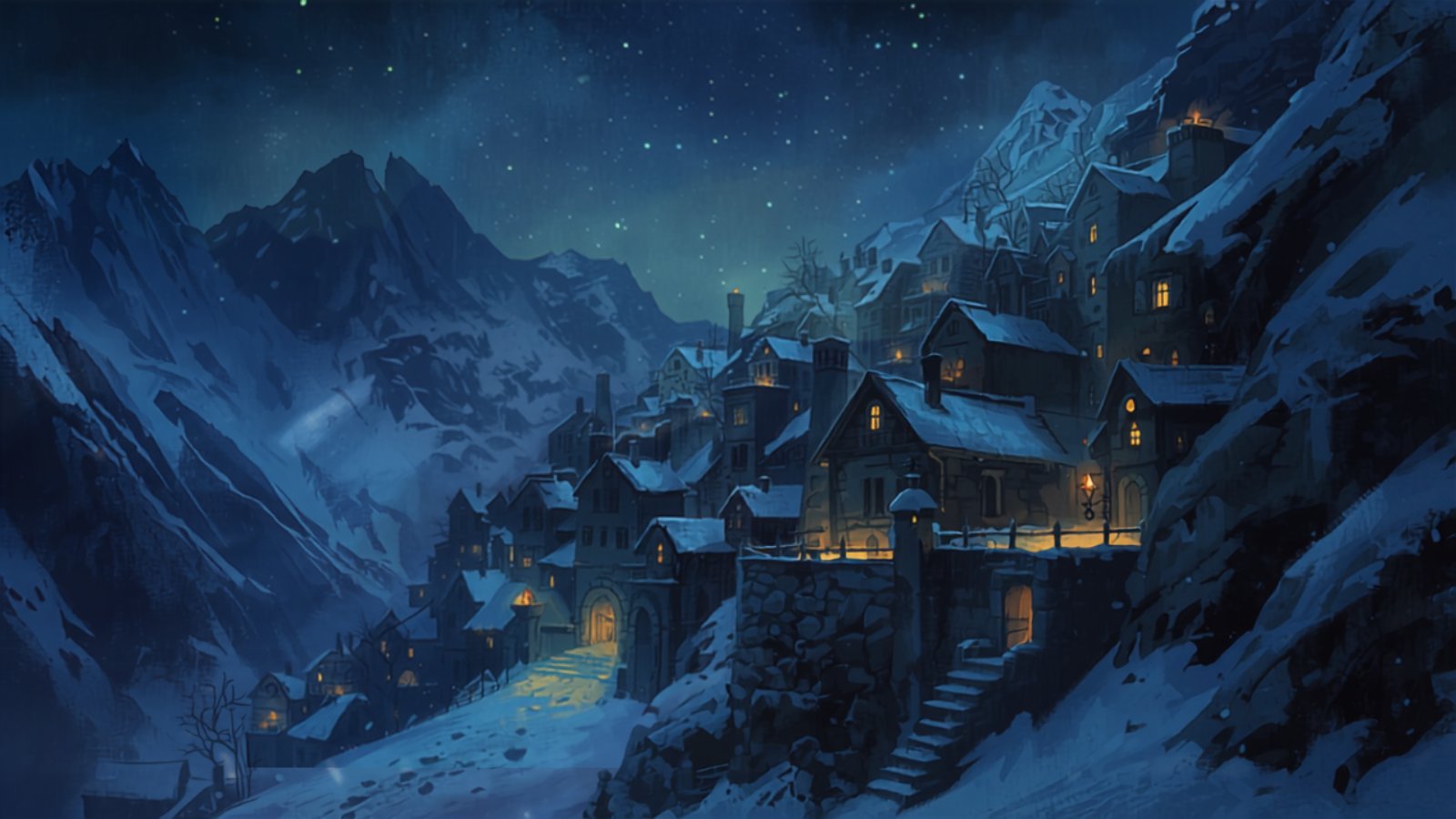
C1 · ADVANCED Reading practice · ~3,400 words · 14-min read
This is an original C1 graded reader — a quiet piece of fiction about a mountain village, a winter festival that no outsider has ever filmed, and the awkward question of what happens to a tradition when the world finally comes to look at it. Before you begin, glance through the ten glossed key words below; then read the story straight through. Comprehension questions, a grammar focus and a short writing prompt follow.
Before you read — 10 key words
- solstice — the day on which winter or summer officially turns; the shortest or longest day of the year.
- mestra — a Portuguese word for a female master craftsperson; in this story, the head of the village lantern-makers.
- reed — a tall, hollow grass that grows beside rivers; here, the raw material for weaving lantern frames.
- custodian — a person entrusted with the safekeeping of something valuable — a building, a collection, or a tradition.
- lineage — the line of ancestors, teachers or ideas passed down from one generation to the next.
- spectacle — a striking public display; often used disapprovingly of something that impresses the eye but changes nothing inside the viewer.
- summit — the highest point of a hill, mountain or ridge.
- threshold — the strip of wood or stone at a doorway; also, figuratively, the moment at which one condition changes into another.
- dispatch — (verb) to send off, often formally or ceremonially; (noun) an official message.
- austere — plain, unadorned, and without comfort or decoration; sometimes admired for exactly that reason.
The story
1 · The letter on the desk
The letter had been sitting on Elena’s desk for three days. She had read it four times, and each time she had put it face-down, as though the words on the page might rearrange themselves if she stopped watching them.
It came from the National Museum of Folk Traditions, and it was signed, unusually, by the director himself. The exhibition, he wrote, would open in the spring. It would be the most ambitious of its kind — a full year of research, film, sound recordings and living demonstrations from six regions of the country. He hoped that Elena, as one of their most promising young curators, would agree to lead the section on the mountain traditions of the north. In particular — and here the letter grew warmer, almost personal — he hoped that she would help them bring the Festival of Small Lights, held only in the village of Ferendal on the night of the winter solstice, to a national audience for the very first time.
Elena was twenty-nine. She had left Ferendal at eighteen, on a scholarship, and in eleven years she had returned only three times. Her mother rang every Sunday. Her grandmother, whom the village still called the mestra — the master lantern-weaver — had not once spoken to her on a telephone. Vera did not trust telephones. She did not, it seemed, trust the modern world at all.
By the fourth reading, Elena had to admit two things. The first was that the exhibition was a genuine honour: only twice in her career had she been asked to lead anything on this scale. The second was that if she said yes, she would need to persuade Vera to open the workshop to the museum’s cameras — and Vera would refuse.
She was still weighing all this when her mother called.
“Elena. Come home.”
She heard at once, in her mother’s voice, that something had shifted. “What is it?”
“The mestra is not well. She has said nothing to me, but I have eyes. She is thinner than she was in the summer. She sleeps in the afternoons, which she has never done. And she has stopped eating meat, which she has always loved. The solstice is next Sunday. Come home.”
Elena looked at the letter. Then she looked at the calendar. Then she picked up her phone and, before she could think better of it, booked a train.
2 · The village at dusk
She reached Ferendal on the Thursday, an hour before dusk. The valley narrowed as the train climbed, and the last stretch was so steep that the carriage tilted like a boat on a slow sea. When she stepped down onto the small stone platform, the cold air pressed itself against her face — a cold she had almost forgotten, precise and mineral, quite unlike the damp cold of the capital.
The road up from the station wound between low stone houses whose windows were already lit. On the walls above the doors, the villagers had begun to hang the season’s first lanterns: pale, egg-shaped, no bigger than a child’s head, made of oiled paper stretched over a light frame. The frame was woven from reed. Reed is a tall, hollow grass that grows along the river below the village, and for as long as anyone could remember, the lanterns of Ferendal had been made from reed and nothing else. Each lantern held a single small candle. Together, along the sloping road, they made a soft chain of light that seemed to guide her home.
Her mother met her at the door. They embraced without speaking. Inside, the kitchen smelled of woodsmoke and roasted chestnuts. And there, in the corner by the stove, seated on a low stool with her fingers busy in a small pile of reeds, was Vera.
She was smaller than Elena remembered. Her hair, once iron-grey, had turned entirely white. Her hands, however, were as they had always been: brown, spotted, patient, and absolutely certain of their work. She did not look up when Elena came in. She only murmured, without pausing, “You are late. The mountain is early this year.”
“I came as soon as I could,” Elena said.
“Everyone says that.” A small smile lifted one corner of the mestra’s mouth. “Sit. Warm yourself. Then you can help me count the reeds.”
That evening, Elena did not mention the exhibition, and Vera did not ask why she had suddenly come. They spoke instead about the weather, about the state of the river, about a neighbour’s dog that had recently learned to open the bakery door with its nose. They spoke, in short, about everything except what mattered — which is, of course, how one begins to speak about the things that matter most.
3 · The apprentice
The next morning, Elena walked with her grandmother to the workshop. It was in an old stone building at the edge of the village, its interior austere: nothing but a long wooden bench, a wall of tools, and two great baskets of drying reeds. Everything smelled faintly of river water and lamp oil.
At the bench, a young man was already at work. He looked up as they came in and got quickly to his feet.
“Elena, this is Rafael,” Vera said. “He is my apprentice, and, until further notice, he is the only person in this valley under fifty who can weave a lantern that will not fall to pieces before it reaches the summit.”
Rafael blushed. He was perhaps nineteen. His hands were red and cracked from the cold water in which the reeds had to be softened. Elena shook his hand.
“How long have you been with the mestra?”
“Since October. My uncle brought me down from Vale do Rio. He said if I did not learn something with my hands soon, I would go the same way as my brother.”
“He walked forty kilometres to knock on my door,” Vera said, without looking up. “In my experience, a boy who walks forty kilometres for something is a boy who will still be there in ten years. Whereas the boys who are driven up by their parents in a car, from an easier place — they leave by the following spring.” She held a curved reed up to the light, turned it, and set it aside. “Rafael will be all right. If, that is, I have long enough to finish teaching him.”
At this, Elena looked up sharply. Vera pretended not to notice.
Rafael, whose ears had turned pink, went back to his work. Elena watched him for a while. He was learning the base of a lantern — the small, tight spiral of reed on which everything else depended. Each turn had to hold exactly the same tension as the last, or the whole basket would twist as it dried. He was clearly not finding it easy.
“Is it always like this?” Elena asked her grandmother, quietly. “One apprentice at a time?”
“It has always been like this. My teacher had one apprentice, which was me. Her teacher had one apprentice, which was her. Lineage is a small word, Elena, but it moves through very narrow doors. If you try to make it wider than one hand at a time, you thin out what it carries. Do you understand?”
Elena, who had come home with an exhibition proposal in her pocket that was intended to do precisely the opposite, did not answer.
4 · What Elena remembered
That night, Elena could not sleep. The old house creaked with the wind. Downstairs, the stove was still warm, and she came down in her thick socks to sit beside it, wrapped in a blanket.
She had not been in this kitchen at night, alone, since she was eight years old.
At eight, she had asked her grandmother the same question that all the children of Ferendal eventually ask: how do you make a lantern? Vera had not laughed. Vera never laughed at a serious question. She had taken Elena down to the workshop the following morning — the same workshop, the same austere bench, the same tools on the wall — and had set a single reed in front of her.
“Before you make a lantern,” Vera had said, “you must know a reed.”
Elena had looked at the reed and had seen nothing at all. It was a length of dried grass. It had a bulge every so often, but so did everything else that grew.
“Count the segments,” Vera said.
Elena counted seventeen.
“Now count again. Slowly. And this time, put your finger on each one as you count.”
The second count was sixteen. Elena had blushed, embarrassed, and said sorry. Vera had looked at her steadily. “You are not sorry, Elena. You are only surprised. There is a difference. A person who is surprised may one day become a mestra. A person who is sorry will not.”
That, too, Elena had never forgotten.
Only now, sitting in the dark kitchen twenty-one years later, did she understand that Vera had been teaching her something even then. Not how to make a lantern. Something older, and harder, and closer to the bone. She had been teaching her how to look at a thing that seemed familiar until it stopped being familiar — until it revealed, instead, its actual and particular shape.
The clock struck two. Somewhere above her, she heard her grandmother cough — a small, dry cough she had not heard before, and did not like. Elena drew the blanket closer. She thought about the museum letter. She thought about Rafael’s cracked red fingers, and about the lineage that moved through such narrow doors. She thought about the reed on the bench, the one she had failed to count.
She had, she realised, been about to give her second wrong answer of her life. She was, for the second time, only surprised.
5 · The journalist
The journalist arrived on Saturday.
Nobody had told Vera that he was coming, which was, in retrospect, an error. He was a friendly man of about forty, with a small camera around his neck and a larger one in a case at his hip. A photographer walked beside him, silent. They had come, they said, on behalf of a well-known lifestyle magazine that had heard about “the last authentic winter festival in the region”, and they wondered whether the mestra might spare them half an hour.
“Absolutely not,” Vera said. She said this without any bitterness at all, which somehow made it more difficult to argue with. Then she went back into the workshop and closed the door.
Elena caught up with the journalist in the lane. She apologised. She said her grandmother was not well. She said perhaps another year, perhaps in the spring, perhaps by letter first. The journalist was courteous, but she could see him thinking: this old woman is not going to give me my article. He asked, therefore, whether Elena herself might speak on the record. She was, after all, a national curator. She had been born in this village. Surely, as a professional, she could see the value of bringing this beautiful tradition to a wider audience?
Elena said she would think about it. That was, at the time, honest.
That evening, over supper, her mother asked, casually, whether Elena had brought “that letter” with her. Elena’s fork stopped halfway to her mouth.
“How do you know about a letter?”
“You left your bag open on the kitchen table this morning. I was folding tablecloths. I saw the museum seal.”
Vera set down her spoon. “What letter?”
There was no way to avoid it now. Elena told her — carefully, choosing each word — about the exhibition, about the museum, about the honour, about the film crew, about the sound recordings and the reconstructed workshop that would stand in the national capital for six months, so that thousands of people who had never set foot in a mountain village could stand in front of a lantern and understand what it was.
Vera listened without interrupting, which was, if anything, more unnerving than any interruption would have been. When Elena had finished, there was a long silence. Then the mestra spoke.
“You know what a spectacle is, Elena. You use the word yourself. A spectacle is something people go to look at and then go home. A spectacle does not require them to be different afterwards. In fact, a spectacle works better if they are not. Now: if this festival becomes a spectacle, it will die. Not because of the cameras — cameras are only glass. It will die because the custodians will forget what they are the custodians of. The custodians are not the lanterns, Elena. The custodians are the small hands that make them, alone, in a cold room, in the winter, for no one to see.”
Elena said nothing. There was nothing, at that moment, that could usefully be said.
6 · The night of the small lights
Sunday came — the winter solstice, the shortest day of the year, when, according to the villagers, the sun stands still for a heartbeat before it turns back towards the spring.
All afternoon, families along the sloping road prepared their lanterns. Each household made its own, with reeds bought from the workshop and paper cut from a single long roll that Vera had blessed at dawn. Into each lantern, before it was closed, was placed a small folded piece of paper — a message. The message could be for anyone. For the dead. For those who lived far away. For a child not yet born. Nobody read anybody else’s message. That, more than anything, was the rule.
At dusk, the procession began. It moved slowly, because it moved at the speed of its oldest members, and the path up to the summit was narrow and steep. Elena walked beside her grandmother, holding her arm. Rafael walked behind them, carrying the mestra’s own lantern with both hands. There must have been sixty or seventy villagers in all, and perhaps a dozen visitors — no film crew, no journalist. The journalist, it turned out, had gone home.
Halfway up, Vera stopped. She had gone as pale as her hair. “I cannot walk any further,” she said, calmly, as if reporting on the weather. “I am sorry. Go on without me. Rafael can carry my lantern to the top.”
“No,” Elena said. “I will carry you.”
Vera laughed — a dry, surprised laugh. “You are a very small woman, Elena.”
“You are a very small mestra.”
Elena knelt, and her grandmother, after a long moment, allowed herself to be lifted. She weighed almost nothing. It was, Elena realised, like carrying a bundle of reeds.
The last hundred metres were the steepest, but Elena did not stop. Behind them, the other lanterns rose up the slope in a slow chain of light, so that when they finally reached the summit — the wind sharp, the valley dark below, the sky above them the deep blue that comes only in the minute before full night — it was as though a river of small stars had followed them up.
At the summit, each family stood on the ridge and dispatched their lantern into the valley wind. The lanterns lifted, wavered, and floated out over the dark, some faster, some slower, some rising, one or two falling — small and brief and unmistakably alive. Nobody spoke. That, too, was the rule.
When it came to Vera’s own lantern, she did not open it. She held it in her lap and, from beneath her shawl, drew out a second lantern that no one had seen before. This second one she placed into Elena’s hands.
“For you,” she said. “Not to send. To receive.”
Elena opened it, though she suspected she should not. Inside, on a single folded sheet of paper, was a pattern — a small, dense drawing in brown ink. She had seen the pattern before. It was the mestra’s mark, the sign that a lantern had been made by the master weaver’s own hand. Only one person in each generation carried it.
“I don’t understand,” Elena whispered.
“Yes, you do. You are the next mestra, Elena. If you want it.”
7 · The threshold
Elena took the early train the following morning. Vera did not come to the station. Vera never did. It was her mother who walked with her down to the platform, said goodbye without fuss, and, at the very last moment, pressed something into her hand — a small warm parcel of bread and cheese for the journey, and a note.
The note read, in her mother’s handwriting: Whatever you decide, decide it slowly. She has waited a long time.
The train pulled out. The valley narrowed and released her; the ridge, where the lanterns had been dispatched the night before, was behind her now, invisible in the mist. Elena sat with her forehead against the cold glass and thought.
She thought about the exhibition. She thought about the six regions and the sound recordings and the reconstructed workshop and the thousands of people. She thought, too, about spectacle — that hard, honest word her grandmother had used. She thought about how easy it would be to fold Ferendal into the national story, and how quietly, once folded, it might disappear. Had Vera said yes to the cameras years ago, the mestra’s mark might already have passed to no one at all.
And she thought about the second lantern.
She had it in her bag. She took it out now, carefully, and set it on the small folding table by the window. In the pale morning light it looked ordinary — a paper egg on a spiral of reed. Only the mark distinguished it, and even that only if you knew what to look for.
Somewhere between the tunnel and the next station, she took out the letter from the museum director and read it for the fifth time. Then she took out a fresh sheet of paper. She sat for a while with her pen resting on the page, and she did not, in the end, write a letter of refusal.
She did not, at that moment, write a letter of acceptance either.
She wrote instead the first line of something new — a proposal she had not been asked for, and would have to argue for from the beginning, and might well be told was impossible. It read: A tradition that is watched by strangers is not, on that account, more alive. It is only more visible. What if, instead of moving the workshop into the museum, the museum quietly moved a very small number of its visitors — one at a time — into the workshop?
She underlined the phrase one at a time, and paused.
She thought about the tight spiral at the base of a lantern, in which each turn had to hold exactly the same tension as the last. She thought about narrow doors. She thought about a walk of forty kilometres in the cold. And she thought, above all, about a very small mestra, weightless as a bundle of reeds, waiting on a mountain in the dark for a custodian to make up her mind.
Elena put down her pen. Outside the window, the last of the mist was lifting, and the country beyond was flat and bright. She was standing, she understood, on a threshold — the threshold Vera had spent her life quietly asking her to see. On one side of that threshold was a spectacle. On the other side was a lineage. Only one of them could be walked across at a time, and only in the shoes she was already wearing.
She was not quite ready to write the next line. But she knew, at least, that whatever it was, it would have to be worth the second lantern.
Check your understanding
Read each question. Think about your answer in a sentence or two. Then click “Show answer” to compare.
Words to remember
Here are the ten key words again, in new sentences. Say each one out loud, and try to make one further sentence of your own that fits your life.
- solstice — Many cultures mark the winter solstice with fire, food, or a moment of quiet reflection.
- mestra — In some crafts, the title of mestra is passed to only one person in each generation.
- reed — She soaked the reed in cold water for an hour before she began to weave.
- custodian — A good museum custodian understands that some objects should not be moved from where they live.
- lineage — The lineage of a teaching is often visible only in the small habits that survive it.
- spectacle — What began as a quiet local ceremony had, over the years, been turned into a spectacle for tourists.
- summit — By the time they reached the summit, the wind had dropped and the whole valley was silent.
- threshold — She paused on the threshold of the room, weighing whether to walk in or turn back.
- dispatch — The villagers dispatched their lanterns into the wind, one by one, without a word.
- austere — His flat was austere — one chair, one lamp, one book — and he preferred it that way.
Grammar in this story: the third conditional
The story turns, quietly, on unrealised alternatives — the paths not taken. That is the natural home of the third conditional, which we use to talk about hypothetical past situations and their imagined past results. The pattern is:
If + past perfect, would / might / could have + past participle.
Two examples drawn straight from the story:
• If Vera had said yes to the cameras years ago, the mestra’s mark would have passed to no one at all.
• If Elena had not come home that week, she would never have carried her grandmother to the summit.
Notice that in both cases we are looking back at a past that did not happen: Vera did not say yes; Elena did come home. The third conditional lets us weigh what those different pasts would have cost or given us — exactly the mental work Elena is doing on the train.
C1 upgrade: at your level, you should also recognise the more literary inverted form, which drops the “if” and moves “had” to the front. The story uses one: “Had Vera said yes to the cameras years ago, the mestra’s mark might already have passed to no one at all.” This is common in careful writing and in essays.
👉 Learn the full rule and get more practice here: The Third Conditional (with real-life examples).
Talk about it · Write about it
Talk about it: Vera argues that some traditions are damaged, not helped, by being watched. Think of one small custom or festival in your own culture. If it were suddenly filmed and broadcast to a million viewers, what would be gained? What might be quietly lost? Is there a middle path — the kind Elena is trying to sketch on the train?
Write about it: Write 200–300 words in the voice of either the journalist (explaining to his editor why he came home without the story he was sent to get) or Elena (finishing the proposal she began on the train). Use at least two third-conditional sentences and at least three of the key words from the list above.
You have just read a full C1 short story — around 3,400 words of controlled but unhurried English. Notice how much your ear can now hold: subordinate clauses, discourse markers (“in retrospect”, “in fact”, “on that account”), inverted conditionals, quiet irony. This is what upper-level reading feels like from the inside.
But Elena has only written the first line of her proposal. Will the museum director agree to a workshop no visitor can film? Will Vera live to see the first stranger walk through her narrow door? And when the next solstice comes, whose small hands will carry her lantern to the summit? Write your own ending, using details from the story to explain your choice.
Nora returns by ferry to Brennholm. Follow the winter festival and consider what it means to return to a place you have left. Next story: The Winter King's Fire (C1 Reading Story)
About this story: This is an original C1 graded reader (~3,400 words), written using the Oxford Bookworms method adapted for the web: a controlled headword ceiling of roughly 1,800–2,500 items, so an upper-intermediate reader can understand around 98% of the running words without a dictionary. Any word above that ceiling — mestra, reed, custodian, lineage, spectacle, threshold, austere, dispatch, solstice, summit — is glossed before the story begins and then reused inside it, so the meaning is reinforced by context as you read. The grammar is level-appropriate C1: full range of tenses, passives, reported speech, discourse markers, and both regular and inverted third conditionals. The plot is entirely original.

I’m Khamis Maiouf. I’m studying Health and Social Care and have completed Functional Skills Level 2 in English and Level 3 Hairdressing. I have taught ESOL in my community and helped students with GCSE English. I run English Teacher Site to help people learn and practise English.