
The Bread Festival (A2 Reading Story)

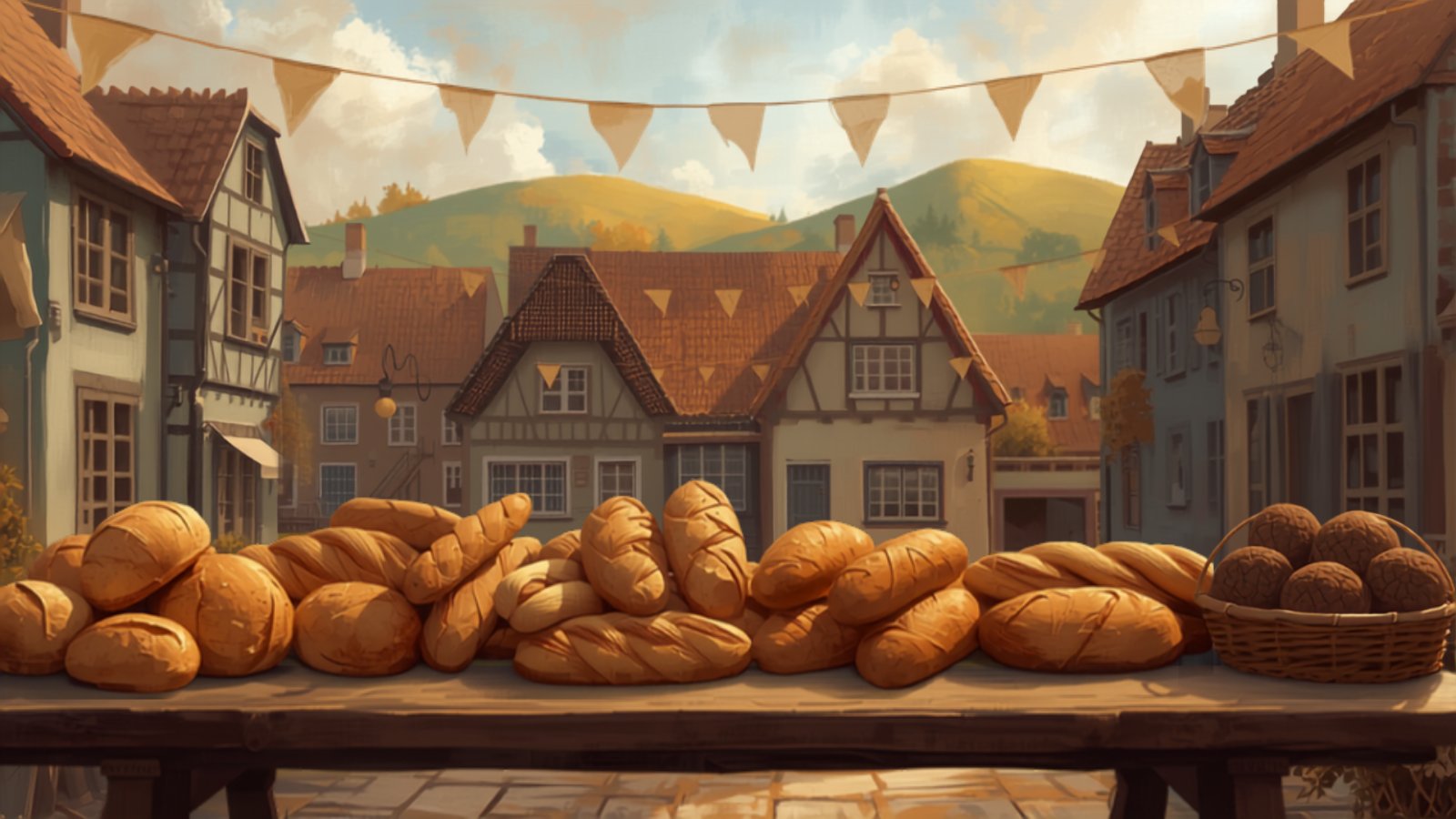
A2 · ELEMENTARY Reading practice · ~1,850 words · 12-min read
This is an original story for elementary learners. It uses the past simple tense and easy connectors like because, so, and when. First, read the ten key words. Then read the story. At the end, there is a small quiz to check what you understand.
Before you read — 10 key words
- festival — a special day when people in a town celebrate together with food, music, or games.
- baker — a person who makes bread and cakes as a job.
- recipe — the instructions that tell you how to cook or bake something.
- competition — an event where people try to win against each other.
- prize — the thing you win in a competition, for example a cup or money.
- judge — a person who decides who wins a competition.
- dough — the soft mix of flour and water before it becomes bread.
- oven — the hot metal box that bakes bread and cakes.
- tradition — something that people do in the same way for many, many years.
- proud — happy because you, or someone in your family, did something good.
The story
1 · The town that smelled of bread
Maya lived in a small town between two green hills. The town was famous for one thing: bread. There was a bakery on almost every street, and in the morning the whole town smelled warm and sweet.
Maya was nineteen. She worked in her grandmother’s bakery, the oldest bakery in town. Her grandmother’s name was Rosa, and everybody called her “Nona Rosa”. Nona Rosa was a famous baker. People came from other towns just to buy her bread.
Every year, on the first Saturday of October, the town had its Bread Festival. It was a big tradition — the town started it more than a hundred years ago. On festival day, the main square was full of long tables, music, flags, and hundreds of people. Every baker in town made their best bread, and everyone ate together in the square.
But the most exciting part of the festival was the bread competition. Each baker gave one loaf of bread to three judges. The judges tasted every loaf slowly and carefully. Then they chose the best bread of the year. The winner got a small gold cup and a red ribbon for the shop door. The prize was small, but in this town it meant everything.
Nona Rosa won the competition three times. The three red ribbons still hung on the bakery door. But last winter, her hands started to hurt. Now she could not make dough anymore. She sat in her chair by the window, and she told Maya what to do.
One evening in September, Maya was cleaning the big wooden table when Nona Rosa said something surprising.
“Maya,” she said, “this year, you are going to enter the competition.”
Maya laughed. “Me? Nona, I can’t! I’m not a real baker. I only help you.”
“You helped me every day for five years,” said Nona Rosa. “Your hands know the dough. You are ready. And I will teach you my recipe — the festival bread.”
Maya’s heart jumped. The festival bread! Nona Rosa never showed the recipe to anyone. It was the bread that won three gold cups. People in town talked about it like a mystery.
“Okay,” Maya said quietly. “I’ll try.”
The next day, the news ran through the town like fire. At the market, people stopped Maya and smiled. “So, you are going to bake this year!” they said. “Good luck!” But not everyone was friendly. Mr Casta, the owner of the new modern bakery on Station Road, laughed when he heard the news.
“A nineteen-year-old girl against me?” he said to his customers. “I have machines from Germany. I have a computer oven. I won the competition last year, and I am going to win it again.”
When Maya heard this, her face went hot. It was true — Mr Casta’s bread won last year, and the year before that. His bread always looked perfect, like a photo in a magazine. “Maybe he is right,” Maya thought. “Maybe I am too young.” But then she remembered her grandmother’s words: Your hands know the dough.
2 · The empty page
The next morning, Nona Rosa took an old brown book from a drawer. The book was full of recipes. The paper was yellow and soft, and some pages had little marks of flour and butter from many years of work.
“Page forty,” said Nona Rosa.
Maya opened the book and found the page. At the top, in old blue ink, it said: Festival Bread. Under the title there was a list: flour, water, salt, honey, a little olive oil, and orange flowers from the hills. Then came the instructions: mix, wait, fold the dough, wait again, and bake in a very hot oven.
But at the bottom of the page, there was a strange thing. The last line said: Step 9 — the most important step: and after that… nothing. The rest of the page was empty.
“Nona,” said Maya, “the recipe is not finished. What is step nine?”
Nona Rosa smiled a small, secret smile. “Step nine is not on the paper,” she said. “You will find it yourself. Every good baker finds it.”
Maya did not understand, but she started to practise. Every night, after the shop closed, she made the festival bread. The first loaf was hard like a stone. The second was better, but too salty. The third was good — but not special.
Every time, Nona Rosa tasted a piece and shook her head. “Good bread,” she said. “But it is not festival bread. You forgot step nine.”
“How can I remember a step that you never told me?” Maya asked. She was tired and a little angry.
“When you find it, you will know,” said her grandmother.
For three weeks, Maya baked and baked. She used the best flour. She picked fresh orange flowers from the hills. She watched the oven like a cat watches a bird. The bread got better and better. But something was still missing, and she did not know what.
3 · A cold oven on festival morning
Festival day came. Maya woke up at four o’clock in the morning, when the sky was still dark. She went down to the bakery, turned on the lights, and started the dough. Outside, she could hear the first sounds of the festival — men building the long tables, a woman testing the microphone, children laughing too early.
The dough was perfect that morning. Soft, warm, alive under her hands. “Today is the day,” Maya thought. “Today I am going to bake my best bread.”
She walked to the big old oven and turned the switch.
Nothing happened.
She turned it off and on again. Nothing. The oven stayed cold and silent. Maya’s hands started to shake. The competition started at eleven o’clock. Without an oven, there was no bread. Without bread, there was no competition.
She ran upstairs. “Nona! The oven is dead!”
Nona Rosa put on her coat slowly. “Then we will not use our oven,” she said. “Come.”
They went out into the street with the bowl of dough. Nona Rosa knocked on the door of the house next to the bakery. Mr Bruno, the old shoemaker, opened it in his pyjamas.
“Rosa? What happened?”
“Our oven died, and Maya is in the competition today. Can she use your kitchen?”
“Of course!” said Mr Bruno. “But my oven is small. It can take only one loaf.”
One loaf was not enough — Maya needed to test the heat first, because every oven is different. So Nona Rosa knocked on the next door, and the next. Soon, half the street was awake. Mrs Petrov brought her key. The teacher, Miss Duran, opened her kitchen too. Even the postman said, “My oven is old, but it is hot!”
That morning, Maya baked in three different kitchens. She ran from house to house with flour on her face. Mr Bruno watched one loaf. Mrs Petrov watched another and sang to it, because she said music helps bread grow. Everyone laughed, and everyone helped.
At ten o’clock, Maya stood in Mr Bruno’s small kitchen and took out the last loaf. It was golden and round, and it smelled of honey and orange flowers. It was the most beautiful bread she ever made.
And in that moment, standing in her neighbour’s kitchen, with the sound of laughing people around her, Maya suddenly understood something. But there was no time to think. The competition was going to start in one hour.
4 · Step nine
The main square was full. Flags of many colours flew over the tables. Twelve bakers stood in a line, and each one held a loaf of bread. Maya was number twelve, the youngest baker in the competition.
Mr Casta stood at number five. His loaf sat on a silver plate, and it looked perfect — white, smooth, and exactly round, like a photo in a magazine. He saw Maya at the end of the line and gave her a small, cold smile. Maya’s loaf did not look perfect. One side was a little darker than the other, because Mr Bruno’s old oven was hotter on the left.
The three judges walked slowly along the line. They cut a small piece from each loaf. They smelled it, tasted it, and wrote notes in little books. The square was so quiet that Maya could hear her own heart. At number five, the judges stopped for a long time. Mr Casta smiled at the crowd like a winner.
The oldest judge stopped in front of Maya. He was a tall man with white hair and very serious eyes. He tasted her bread. He closed his eyes. He tasted it again.
“Young lady,” he said, “this bread tastes like this town. Why?”
Maya thought about her crazy morning. Then she answered, “Because the whole street baked it with me. Our oven died today, so I baked in three kitchens. Mr Bruno watched it. Mrs Petrov sang to it. This bread is not only mine.”
The judge did not smile. He only wrote something in his book and walked on. Maya’s face went red. “I said something stupid,” she thought.
At one o’clock, the judges stood on the small stage. The square went silent again.
“The gold cup this year,” said the old judge, “goes to… loaf number twelve. Maya, from Rosa’s bakery.”
The square exploded. People shouted her name. Mr Bruno jumped like a young man. Mrs Petrov cried and sang at the same time. Maya walked to the stage with shaking legs and took the little gold cup and the red ribbon.
Mr Casta’s face was grey. But then a surprising thing happened. He walked through the crowd, stopped in front of Maya, and put out his hand. “Your bread was better than mine,” he said slowly. “I don’t know how. My machines are perfect. But your bread… your bread had something extra.” Maya shook his hand and smiled. She knew what the something extra was, but she did not tell him.
She found Nona Rosa at the front of the crowd. Her grandmother’s eyes were wet, and her smile was enormous. Maya never saw her so proud.
“Nona,” Maya said, “I found step nine.”
“Tell me,” said Nona Rosa.
“Step nine is people,” said Maya. “You never bake alone. The bread remembers everyone who helped.”
Nona Rosa took her hand. “That is why it is called festival bread,” she said. “A festival is never one person. Now you are a real baker.”
That evening, the whole street ate dinner together at one long table. Later, when the music stopped, the old judge came to find Maya. He gave her a small white card.
“In spring, there is a national bread competition in the capital,” he said. “The best young bakers from every town. I think you should come.”
Maya looked at the card, then at the three old ribbons on the bakery door, then at her grandmother. The capital! A national competition! Was she ready for that?
Check your understanding
Read each question. Think about your answer. Then click “Show answer” to check.
Words to remember
Here are the key words again, in new sentences. Say each one out loud.
- festival — Our town has a music festival every summer.
- baker — The baker starts work at four o’clock in the morning.
- recipe — I followed my mother’s recipe, but my soup tasted different.
- competition — Fifty runners entered the competition last year.
- prize — The first prize was a gold cup and a hundred pounds.
- judge — The judge tasted every cake before she chose the winner.
- dough — He mixed flour and water and made soft dough.
- oven — The pizza cooked in a very hot oven for ten minutes.
- tradition — Eating together on Sunday is an old tradition in my family.
- proud — My parents were proud when I passed the exam.
Grammar in this story: the past simple
This story uses the past simple tense. We use it for finished actions in the past. Look:
Maya lived in a small town. She worked in her grandmother’s bakery. The judges tasted every loaf.
Regular verbs add -ed: work → worked, taste → tasted. But many important verbs are irregular and change completely: go → went, take → took, win → won, come → came.
👉 Learn the full rule here: What is the Past Tense: The 4 Main Forms.
Talk about it · Write about it
Talk about it: Is there a festival or a food tradition in your town or country? What do people eat? What do people do together?
Write about it: Write 6–8 sentences about a day when somebody helped you, or when you helped somebody. What happened? How did you feel at the end? Use the past simple.
🎉 Well done — you finished a whole A2 story in English! You read about 1,850 words, and you now know ten new words too. That is real progress.
But the story is not over. Maya has a white card in her hand and a big question in her head. Will she go to the national competition in the capital? You will find out in a future story…
Amira has moved to Milbrook. Read about the golden-bird festival and the people she meets. Next story: The Night of the Golden Bird (A2 Reading Story)
About this story: This is an original A2 graded reader (~1,850 words). It uses controlled elementary vocabulary, the past simple tense, and easy connectors, so A2 learners can understand about 98% of the words. Any harder word is explained before the story and used again inside it.

I’m Khamis Maiouf. I’m studying Health and Social Care and have completed Functional Skills Level 2 in English and Level 3 Hairdressing. I have taught ESOL in my community and helped students with GCSE English. I run English Teacher Site to help people learn and practise English.