
The Winter King’s Fire (C1 Reading Story)

C1 · ADVANCED Reading practice · ~3,150 words · 16-min read
This is an original story for advanced learners about a small town, a winter fire festival, and an uncomfortable question: what makes a tradition real? The language is rich but controlled. First, study the ten key words below — they carry the weight of the story. Then read, and test yourself at the end.
Before you read — 10 key words
- effigy — a rough model of a person, often carried or burned in a ceremony.
- procession — a long line of people moving slowly and formally as part of a ceremony.
- custodian — the person responsible for protecting and looking after something valuable.
- heirloom — a treasured object passed down through a family for generations.
- folklore — the traditional stories, beliefs, and customs of a community.
- dwindle — to become gradually smaller, weaker, or fewer.
- commercialise — to change something so that its main purpose is making money.
- reticent — unwilling to talk about what you think or feel.
- poignant — causing a sharp feeling of sadness mixed with tenderness.
- embers — the small, glowing pieces that remain when a fire is dying.
The story: The Winter King’s Fire
1 · The ferry to Brennholm
The ferry smelled of diesel and wet wool, and Nora Lindqvist stood at the rail letting the cold strip away three years of city life. Ahead of her, rising out of a grey sea, lay Brennholm — a scatter of red and ochre houses pressed against a hillside, with the church tower standing over them like a patient teacher. She had grown up counting those houses from this exact spot on the deck. She had also spent most of her adult life explaining to strangers why anyone would voluntarily live on an island where the sun barely rose in January.
She was coming home for two reasons, and she was not sure which one frightened her more. The first was her grandmother’s funeral, which had taken place three weeks earlier without her — a delayed flight, a missed connection, a phone call in an airport lounge that she would replay for the rest of her life. The second was the festival.
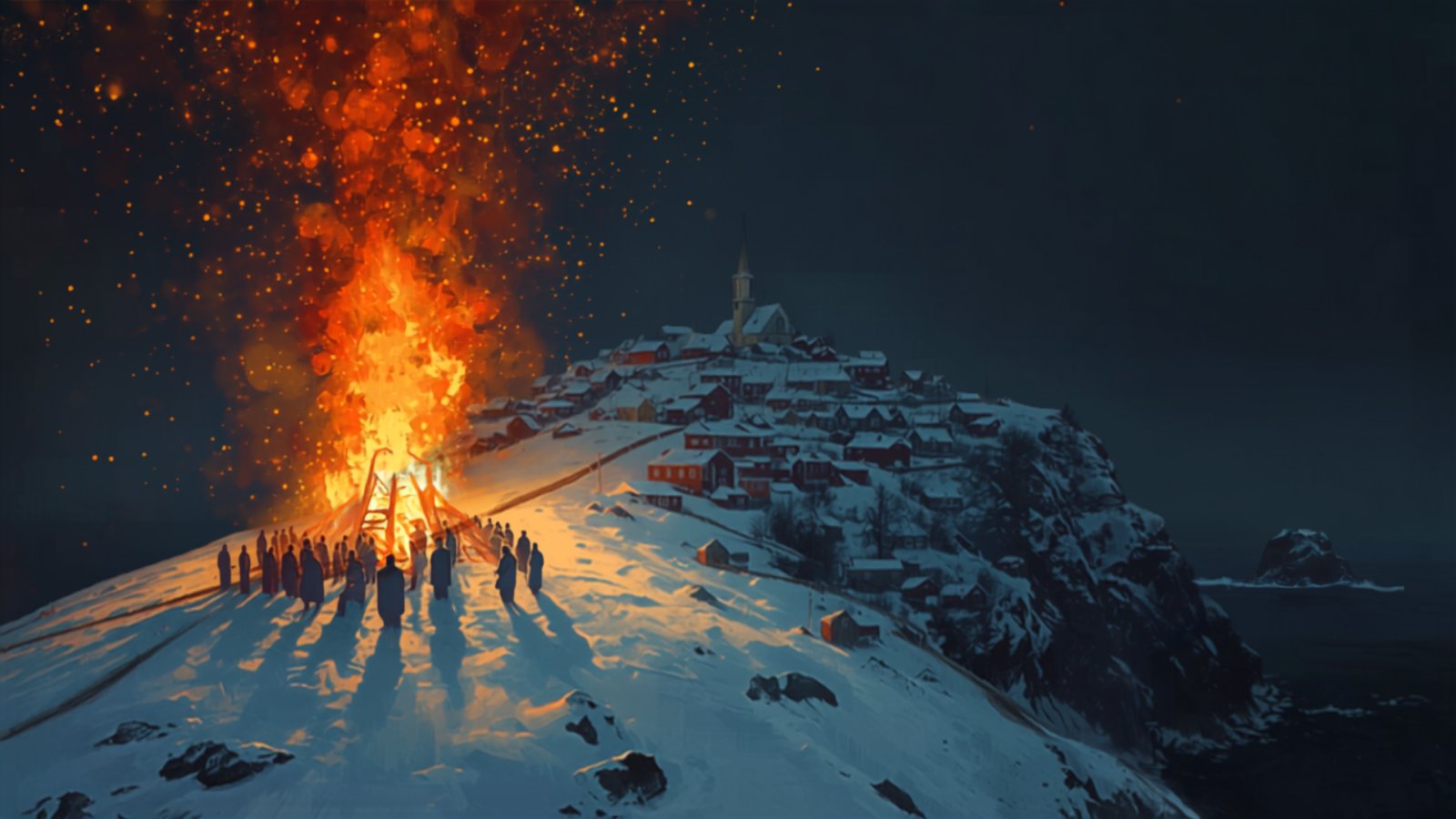
Every year, on the last Saturday of February, Brennholm burned the Winter King. It was, depending on whom you asked, either the island’s soul or its embarrassing secret. The islanders built a great effigy of straw and driftwood — a crowned figure three metres tall, with a beard of dried seaweed and a cloak of old fishing nets. At dusk, they carried him through the streets in a slow procession, every household adding a splinter of wood from their own fire to the sledge that bore him. Then, down on the black beach, they set him alight and sang him into the sea. When the last embers washed away with the tide, winter was considered — officially, absurdly, wonderfully — over.
The festival had a modest fame beyond the island, too. Twice in Nora’s childhood, folklore researchers had arrived on the ferry with tape recorders and hopeful expressions, and twice they had gone home with less than they wanted. The islanders answered questions the way they fished — patiently, and giving away nothing that mattered. One researcher had published a paper calling the Brennholm fire “a remarkably intact survival of pre-modern seasonal custom”, and for years a photocopy of it hung in the harbour café, next to the tide tables, as a kind of joke that outsiders were never quite let in on. What exactly the joke was, Nora had never thought to ask. Children accept the strangeness of their own home the way they accept weather.
Nora was a documentary researcher. Having spent three years filming other people’s traditions — harvest rituals in the mountains, bread blessings in border villages — she had finally been commissioned to film her own. The Last Fire Festivals of the North, the series was called. Her producer’s instructions had been cheerfully brutal: “Find the oldest person who remembers everything, and point the camera at them.”
The problem was that the oldest person who remembered everything had been her grandmother, Astrid. And Astrid was gone.
For sixty-one years, Astrid Lindqvist had been the custodian of the festival. Not officially — Brennholm was suspicious of anything official — but everyone knew that nothing burned without her. She decided when the effigy was ready. She knew which songs were sung in which order, and why the procession paused, inexplicably, outside the old boathouse for exactly one minute. She carried the whole architecture of the ritual in her head, and she had been famously reticent about writing any of it down. “Paper traditions are dead traditions,” she liked to say, tapping her temple. “This one lives here.”
Now the festival was eleven days away, and the head that held it was under the churchyard snow.
2 · The committee
Her uncle Per met her at the harbour, hugged her hard enough to hurt, and told her the bad news before her suitcase had stopped rolling.
“They’ve formed a committee,” he said, pronouncing the word as if it were a disease.
The committee, it turned out, was led by a man called Magnus Berg, who had moved to the island four years ago, renovated three cottages into holiday lets, and discovered — with the enthusiasm of a man discovering oil — that tradition could be sold. Sitting in the community hall that evening, Nora listened to him present his vision on a large screen: Winterfire Brennholm™. A festival weekend. Food trucks on the harbour. A ticketed viewing area on the beach. A drone display forming the shape of a crown above the burning effigy. A professional pyrotechnics company, “for safety and for spectacle”.
“The numbers speak for themselves,” Magnus said, and to be fair to him, they did. The island’s population had dwindled from nine hundred to barely five hundred in Nora’s lifetime. The school was down to nineteen children. The fish plant had closed. What Magnus was offering was not villainy; it was arithmetic. Two thousand paying visitors, he argued, would fund the school bus, the harbour repairs, the future. All the islanders had to do was let their festival become a product.
“And who builds the Winter King?” asked old Signe from the front row. “Astrid’s gone.”
“We’ve costed that,” Magnus said smoothly. “There’s a theatrical workshop on the mainland. They can deliver a reusable figure — flame-retardant core, replaceable straw shell. It would look identical on camera.”
The hall went very quiet. On camera. Nora felt the phrase land on the room like wet snow. She was suddenly, uncomfortably aware of her own tripod bag leaning against the back wall.
Per stood up. “The King is built from what the island throws away,” he said. “Broken oars. Torn nets. The straw from the last harvest. That’s the point. We burn our bad year. You can’t order a bad year from a workshop.”
“Then who will build it?” Magnus asked, not unkindly. “Genuinely. Who here knows how?”
Nobody answered. And in that silence, Nora heard her producer’s voice in her ear, and hated herself a little for it: whatever happens, this is a brilliant film.
3 · The sea chest
Astrid’s house stood at the top of Kirkegata, smelling of coffee, tar soap, and sixty years of woodsmoke. Nora spent two days sorting through her grandmother’s life, filming nothing, crying more than she had expected to. On the third evening, under the bed, she found the sea chest.
It was the family heirloom — her great-great-grandfather’s, according to legend, salvaged from a wreck on the northern rocks. As children, Nora and her cousins had been forbidden to touch it, which naturally meant they had spent years trying to pick its lock with hairpins. Now the key hung on a string from the handle, left there, she understood at once, deliberately. Left for whoever came looking.
Inside, wrapped in oilcloth, she found three things: a bundle of letters; a hand-stitched notebook, swollen with pasted-in papers; and a photograph of a beach fire dated February 1963.
The notebook was the festival. Page after page, in Astrid’s fierce square handwriting, was everything she had sworn she would never write down. Diagrams of the effigy’s frame, with measurements. The words of the songs, with notes on breathing. The order of the procession. The exact minute of silence outside the boathouse. Nora laughed out loud, alone in the cold bedroom. Paper traditions are dead traditions. Her reticent, secretive grandmother had documented everything — and told no one.
Then she reached the last section, and stopped laughing.
It was headed, in red pencil, The truth, for whoever needs it. And what it said, in plain island sentences, was this: the festival was not ancient. Or rather — not all of it. There had been a fire custom once, centuries old, but by the 1950s it had dwindled to almost nothing: a few families burning straw on the beach, a half-remembered song, an evening that fewer people attended each year. In 1962 it had not happened at all. The island was emptying. Winter had won.
And so, in the winter of 1963, a twenty-two-year-old Astrid Lindqvist and her friend Else — grieving, furious, unwilling to watch their home die quietly — had rebuilt the festival themselves. They took the surviving fragments and stitched around them a new ceremony, invented in Else’s kitchen in three weeks. The crown of driftwood: invented. The cloak of fishing nets: invented, because Else’s father had drowned that autumn and his nets were lying in the boathouse, and burning them felt like both a funeral and a beginning. The pause outside the boathouse — the mysterious, sacred, one-minute silence that folklore researchers had puzzled over — was for him.
Having sewn old and new together so carefully that the seam disappeared, the two women then did the hardest thing of all: they kept the seam secret for sixty years. People need to believe a thing is older than they are, Astrid had written. A tradition is not a fact. It is a promise repeated until it becomes true. We did not lie to the island. We made the island a promise.
Nora sat back against the bed, the notebook open on her knees, and stared at the wall. She had come home to film the authentic ancient fire festival of Brennholm. She was now, as far as she could tell, the only living person who knew there was no such thing.
4 · What the camera wants
She did not sleep that night. Instead she sat at the kitchen table with the notebook and her phone, on which sat a one-line message from her producer: Any progress? We need an angle by Friday.
She had her angle. She knew exactly what television would do with it. The Festival That Never Was: how one woman invented an ancient tradition and fooled the folklore experts for sixty years. It would be picked up internationally. It would be, in the industry’s favourite word, a conversation. It would also, she suspected, be the end of the festival — because Magnus Berg would read it as permission. If the tradition was invented anyway, why not reinvent it properly this time, with tickets and drones? You cannot commercialise a sacred thing without resistance. An invented thing, though — an invented thing is just content, and content belongs to whoever pays for it.
She had watched it happen elsewhere, more than once. In the mountains, two summers ago, she had filmed a harvest ritual that a regional tourism board had decided to commercialise: the dates moved to suit the school holidays, the songs shortened for attention spans, the farmers paid a day rate to look picturesque. The visitors loved it. The money was real; she would not pretend otherwise. But she had also filmed the village’s oldest woman standing at the edge of her own festival like a guest, and of all the footage Nora had ever shot, that thirty-second clip was the most quietly poignant — and the broadcaster had cut it, because it “complicated the tone”. That was the future Magnus was selling, whether he knew it or not. She had it on a hard drive.
But the alternative troubled her just as much. If she hid the notebook, her film would repeat the myth of the unbroken ancient custom — and she would spend her career, which was supposedly devoted to truth, knowingly filming a fiction.
At four in the morning she made coffee and read the letters. They were from Else, who had left the island in 1971, and they were among the most poignant things Nora had ever read — two old friends writing across a widening sea, year after year, about one night of fire. I hear the King wore my father’s nets again, Else wrote in 1988. Good. Let him keep warm. And in her final letter, in a hand gone thin and uncertain: You ask if we did wrong, inventing it. Astrid, my dear, listen. Every tradition on this earth was invented by somebody. The only question is whether it was invented with love. Ours was. Let them keep it.
Nora put the letter down. Outside, the first ferry of the morning was crossing the sound, its lights small and stubborn in the dark. She thought about what her grandmother had actually been custodian of, all those years. Not information — the notebook proved the information could be written down in an evening. What Astrid had guarded was something else: the island’s willingness to believe in itself. That was the thing now sitting, unprotected, in a sea chest under a bed.
By the time it was light, she had made two decisions. The first was that the Winter King would be built this year, properly, from the island’s own broken things, if she had to lash every oar to the frame herself. The second decision she told no one — not yet.
5 · Building the King
She went first to Signe, then to Per, then door to door down Kirkegata with the notebook under her arm, showing the diagrams to anyone who would look. The effect was extraordinary. Islanders who had sat silent in the community hall stood in their doorways turning the pages as though handling something holy. “She wrote it down,” they kept saying, half betrayed, half relieved. “The old fox. She wrote it all down.”
The boathouse became a workshop. Per brought the frame timber. The school’s nineteen children were released for two afternoons — the teacher declared it cultural heritage education, and dared the mainland to argue — and they tied straw bundles until their fingers ached, shouting corrections at each other out of the notebook like small lawyers. Signe, who had sung beside Astrid for fifty years, taught the songs to anyone who could hold a note, and several who could not. Broken things arrived by wheelbarrow: a smashed ladder, a rotten window frame, the nets from a skiff that had gone onto the rocks in November. The island’s bad year, gathered to be burned.
Nora filmed all of it. Not the festival the brochure promised — the real thing: arguments about the angle of the crown, laughter, a nine-year-old solemnly explaining to camera that the seaweed beard had to be collected below the tide line “or it doesn’t count”. This, she realised, watching the footage at night, was the film. Not the fire. The building.
On the fifth evening, when the others had gone home and the King lay finished but uncrowned, Signe stayed behind with a thermos and two cups, and told Nora things the camera never got. How Astrid, at eighty, still climbed the ladder herself to set the crown, waving away every offered hand. How, each year on the morning after the fire, she walked the tideline alone, “checking”, she said, though no one knew for what. “I asked her once,” Signe said, turning her cup slowly. “Why the boathouse. Why the minute. She looked at me the way she looked at bad weather, and she said: every fire is for somebody, Signe. Ours knows who it’s for. I didn’t ask again.” She glanced at the notebook on the workbench, then at Nora, and her old eyes were sharp as gulls. “You found more than diagrams in that chest, I think.” It was not a question, so Nora did not answer it, and Signe nodded slowly, as if the silence itself had been the answer, and poured more coffee. Some conversations on Brennholm are conducted almost entirely without words; it had taken Nora three years away to learn to hear them.
Magnus Berg came to the boathouse on the sixth day. He stood for a long time looking at the half-built King lying on its sledge like a sleeping giant, and Nora braced herself for the argument. It did not come.
“My grandfather kept bees,” he said at last, unexpectedly. “In Värmland. When he died, nobody took the hives, and I’ve regretted it for thirty years.” He touched the driftwood crown with one finger. “I still think you need the money, you know. The school. The harbour. I haven’t changed my mind about the arithmetic.”
“I know,” Nora said. “Maybe there’s a version where the visitors come and it’s still ours. Where they stand where we tell them, and buy Signe’s fish soup, and don’t get a drone display.”
“A festival on our terms.” He rolled the idea around like a boiled sweet. “That’s harder to sell.”
“Most true things are,” Nora said, and went back to tying straw.
6 · The last Saturday of February
The night of the festival was windless and bitterly clear, the sky rinsed with stars. At dusk the procession formed at the top of Kirkegata: the Winter King upright on his sledge, crowned and cloaked, magnificent and ridiculous; behind him the whole dwindled, stubborn population of Brennholm, five hundred people and nineteen children, each household carrying its splinter of wood. Outside the old boathouse, the procession stopped, and for one minute nobody moved and nobody spoke, and only Nora — camera lowered, because some things should not be filmed — knew they were standing in silence for a fisherman sixty-three years drowned, mourned forever by a ceremony that never says his name.
Down on the black beach they set the King alight. The fire took the straw, then the nets, then the crown, and the songs rose with the sparks, old words and invented words fused so completely that no seam showed, because there was no seam anymore; sixty years of repetition had welded it shut. Nora filmed the faces, gold in the firelight — Per, Signe, Magnus Berg singing carefully from a printed sheet — and found that she was singing too, and that she could not have said, and no longer cared, which lines were from the seventeenth century and which from Else’s kitchen.
When the tide came for the embers, hissing them dark one by one, she stayed behind on the empty beach and made her second decision real. She took the last section of the notebook — the truth, for whoever needs it — and she did not burn it, and she did not broadcast it. She photographed every page and sealed the copies with a letter of her own in the sea chest, addressed to the festival’s next custodian, whoever that turned out to be. Some truths, she wrote, are not secrets; they are heirlooms — passed down, not published. Her film would end with the fire on the water and one line of narration, the only fully honest sentence she had ever written for television: “No one on this island can tell you exactly how old this festival is. They can only tell you that it is theirs, and that it works.”
She walked back up Kirkegata with the tripod over her shoulder. Behind her the sea moved the last embers gently, putting winter out. In her pocket, her phone buzzed: the producer. Saw the rushes. Extraordinary. One question — the minute of silence at the boathouse. What’s the story there?
Nora looked at the message for a long moment, up there in the cold, with all the lit windows of Brennholm around her. Then she began, very carefully, to type.
Check your understanding
Think about each question first — some ask for facts, some ask for inference. Then click “Show answer” to compare.
Words to remember
Here are the ten key words again, in new contexts. Try writing one more sentence of your own for each.
- effigy — The protesters carried a cardboard effigy of the minister through the square.
- procession — The funeral procession moved through streets lined with silent onlookers.
- custodian — As custodian of the archive, she alone decided who could handle the manuscripts.
- heirloom — The watch is a family heirloom; my grandfather carried it through the war.
- folklore — Local folklore insists that the lake is bottomless, though divers have proved otherwise.
- dwindle — Attendance at the evening classes dwindled from forty students to a stubborn half-dozen.
- commercialise — Purists complain that the ceremony has been commercialised beyond recognition.
- reticent — He was famously reticent about his years abroad, deflecting every question with a joke.
- poignant — The most poignant exhibit was a child’s shoe, unclaimed for eighty years.
- embers — Long after midnight they sat talking, watching the embers collapse into ash.
Grammar in this story: participle clauses
This story leans heavily on participle clauses — a compact C1 structure where an -ing form, a past participle, or having + past participle replaces a full clause. Watch them work:
“Nora stood at the rail, letting the cold strip away three years of city life.” (= while she let…)
“Having spent three years filming other people’s traditions, she had finally been commissioned to film her own.” (= because she had spent…)
“Having sewn old and new together so carefully that the seam disappeared, the two women then did the hardest thing of all.” (= after they had sewn…)
The participle clause shares its subject with the main clause and lets a writer fold two ideas into one elegant sentence — which is exactly why literary English is full of them.
👉 Master the structure here: Participle Clauses in English: Shorten Sentences Like a Native Writer.
Talk about it · Write about it
Talk about it: Else writes that “every tradition on this earth was invented by somebody — the only question is whether it was invented with love.” Do you agree? Think of a festival or custom from your own culture: does it matter to you how old it really is? And where is the line between sharing a tradition with visitors and commercialising it?
Write about it: Write the message Nora sends to her producer about the minute of silence (120–180 words). Decide how much truth she tells — and use at least three participle clauses, for example: “Having thought about your question, I…”
🎉 That was a full-length C1 graded reader — around 3,150 words of layered, literary English, and you carried all ten key words through it. Notice how much of the story lived between the lines: nobody ever told you how to feel about Magnus, yet you formed a view anyway. That’s advanced reading.
But the story keeps one door open. Nora is standing in the cold, typing her answer about the boathouse. Does she guard the secret as Astrid did — or does she believe a new custodian may choose a new way? What would you type?
Enter Cobb’s Hollow in a folk tale about borrowed hours. Notice how an impossible premise exposes recognisable human choices. Next story: The Weaver of Borrowed Hours (C1 Reading Story)
About this story: This is an original C1 graded reader (~3,150 words), written with a controlled advanced vocabulary so that strong learners meet roughly 98% known words. The full range of English grammar appears — participle clauses, inversion, complex discourse markers — but every low-frequency word essential to the plot (effigy, custodian, heirloom, and the rest) is glossed before the story and repeated inside it for reinforcement.

I’m Khamis Maiouf. I’m studying Health and Social Care and have completed Functional Skills Level 2 in English and Level 3 Hairdressing. I have taught ESOL in my community and helped students with GCSE English. I run English Teacher Site to help people learn and practise English.