
The Letter in the Guitar Case (B1 Reading Story)

B1 · INTERMEDIATE Reading practice · ~3,000 words · 17-min read
This is an original story for intermediate learners. It is about two friends, one mistake, and a letter that waited twelve years to be read. First, study the nine key words. Then read the story — it is in six short chapters. At the end, there is a quiz to check what you understood.
Before you read — 9 key words
- scholarship — money that a school gives a student so they can study for free.
- audition — a short performance you give to show a judge how well you play or sing.
- misunderstanding — a situation where someone understands something in the wrong way.
- jealous — unhappy or angry because someone has something that you want.
- envelope — the paper cover that you put a letter inside.
- regret — a sad feeling about something you did, or something you did not do.
- forgive — to stop being angry with a person who hurt you.
- workshop — a room or small building where a person makes or repairs things.
- melody — the main line of notes in a piece of music; the part you can sing.
The story
1 · The house by the sea
Daniel stood in front of the house where he grew up and did not ring the bell. He just looked at it. The blue paint on the door was older now, and the little garden was full of boxes. His mother was moving to the city to live near her sister, and Daniel had come back to help her pack.
He had not been back to Westhaven for twelve years. Twelve years is a long time, but the town smelled exactly the same: salt, rain, and fried fish from the shop on the corner. Somewhere behind the houses, he could hear the sea.
“You’re late,” his mother said when she opened the door, but she was smiling. She hugged him for a long time. “You’ve grown thinner. Doesn’t anyone cook in London?”
“I cook,” Daniel said. “Badly, but I cook.”
Inside, the house was a strange mix of full and empty. The kitchen was already in boxes. The living room still looked like his childhood: the same green sofa, the same photos on the wall. In one photo, two boys of about fifteen stood on the pier with guitars on their backs, laughing at something outside the picture.
Daniel looked at that photo for a second too long, and his mother noticed.
“He still lives here, you know,” she said quietly. “Sam. He has a little workshop down by the harbour now. He repairs guitars.”
“That’s nice,” Daniel said, in the flat voice of a man who wanted to change the subject.
His mother studied his face. “Twelve years, Daniel. You were like brothers. Have you really never spoken to him in all that time? Not once?”
“Not once,” Daniel said. “Where do you want me to start? The kitchen or the bedrooms?”
She sighed and handed him a roll of tape. “Start upstairs. And Daniel — some boxes are heavier than they look.”
He carried empty boxes up the narrow stairs, past the marks on the wall that showed how tall he had been at eight, at ten, at twelve. He did not know it yet, but his mother was right. One of the boxes in that house was going to be very heavy indeed — and it was not heavy because of what it weighed.
2 · Two boys and one prize
To understand what happened next, you need to know what happened twelve years before.
Daniel and Sam had been friends since the first day of school, when they were five and both refused to eat the school soup. They learned to swim in the same cold sea. They broke the same window with the same football. And when they were thirteen, they discovered music at exactly the same moment, in Sam’s uncle’s garage, where two old guitars hung on the wall like sleeping animals.
From that day, they were a band of two. Daniel wrote the words. Sam found the melodies. Daniel played fast and loud; Sam played slow and clean. Everyone in Westhaven knew them. They played at school shows, at birthday parties, and every Saturday on the pier, with a guitar case open for coins.
“One day,” Daniel used to say, “we’ll get out of this town and play real concerts.”
“One day,” Sam always answered, and smiled his slow smile.
Those Saturdays on the pier were the best part of the week. Old Mrs Field from the flower shop always stopped to listen and always asked for the same song. Tourists threw coins and sometimes notes. Once, a man in an expensive coat listened to three whole songs, then gave them his card and said, “Call me when you’re older, boys.” They never called him — they lost the card in a storm, chasing it down the pier and laughing too hard to catch it — but for weeks afterwards they talked about him as if he were the door to another life.
The chance came in their last year of school. The Marlow College of Music — the best music school in the country — offered one scholarship for a young musician from the region. One. The scholarship paid for everything: lessons, a room, even a new instrument. To win it, you had to pass an audition in front of three judges at the town hall.
Both boys applied. Of course they did. They practised together every evening, and they promised each other something in the garage, with their right hands on Sam’s uncle’s old radio, because it was the most serious object they could find.
“Whoever wins,” Daniel said, “the other one is happy for him. No jealousy. Nothing changes.”
“Nothing changes,” Sam repeated.
The day of the audition was hot and windless. Daniel arrived early and waited in the corridor of the town hall, holding his guitar so hard that his fingers hurt. Through the tall wooden door, he could hear voices — Sam’s voice, and the voice of the main judge, a woman with grey hair and sharp eyes.
Daniel did not plan to listen. But the door was old, and the words came through it in broken pieces, like a radio losing its signal.
“…Daniel…” he heard, in Sam’s voice. “…shouldn’t… the scholarship…”
Then the judge said something. Then Sam again: “…don’t tell him…”
Daniel stepped back from the door. His face felt cold in the hot corridor. There was only one way to understand those words, he thought. His best friend — his brother — was telling the judges that Daniel shouldn’t get the scholarship. Sam wanted it for himself, and he didn’t even have the courage to say it to Daniel’s face. Don’t tell him.
Daniel walked into his own audition five minutes later with a storm inside his chest. Maybe that storm was the reason he played the best music of his life. The anger went into his fingers and came out as fire.
A week later, a white envelope arrived at Daniel’s house. He had won.
Sam came to the house that evening. Daniel saw him through the window, standing at the gate with something in his hand. Daniel did not open the door. Sam knocked, waited, knocked again, and finally went away into the summer rain.
In September, Daniel left for the city. He did not say goodbye. He was eighteen and sure of exactly two things: that he was going to be a musician, and that Sam had never really been his friend.
He was right about the first thing.
3 · The heavy box
Now, twelve years later, Daniel was on his knees in his old bedroom, packing his old life into brown boxes. School books. Football cards. A broken watch. It was slow work, because every object wanted to tell him a story.
He worked through the afternoon. From the window of his old room he could see the grey line of the sea between the roofs, and once, without planning to, he found himself listening for two guitars that had stopped playing years ago. He shook his head and taped another box shut.
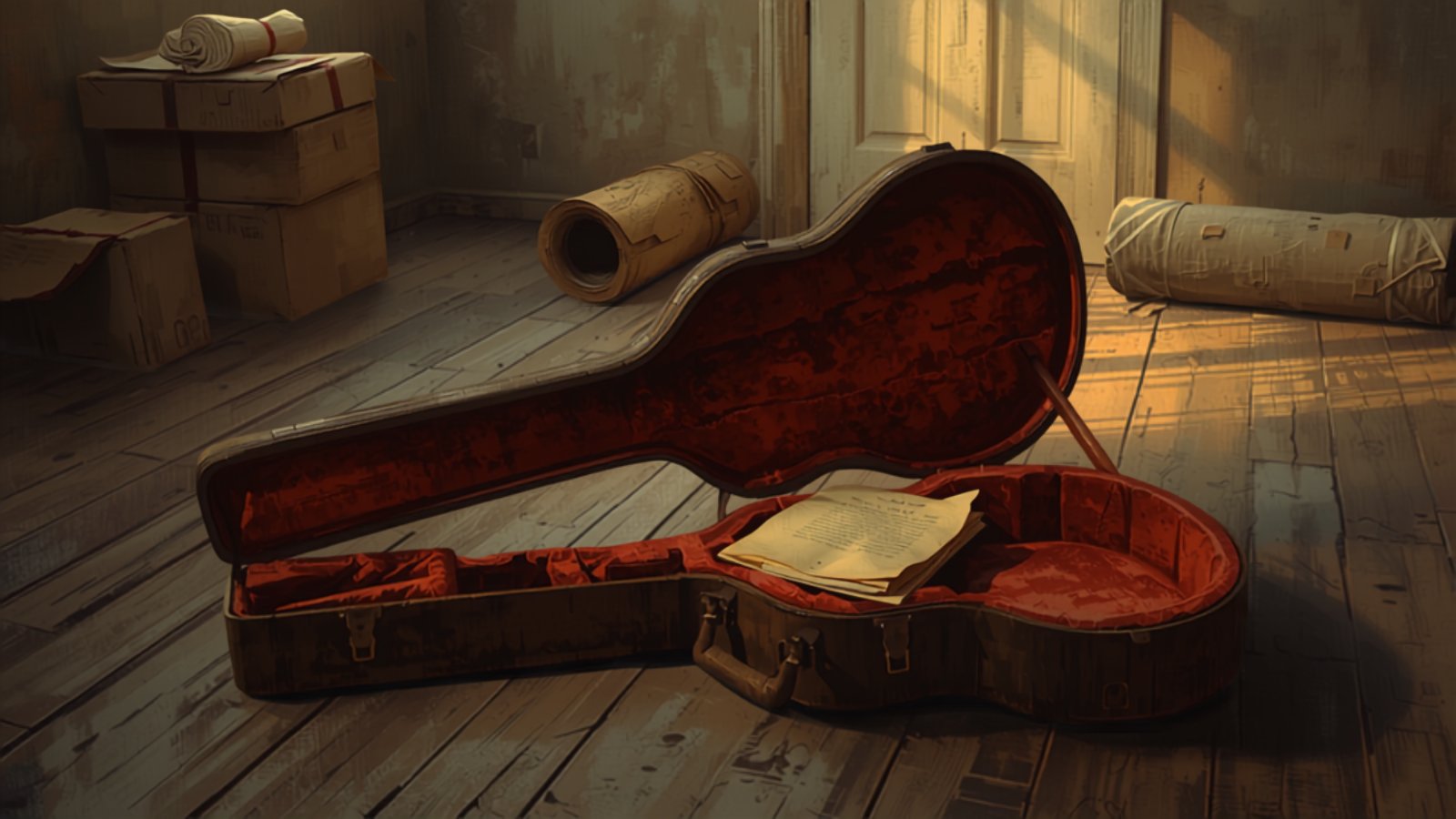
At the bottom of the wardrobe, under a winter coat, he found his first guitar case. The black plastic was grey with dust. He hadn’t touched it since he was eighteen — at college they had given him a better instrument, and the old one had stayed here, sleeping.
He opened the case. The old guitar was still inside, still wearing its strings. And under the neck of the guitar, in the little space where he used to keep spare strings and picks, there was a white envelope.
On the front, in handwriting he knew as well as his own, was one word: Daniel.
He sat very still. Downstairs, he could hear his mother wrapping glasses in newspaper. He carried the envelope down to the kitchen and held it up.
“What is this?”
His mother looked at it, and her hands stopped moving. “Oh,” she said softly. “So that’s where it went.”
“Mum. What is it?”
“Sam brought it. The night before you left. You wouldn’t see him, so he asked me to give it to you.” She sat down slowly. “You were so angry that September, Daniel. You said that if anyone even said his name, you would tear the letter up. So I put it in the guitar case. I thought — he’ll find it when he’s calmer. He’ll find it at Christmas.” She shook her head. “But you didn’t come home at Christmas. You didn’t come home at all. And after a few years, I honestly forgot it was there. I’m sorry. I have wondered, sometimes, what was in it.”
Daniel turned the envelope over in his hands. Twelve years. The letter had waited twelve years inside a guitar case, one metre from his bed, while he was busy in another city being angry.
“Are you going to open it?” his mother asked.
He didn’t answer. He took the envelope out into the garden, sat on the step, and opened it carefully, the way you open something that might explode.
4 · The letter
Dear Daniel,
You won’t open the door, so I’m writing this. You were always better with words than me anyway.
I know what you think. Your mum told me what you said — that I went to the judges and spoke against you. I’ve thought about it all week, and I finally understand what happened. You heard me through the door, didn’t you? You heard half of it and built the other half yourself.
So here is the whole of it. It was a misunderstanding, Daniel — nothing more. But a misunderstanding can grow teeth if you feed it, so read this slowly.
Three weeks before the audition, my dad got sick. It’s his heart. He can’t work like before, and the workshop doesn’t run itself. Mum can’t do it alone. I’m not going to any college, Daniel — not this year, maybe not ever. I decided that before the audition. But I knew that if I told you, you would do something stupid and loyal, like refusing the scholarship, or staying in Westhaven to help me. I know you. You would have done it, and I would never have forgiven myself.
So I went into my audition and I played badly on purpose. Then I told the judge the truth. I said: “Daniel shouldn’t lose the scholarship because of me. He’s the best musician this town has ever had. Give it to him — and please don’t tell him I asked you.” That is what you heard through the door. Those exact words, with holes in them.
I’m not jealous of you. I have never been jealous of you, not for one day. It was always going to be you, and I was always going to be glad about it.
Go and be brilliant. Send me a postcard when you play your first real concert. And when you finally come home — because everyone from Westhaven comes home in the end — you know where to find me.
Nothing changes.
Sam
Daniel read the letter twice. Then he sat with it in his hands and watched the light move across the garden wall, and for a long time he did not move at all.
A misunderstanding is a quiet kind of accident. Nobody lies, nobody means any harm — and still something breaks. Half a sentence through an old door had cost him his best friend, and his anger had guarded the mistake for twelve years, like a soldier guarding an empty castle.
He thought of all the things he had never sent: the postcard from his first concert, the message on Sam’s birthday that he wrote and deleted, deleted and wrote. Regret, Daniel discovered, doesn’t arrive slowly. It arrives all at once, like cold water.
His mother came out and stood behind him. She read the letter over his shoulder, and he heard her breathe in.
“Oh, Sam,” she said quietly. “Oh, you silly, wonderful boys.”
Daniel stood up. “The workshop by the harbour,” he said. “Which one is it?”
5 · Harbour Strings
The workshop was easy to find. It sat between the fish shop and the old boat office, with a wooden sign above the door: HARBOUR STRINGS — repairs & lessons. Through the window, Daniel could see guitars hanging on the wall in a neat row, like the ones in the garage all those years ago.
He stood outside for five whole minutes. If twelve years of silence were a wall, how did you knock on it?
In the end, the door solved the problem for him. It opened, and a man came out carrying a broken chair — a man with grey in his beard and sawdust on his hands. He stopped. The chair slid slowly out of his arms, and he did not try to catch it.
“No,” Sam said. “No, I don’t believe it.”
“Hello, Sam.”
“Daniel Reed.” Sam said the name the way you say the answer to a very old question. “You’ve come home.”
“I found your letter,” Daniel said. There was no clever way to say it, so he said it simply. “Today. I found it today, Sam. It was in my old guitar case. It’s been there since the night you brought it. I never knew.”
Sam looked at him for a long moment. The sea slapped the harbour wall. A seagull shouted about something.
“Twelve years,” Sam said at last. “You’ve been angry with me for twelve years over half a sentence?”
“Yes.”
“That,” said Sam, “is the most Daniel thing I have ever heard.” And then he started to laugh — the same laugh as at fifteen, only deeper — and the wall of twelve years did not fall down slowly. It simply wasn’t there any more.
They sat in the workshop until it got dark, among the smell of wood and glue, and talked the way you can only talk to someone who knew you before you were anyone. Sam’s father was better now — slower, but better; he still came in on Tuesdays to complain about modern music. Sam had a daughter, aged six, who was already breaking guitar strings like a professional. Daniel told him about the concerts, the tours, the famous names — and how, in every city, he had looked at the crowd and felt that one person was missing.
“Do you ever regret staying?” Daniel asked at one point. “The workshop, the town — instead of the music?”
“Regret it?” Sam looked around at the guitars on the wall, and through the window at the harbour lights coming on one by one. “I fix broken things and give them back with their voices working. My dad got his ten more years. I got Rosie. No, Daniel. I don’t regret a single day.”
“Then why didn’t you write again?” Daniel asked. “When I didn’t answer the letter — why didn’t you send another one? Or call? Twelve years, Sam.”
Sam turned a guitar peg slowly, thinking. “Pride, probably,” he said. “The first year, I told myself: he’s read it, and he’s still angry, so a second letter won’t help. The second year, I told myself: he’s famous now, he’s forgotten us. After that, it just became normal — like an old injury. You know it’s there, but you stop looking at it.” He glanced up. “If I had known the letter was sitting in a guitar case the whole time, I would have driven to London and read it to you through your letterbox.”
“I wish you had,” Daniel said quietly.
“I need to say it properly,” Daniel said finally. “I should have knocked on your door before I judged you. I’m sorry. Can you forgive me?”
Sam picked up a guitar and put it into Daniel’s hands.
“I forgave you twelve years ago,” he said. “In the letter. You’ve just been too slow to read your post. Now play something — and we’re even.”
6 · One more song
So Daniel played. His fingers found the old melody before his brain remembered its name — the first song they had ever written together, on a rainy Saturday in the garage, when they were thirteen and immortal. Sam took a second guitar down from the wall and joined in, slow and clean, exactly as before. Nothing changes.
Halfway through, the workshop door opened and a small girl in a yellow raincoat marched in, followed by the smell of chips from next door. She stopped, looked at the two men with guitars, and folded her arms like a tiny teacher.
“Dad,” she said, “you always tell me the shop is not for concerts.”
“This is different, Rosie,” Sam said. “This is Daniel. When your dad was young, Daniel and I were a band.”
Rosie studied Daniel with serious eyes. “Were you any good?”
“We were the best band in Westhaven,” Daniel told her.
“Were there any other bands in Westhaven?”
“No,” both men said together, and the old laugh came back to the room.
When the song ended, the workshop was quiet in a warm way.
“Play at the harbour festival with me,” Sam said suddenly. “Next month. One night only. The band of two, back on the pier. If you say no, I’ll understand — you’re a big star now.”
“If you call me a big star again,” Daniel said, “I’ll charge you for this concert.” He looked at his old friend. “Of course I’ll play.”
Sam grinned. Then his face changed, as if he had just remembered something important. He went to the back of the workshop, opened a drawer, and took out a small, flat box.
“Since we’re opening old things today,” he said, “there’s something I’ve kept for twelve years. I always believed that one day you’d come back and I’d give it to you. It’s yours, really. It always was.”
He put the box on the table between them. On the lid, in faded pen, were two names — Daniel & Sam — and one word underneath that made Daniel’s heart jump.
Daniel reached for the lid.
Check your understanding
Read each question. Think about your answer. Then click “Show answer” to check.
Words to remember
Here are the key words again, in new sentences. Say each one out loud.
- scholarship — She has won a scholarship, so her university course is free.
- audition — He was so nervous before the audition that he couldn’t eat breakfast.
- misunderstanding — It was all a misunderstanding — she never actually said that.
- jealous — Don’t be jealous of your friend’s success; your turn will come.
- envelope — He wrote the address on the envelope and posted the letter.
- regret — My biggest regret is that I never learned to play the piano.
- forgive — If you explain what happened, I’m sure she will forgive you.
- workshop — My grandfather repairs old clocks in his little workshop.
- melody — I can’t remember the words of the song, but the melody stays in my head.
Grammar in this story: the present perfect
This story uses the present perfect (have/has + past participle) when the past still touches the present. Look at what the characters say:
“Have you really never spoken to him in all that time?” · “You‘ve come home.” · “You‘ve been angry with me for twelve years.” · “I‘ve kept something for twelve years.”
Notice the difference: the story of the audition uses the past simple (Daniel won, Sam knocked, he left) because it happened at a finished time, twelve years ago. But when Sam says “I‘ve kept something for twelve years”, he uses the present perfect — because he started keeping it in the past and he still has it now.
👉 Learn the full rule here: Understanding the Present Perfect Tense.
Talk about it · Write about it
Talk about it: Have you ever lost contact with a good friend? What happened? If you could send that person one message today, what would you say? Do you think Daniel’s mother made a mistake when she hid the letter — or was she trying to help?
Write about it: Imagine you are Daniel on the train back to London. Write a short letter (80–120 words) to Sam about the day you found the envelope. Use the present perfect at least three times — for example: I have thought about…, I have never told you…, you have given me…
🎉 Well done — you have just read a complete story of about 3,000 words in English. A year ago, could you have done that? And notice: you now own nine new words too.
But one question is still open — what is inside the small, flat box with two names on the lid? Daniel is about to lift the lid… and what he finds will need a story of its own.
Sofia finds her grandmother’s old postcards. Follow the clues and notice how the past changes her understanding. Next story: The Last Postcard (B1 Reading Story)
About this story: This is an original B1 graded reader (~3,000 words). The vocabulary is controlled to around a 1,000-headword level, so intermediate readers should know about 98% of the words. The grammar stays at B1: past simple narrative, present perfect, relative clauses, and first and second conditionals. The nine harder words are explained before the story and reused inside it.

I’m Khamis Maiouf. I’m studying Health and Social Care and have completed Functional Skills Level 2 in English and Level 3 Hairdressing. I have taught ESOL in my community and helped students with GCSE English. I run English Teacher Site to help people learn and practise English.