
The Weaver of Borrowed Hours (C1 Reading Story)

C1 · ADVANCED Reading practice · ~3,500 words · 24-min read
This is an original folk tale written for advanced learners. The plot is invented, but the story keeps the rhythm and flavour of the tales people once told around the fire. Before you begin, look through the ten key words below — every one of them appears more than once in the story, so by the end they should feel like old friends.
Before you read — 10 key words
- loom — a wooden frame on which thread is woven into cloth.
- shuttle — the small tool that carries the thread back and forth across a loom.
- to covet — to long for something that belongs to someone else, with a touch of envy.
- to hoard — to gather and store far more of something than you could ever need.
- to wither — to dry up, fade, and lose life, the way a plant does without water.
- reckoning — the moment when you must finally pay for what you have done.
- threadbare — (of cloth) worn so thin that the threads show; (of a person or an excuse) exhausted, weak.
- apprentice — a young person who learns a craft by working for a master.
- to barter — to trade goods or services directly, without using money.
- to forfeit — to lose something as the penalty of a deal, a rule, or a mistake.
The story
1 · The house at the end of Lantern Row
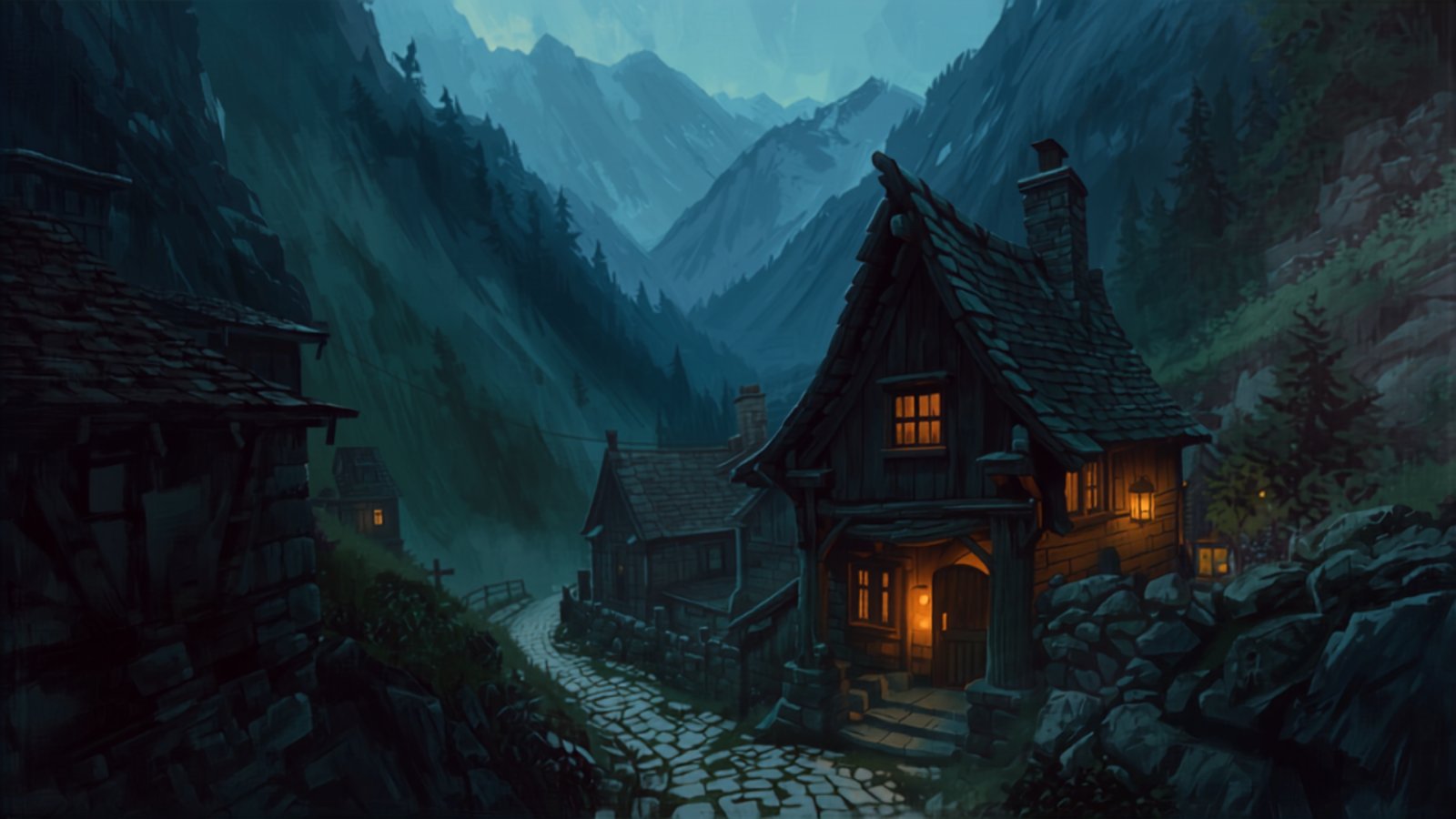
In a valley so narrow that the sun had to queue behind the mountains each morning, there lay a village called Cobb’s Hollow. It was a place of modest ambitions. The miller ground his flour, the shepherds walked their slow circles on the hillsides, and the magistrate — a broad, red-faced man named Corvan — collected his taxes with the tenderness of a crow collecting shiny things.
At the end of Lantern Row, in a crooked house that leaned against the hillside as though it were tired, lived a weaver known to everyone as Old Sera. Nobody could say when she had arrived. The baker’s grandmother swore Sera had been old when she was a girl, and the baker’s grandmother was not a woman you contradicted twice.
Never had the village seen cloth like Sera’s. Her shawls seemed to carry their own weather: one shimmered like rain on a summer pond, another glowed like the last coals of an August evening. People came from three valleys away to buy them, and they paid whatever she asked — which was strange, because she never asked for money.
Sera bartered. That was the first rule of Lantern Row, learnt by every child before they learnt their letters. You did not offer the weaver coins; to do so was considered almost rude. You offered her something of yourself, and she would name the price. Rarely did anyone understand, at the moment of the deal, what that price truly was.
The loom itself stood in her front room, filling it the way a ship fills a harbour. It was built of black wood that no carpenter could name, and its frame was carved with tiny figures — reapers, dancers, kings — whose faces were worn smooth by centuries of touching. When Sera worked, the shuttle flew through the threads so fast that visitors said it blurred, and some said it whispered.
And what Sera wove, if you believed the stories — and in Cobb’s Hollow, everyone did — was not merely cloth. It was time.
2 · The bargain
The bargain worked like this. Into every piece of cloth, Sera could weave a single borrowed hour — one perfect hour of somebody’s life, captured whole, with all its light and warmth still inside it. Wrap the shawl around your shoulders, close your eyes, and for sixty minutes you would live that hour as if it were your own: a wedding morning, a child’s first laugh, an afternoon of rain when nothing needed doing and nobody needed you.
The hours came from the sellers — villagers who, for reasons of their own, wished to be rid of a memory or simply needed what Sera offered in exchange: a good harvest, a mended roof, a winter without fever. They would sit at the loom, place one hand on the black wood, and let the shuttle draw the hour out of them like a splinter. Afterwards they remembered that the hour had existed, but not how it had felt. There is a kind of mercy in that, and a kind of theft.
The buyers paid differently. Not with money — never with money — and not with hours they had already lived. The loom took its payment from the future. For every borrowed hour you enjoyed, you would forfeit one hour you had not yet lived, and here was the cruelty of it: the loom chose which one. You would not know what you had lost until you arrived at the missing hour, years later perhaps, and found it flat and colourless, like a page torn from a book and clumsily glued back in.
“Is it worth it?” a traveller once asked the blacksmith, who was known to have bought two hours in his youth.
The blacksmith considered the question for a long time. “I lived an hour of another man’s happiness,” he said at last. “It was the finest hour I ever had. And somewhere ahead of me are two grey hours waiting, and not a day passes without my wondering which ones they’ll be.” He turned back to his anvil. “You tell me whether that’s worth it. I’ve stopped being able to do the sums.”
Little wonder, then, that most villagers treated Sera’s house the way you might treat a deep well: a marvellous thing, best approached carefully and never leaned over too far. Most bought one hour in a lifetime, for a wedding gift or a dying parent, and left it at that.
Most. Not all.
3 · The miller’s trade
The first to lose his balance was the miller, a decent man hollowed out by grief. His wife had died in the spring, and by autumn he had discovered that Sera held, woven into a plain brown shawl, one hour of his own wedding day — sold to her years earlier by a wedding guest who had coveted the couple’s happiness and then, ashamed of coveting it, had asked the weaver to take the memory away.
The miller bought the hour and lived it, and his wife was alive again inside it, laughing at something his brother had said, flour dust still under her fingernails because she had insisted on baking her own wedding bread. When the hour ended he sat in his cold kitchen and wept, and the next morning he was at Sera’s door again.
“There must be more,” he said. “Other guests. Other hours. I’ll pay whatever it takes.”
Sera looked at him for a long moment, and those who saw her face said afterwards that there was no greed in it, only a terrible weariness. “There are three more,” she admitted. “But hear me, miller. The loom has begun to notice you. The first hour it takes from a man is usually a kindness — some dull afternoon he’d never miss. The hours it takes afterwards are less kindly chosen. Not until the debt is called in does a buyer learn what he has truly spent.”
“I don’t care,” said the miller, and he meant it, which is the most dangerous way of not caring.
He bought all three. Through that winter he lived them over and over — for the shawls could be used again and again, though each use cost a fresh hour of future — and the villagers watched him change. His mill fell quiet on odd mornings. His conversation faded to politeness. It was as if the best of him had moved into the past and left only a caretaker behind, a man growing threadbare in the way that cloth does: still whole, still functioning, but thin enough that you could see the light through him.
Only when his daughter took the shawls and locked them in the church strongbox did the miller begin, slowly, to return to the present. He never thanked her. But years later, at her own wedding, he danced — and if the dance had a grey, flat hour hidden somewhere inside it, he was gracious enough not to say which one.
4 · The magistrate develops an appetite
Magistrate Corvan had watched the miller’s decline with great interest and no sympathy whatsoever. Where others saw a warning, Corvan saw an inefficiency. The miller’s mistake, he concluded, was sentimentality: the man had bought hours he was emotionally attached to, and attachment was expensive. Corvan intended to be a more disciplined customer.
He began to buy strategically. An hour of the old judge’s sharpest thinking, worn before difficult rulings. An hour of the horse trader’s charm, worn at tax time, when charm made the collecting smoother. He kept a ledger of his purchases, in the same neat hand he used for the village accounts, and he saw no irony in that at all.
And he hoarded. This was the thing the village found hardest to forgive. Other buyers used their hours; Corvan collected them. Shawl after shawl went into the locked room at the top of his fine stone house — hours of courage, hours of wit, hours of other people’s summers — until he owned more borrowed time than any man in the valley’s memory. Seldom did he actually wear any of it. Owning it was the pleasure. He hoarded hours the way misers hoard gold: not for what it could do, but for the simple arithmetic of having more.
“You do understand,” Sera said to him one evening, as the shuttle flicked back and forth and another of his purchases took shape in the threads, “that every one of these is a debt. The loom keeps its own ledger, magistrate, and it has never once lost count.”
“I am familiar with ledgers,” said Corvan pleasantly. “Debts fall due. When they do, one negotiates.”
“Not with this creditor.”
“Everything negotiates,” said Corvan, and smiled the smile of a man who had never yet met the exception. He straightened his coat and placed his next order — and it was an order that made even Old Sera’s hands pause on the shuttle. Not an hour this time. A year. A single woven year of youth, stitched together from a thousand bartered fragments, to be worn against the old age he could feel coming for him.
“The price of a year,” Sera said slowly, “is a year. The loom will choose it, and it will not choose kindly. It never does, with the greedy.”
“Weave,” said the magistrate.
5 · The girl who counted
Every folk tale needs somebody who counts, and in Cobb’s Hollow that somebody was Lena, the shepherd’s daughter — sixteen years old, with a habit of noticing things and the far more dangerous habit of saying them out loud.
Lena had been apprenticed to Sera the previous autumn. It was an ordinary arrangement on the surface: the weaver was old, her hands ached in the cold, and an apprentice could card wool, dye thread, and keep the fire going. Lena’s father had bartered a winter’s worth of cheese for the position, reasoning that a craft in the hands was worth more than a daughter in the kitchen.
But an apprentice sees things a customer never does. Lena saw that Sera never touched the finished shawls, handling them only with wooden tongs, the way you handle something hot. She saw that the little carved figures on the loom’s frame were not decorations — that their number changed. And she saw what happened to the sellers after their hours were drawn out of them: the slight dimming, the pause before a smile, as though joy now had to travel a longer road to reach their faces.
She began to keep her own ledger, in chalk, on the underside of the wool table where Sera never looked. So many hours in, so many out. And little by little the chalk marks taught her what the village had spent generations politely not knowing: the trade was not balanced. It had never been balanced. Every bargain left both sides poorer and the loom richer, and the loom had been collecting for a very, very long time.
The village was withering. Not dramatically — nothing in Cobb’s Hollow was dramatic — but measurably, the way a garden withers in a dry month. Fewer weddings than her grandmother’s day. Fewer songs at harvest. The best hours of the valley were leaving the world of the living and going into cloth, and the cloth was piling up in the magistrate’s locked room, where it made nobody happy at all, not even him.
One evening Lena rubbed out her chalk marks, walked into the front room, and asked the question no customer had ever thought to ask.
“Sera — what did you pay?”
6 · The weaver’s debt
The shuttle stopped. In the whole year of her apprenticeship, Lena had never once seen the shuttle stop while there was daylight left.
“Sit down,” said Old Sera, and told her.
Long ago — she would not say how long, and Lena, doing the arithmetic of the baker’s grandmother, chose not to press — Sera had been young in another valley, and there had been another weaver, and another crooked house at the end of another row. Sera had been the customer then. She had coveted a borrowed hour in a shawl the colour of October, and then another, and then more, buying recklessly, spending a future she could not imagine ever running short of. The young are all rich that way, and all wrong.
“No sooner had I worn the tenth hour,” Sera said, “than the reckoning came. The loom called in its debt — all of it, at once. And the price of a spent future, girl, is this: you become the weaver. You take the house, and the loom, and the shuttle, and you weave until some other fool spends their way as deep as you did and takes your place. That is the oldest bargain, the one underneath all the others. The loom does not want hours. Hours are only its bait. What it wants is a weaver, forever.”
“Then the one before you—”
“Went free the day I sat down at her loom. I remember her walking out into the sunshine with her shadow all wrong, like a coat that no longer fitted her.” Sera’s hands, resting on the black wood, were very still. “I have sat here since, keeping the trade small where I could. Frightening off the young ones. Warning the millers and refusing more than I ever sold — you’d not believe how much refusing I’ve done. But the magistrate is beyond refusing. He has spent his future to the very bottom, and the loom has noticed him, and his reckoning is near. When it comes, he’ll take my seat.”
Lena should have felt glad, and was ashamed to find that part of her did. “And you’ll be free.”
“Free,” Sera agreed, in the voice of someone naming a foreign city she never expected to visit. “And in thirty years, or fifty, some other clever, hungry soul will sit down where Corvan sat down, and the wheel will turn again. It has always turned. Little wonder I have no love for the sound of my own shuttle.” She looked up, and her eyes were old the way riverbeds are old. “Unless my apprentice has counted her way to something better. You have been keeping chalk under my wool table for eight months, girl. Not once did I rub it out. I’ve been hoping you’d see what I’ve grown too tired to see.”
7 · The reckoning of Magistrate Corvan
The woven year was finished on the last day of autumn: a great cloak, heavy as guilt, its threads holding twelve months of other people’s youth. Corvan came for it at dusk, alone, having told his household he was inspecting granaries. Greed prefers not to be watched.
“I would not put it on,” said Sera, one last time. “Walk away, magistrate. Forfeit the cloak, keep your seat by your own fire, and grow old at the ordinary speed. There is no shame in refusing a bad bargain late. The shame is only in keeping it.”
“I have paid,” said Corvan, “and I take delivery.” And he swung the cloak around his shoulders.
For one breath, it worked. The years lifted from his face like mist off a morning field; he stood straighter; he laughed, and the laugh was thirty years younger than his throat. Then the loom, which had kept its ledger with perfect patience through every small purchase and every smug negotiation, called in the whole account.
Under the reckoning, the black wood seemed to breathe out. Every carved figure on the frame turned — Lena would swear to this until she was an old woman — every reaper and dancer and king turned its small smooth face towards the magistrate. The cloak faded to grey on his shoulders, then to something greyer than grey, the colour of a page torn out and thrown away. And Corvan walked, not because he wished to but because the bargain was underneath him now and walking him like a garment, across the room, to the weaver’s bench, and sat down.
His hand closed on the shuttle.
Sera stood up from sixty years of weaving — or six hundred; the baker’s grandmother’s arithmetic was never settled — and her shadow, Lena noticed, hung on her all wrong, like a coat that no longer fitted.
“It’s done,” Sera whispered. “God help him, and God forgive me, it’s done.”
“No,” said Lena. “It isn’t. The wheel just turned, that’s all. You said it yourself: it has always turned.” She stepped forward, past her mistress, towards the loom and the grey-faced man now welded to its rhythm. “I’ve done the counting, Sera. There’s one kind of hour the ledger has no column for. I checked eight months of chalk. It’s never taken one. I don’t think it can.”
8 · The hour that could not be bought
Every transaction the loom had ever made — every barter, every purchase, every forfeit — had one thing in common, and Lena had needed eight months of chalk to see it because it was so obvious: somebody wanted something. Desire went in, and cloth came out. Coveting, hoarding, grieving, bargaining — the loom could digest them all, because they were all, in the end, forms of wanting. It was a machine for turning appetite into thread.
What it had never been offered, in all its centuries, was an hour given freely — wanted by nobody, priced at nothing, an hour with no ledger entry possible because nothing was asked in return.
Lena sat down beside the magistrate on the weaver’s bench — the loom shuddered; there had only ever been one seat — and placed her hand flat on the black wood, and made the loom a gift.
One hour. Her own. Not a spare one, not a dull one — the loom must not be able to refuse it as worthless — but a true hour, the best she had: a June morning on the high pasture the year she was twelve, her father teaching her to whistle through a grass blade, the whole valley below them still holding its breath before the day began. She poured it in with both hands open, asking for nothing, and said, out loud, the words no customer had ever said in that room:
“Keep it. It’s yours.”
Machines for turning appetite into thread do not have a gear for grace. The shuttle flew on for a moment out of pure habit; then the rhythm stumbled, like a liar asked a simple, honest question. The carved figures turned their faces from the magistrate to the girl, and one by one — reaper, dancer, king — they bowed their small smooth heads, and were still. The black wood groaned, softened, and split along a seam no carpenter had ever found, and out of the split poured light: hour after hour after hoarded hour, centuries of them, streaming out of the threads and up through the crooked roof and home to wherever spent time goes when it is finally released.
In the magistrate’s fine stone house, a locked room full of shawls went suddenly, permanently ordinary — just cloth now, threadbare and moth-eaten cloth at that. Corvan himself woke on the weaver’s bench like a man surfacing from deep water, old, frightened, and free, his debts not forgiven but simply — the word Lena used ever afterwards — irrelevant. The creditor was gone. He lived another twenty years, gave away a surprising amount of grain, and never once locked a door again, which the village found stranger than anything else in this story.
And Old Sera stood at the window in the last of the light, watching centuries of stolen hours go home, with tears running down the riverbeds of her face and her shadow settling onto her shoulders, at long last, like a coat that fitted.
9 · What was left on the loom
The loom never wove again. It stands in the crooked house to this day, they say, split down its seam, its figures bowed — a piece of furniture now, and nothing more. Sera lived out her freedom in the sunshine she had stopped believing in, and Lena, who finished her apprenticeship under a mistress who finally taught her plain, honest weaving, became the finest ordinary weaver in three valleys. Her cloth held no hours. People slept better under it for exactly that reason.
Only one small thing remained unexplained, and Lena told nobody about it for fifty years.
On the night the loom split, when she finally rose from the bench, she found that the shuttle had not gone still with the rest. It lay in her palm faintly warm, like a stone that had spent the day in the sun, and inside it — she could feel it the way you feel a word on the tip of your tongue — one single hour remained. The last one. Hers, given freely; kept, but never spent; a gift the dying loom had somehow, in its final stumbling moment, given back.
She has it still, the story goes — an old woman now on the high pasture, with a grass blade and a warm shuttle in her apron pocket, deciding, on the good June mornings, whether today is the day to spend it.
What would you do with it? Think carefully. That is exactly how all of this began.
Check your understanding
Read each question. Think about your answer. Then click “Show answer” to check.
Words to remember
Here are the ten key words again, in fresh sentences. Try writing one sentence of your own for each.
- loom — The museum still displays a working loom from the eighteenth century.
- shuttle — Her hands moved so quickly that the shuttle seemed to disappear between the threads.
- covet — It’s easy to covet a colleague’s success and forget the years of work behind it.
- hoard — During the shortage, some families began to hoard flour and candles.
- wither — Without investment, even a thriving town can wither within a generation.
- reckoning — After years of careless spending, the day of reckoning finally arrived.
- threadbare — He kept wearing that threadbare coat long after he could afford a new one; his excuses for it were just as threadbare.
- apprentice — She spent four years as an apprentice before opening a workshop of her own.
- barter — With no cash in the village economy, people would barter eggs for cloth and labour for grain.
- forfeit — Miss the deadline and you forfeit the deposit — read the contract carefully.
Grammar in this story: inversion with negative adverbials
Folk tales love a dramatic sentence, and one of English’s most dramatic structures is inversion: starting with a negative or limiting adverbial and flipping the subject and auxiliary verb. This story uses it several times:
Never had the village seen cloth like Sera’s. · Rarely did anyone understand what that price truly was. · No sooner had I worn the tenth hour than the reckoning came. · Not once did I rub it out. · Only when his daughter took the shawls did the miller begin to return to the present.
Compare the ordinary word order: The village had never seen… / Anyone rarely understood… The inverted versions sound more formal, more literary — perfect for storytelling, speeches, and high-band writing exams.
👉 Learn the full rule here: Inversion in English: Never, Rarely, Seldom (and Why You Flip the Verb).
Talk about it · Write about it
Talk about it: If you could relive one hour of your life — knowing the price was a random future hour, chosen for you — would you make the trade? Where is the line between treasuring the past and being trapped by it, like the miller?
Write about it: Write 200–250 words retelling a folk tale from your own culture — but change one rule of its magic, the way this story’s loom takes payment from the future. Try to include at least two examples of inversion with negative adverbials (Never had…, No sooner had… than…, Only when… did…).
🎉 Well done — that was more than three thousand words of advanced English, full of literary structures you’ll meet in novels and exams alike. And the ten key words? You’ve now seen every one of them at least twice, in context, which is exactly how vocabulary sticks.
But one question stays open, doesn’t it? An old woman on a high pasture, a warm shuttle in her apron pocket, one perfect hour left unspent. Would spending it be a gift to herself — or the first step of a brand-new bargain? Some stories end; this one is merely waiting…
Nadia arrives during the Festival of the Quiet Bell. Read closely for what the town’s unusual tradition reveals. Next story: The Bell That Never Rang (C1 Reading Story)
About this story: This is an original C1 graded reader (~3,500 words) with an invented plot told in the style of a traditional folk tale. Vocabulary is controlled to an advanced (C1) level, with a full range of grammar including inversion, participle clauses, and literary discourse markers. The ten harder key words are glossed before the story and each is reused at least twice inside it, following the graded-reader method.

I’m Khamis Maiouf. I’m studying Health and Social Care and have completed Functional Skills Level 2 in English and Level 3 Hairdressing. I have taught ESOL in my community and helped students with GCSE English. I run English Teacher Site to help people learn and practise English.