
The Allotment on Whitmore Lane (C1 Reading Story)

C1 · ADVANCED Reading practice · ~3,100 words · 16-min read
This is an original story for advanced learners. The language is rich but controlled: before you start, skim the ten key words below — each one appears at least twice in the story, so you will meet it again in context. At the end, there are comprehension questions, the vocabulary in fresh sentences, and one grammar point worth stealing for your own writing.
Before you read — 10 key words
- allotment — a small piece of rented land, usually from the local council, where people grow vegetables and flowers.
- bereavement — the experience of losing someone close to you through death.
- procrastinate — to keep delaying something you know you should do.
- ramshackle — old, untidy, and in poor condition; looking as if it might fall down.
- begrudgingly — doing something unwillingly, without any real enthusiasm.
- perennial — a plant that dies back in winter but returns every year without being replanted.
- windfall — an unexpected piece of good fortune, often money or goods; literally, fruit blown down from a tree.
- take stock — to pause and think carefully and honestly about your situation.
- officious — too eager to use small amounts of authority; bossy in an official, self-important way.
- poignant — causing a sharp feeling of sadness mixed with tenderness.
The story
1 · The letter she ignored
The letter arrived on a Tuesday, wedged between a takeaway menu and a bank statement, and Nora Fenwick did what she had done with almost everything since April: she put it on the pile by the kettle and promised herself she would deal with it later.
Later, in Nora’s world, had become a flexible concept. She was thirty-eight, a senior project manager for a firm that fitted out office buildings, and she spent her days chasing other people’s deadlines with a discipline that bordered on the heroic. Her own life, meanwhile, ran on postponement. Since her father’s death in the spring, she had postponed sorting his flat, postponed answering the condolence cards, postponed grief itself, as far as such a thing can be postponed. Bereavement, she was discovering, did not behave like a project. It had no milestones. It simply sat in the corner of every room she entered, patient and unscheduled.
The letter surfaced again a fortnight later, during a half-hearted attempt at tidying. It was from the Whitmore Lane Allotment Association, and it was signed, with a flourish that suggested its author enjoyed signing things, by one Cyril Beckett, Chair.
Dear Ms Fenwick, it read. We were saddened to learn of the passing of your father, Arthur Fenwick, tenant of Plot 17. As you may be aware, Association rules require every plot to be actively cultivated. Plot 17 has now stood untended for eleven weeks. Under Rule 9(c), the tenancy may pass to next of kin, provided the plot is brought back into good order by 31 August. Otherwise it will be offered to the next person on the waiting list, which currently stands at forty-one names.
Nora read it twice, feeling a familiar cocktail of guilt and irritation. Her father had kept that allotment for nearly thirty years. As a child she had spent Saturday mornings there under protest, shelling peas and being lectured about compost; as an adult she had visited it perhaps twice a decade. She had no intention of taking it on. She could barely keep a supermarket basil plant alive on her kitchen windowsill.
Still, one didn’t simply ignore a letter like that — or rather, one did, which was precisely the problem. Having procrastinated for another full week, telling herself each evening that she would ring the Association first thing in the morning, she finally lost patience with her own cowardice. On the last Saturday of July she dug her father’s spare key out of the drawer of his desk, drove across town, and parked outside the gates of Whitmore Lane with a clear and sensible plan: she would hand back the key, thank Mr Beckett for his letter, and be home by lunchtime.
2 · Plot seventeen
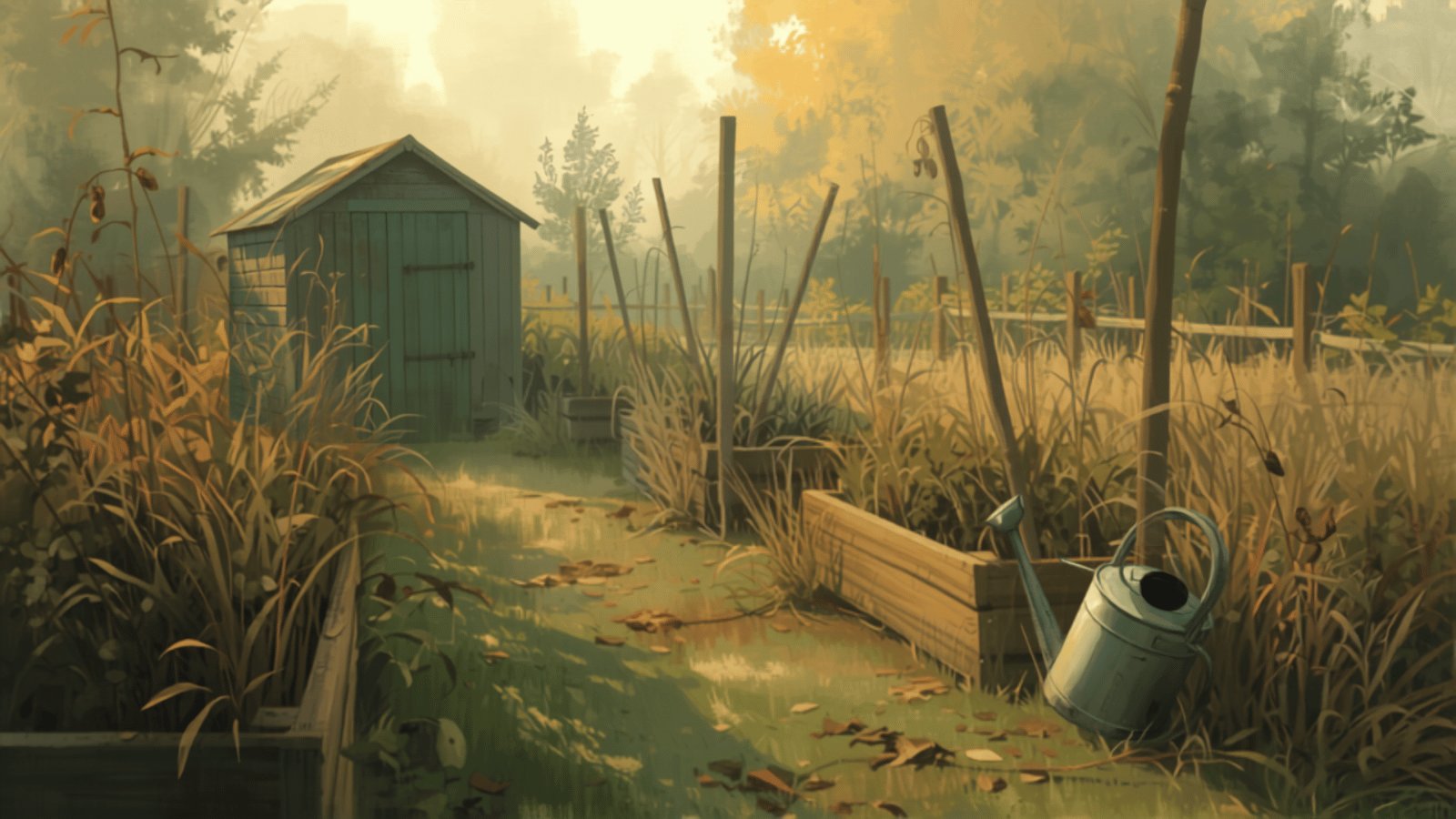
Whitmore Lane was not what she remembered. Or rather, it was exactly what she remembered, which was somehow the surprising thing. The same crooked gravel path ran between the plots. The same ramshackle sheds leaned against one another like old men at a bus stop, patched with corrugated iron and painted doors that had clearly begun their lives as something else. Somewhere a radio was playing cricket commentary. The air smelled of cut grass and creosote and, faintly, of woodsmoke, and the smell went through her like a knife, because it was the smell of her father.
She had barely taken ten steps when a man intercepted her. He was in his seventies, wearing a hi-vis waistcoat that no risk assessment could possibly have required, and carrying a clipboard.
“This is a members’ site,” he announced. “Can I help you?” His tone made it clear that helping her was the last thing on his mind.
“Nora Fenwick. Arthur’s daughter. You wrote to me — Mr Beckett, is it?”
Cyril Beckett softened by roughly one degree. “Ah. Plot 17.” He consulted the clipboard, though he plainly knew every plot on the site by heart. “Eleven weeks untended. Twelve now. You’ll appreciate that the rules apply to everyone, Ms Fenwick. We can’t make exceptions, or where would we be?” He said it with the particular satisfaction of an officious man who has waited all week for a rule to enforce.
“I’ve actually just come to hand back the—” Nora began, but he was already marching her down the path, narrating as he went. Water charges. Bonfire regulations. The controversy of the communal manure delivery. She stopped listening somewhere around the bee-keeping by-laws, because they had arrived at Plot 17, and Plot 17 had knocked the words out of her.
It was overgrown, of course. Twelve weeks of an English summer will bury any garden. But underneath the weeds, the plot was still unmistakably her father’s: the beds laid out with surveyor’s precision, the rhubarb erupting in one corner like a green fountain, the raspberry canes tied to their wires in neat rows. The perennials had simply carried on without him. That was the thing about perennials, she remembered him saying — annuals need you, love, but perennials just need the world to keep turning. Fruit had dropped from the old apple tree and lay in the long grass, a small windfall that nobody had gathered, and for some reason it was the sight of those wasted apples, more than the funeral, more than the flat, that finally made her cry.
Cyril Beckett studied his clipboard with tremendous concentration and gave her a moment.
“I’ll tidy it,” she heard herself say. “Before anyone takes it over. I’m not keeping it — I just don’t want a stranger to see it like this. One afternoon.”
“Thirty-first of August,” said Cyril, and walked off to enforce something else.
Begrudgingly, she fetched the tools from the shed — everything hanging exactly where he had left it, each hook labelled in his careful capitals — and began to weed. She worked clumsily at first, then with a rhythm she didn’t know she possessed. Kneeling in the dirt with the cricket commentary drifting over the hedges, she lost track of time in a way she hadn’t managed for months. When she next looked at her phone it was six o’clock, her back ached magnificently, and a woman was standing at the edge of the plot holding two mugs of tea.
“You’ll be Arthur’s girl,” the woman said. “I’m Ada. Plot 12. He talked about you all the time.” She handed Nora a mug as if they had known each other for years. “Don’t mind Cyril. Every allotment in England has one. We find him useful for frightening the pigeons.”
They drank their tea standing among the half-cleared beds while the light softened over the sheds. Ada asked no questions — not about the funeral, not about the plot’s future, not about why Nora’s face was streaked with dirt in a pattern that suggested she had been crying into her weeding. She simply pointed out which of the green things were vegetables and which were impostors, collected the empty mugs, and paused at the boundary on her way back to Plot 12. “Same time next week, then,” she said. It was not a question either. Driving home, Nora rehearsed all the reasons she would certainly not be there, and noticed, with some irritation, that she had already decided which tools needed sharpening.
3 · The notebook
She went back the following Saturday, telling herself it was only to finish the job. Then she went back on the Sunday, telling herself nothing at all.
It was on the third visit, while hunting for string, that she found the notebook. It sat on the shed shelf between a tin of nails and a jar of seed packets: a fat, water-stained exercise book with thirty years of dirt worked into its cover. She opened it expecting planting records, and planting records were what she found — but not the kind she expected.
Her father had not organised his pages by crop. He had organised them by person.
ADA — Scotch bonnets. Start indoors, March. She says mine are hotter than her sister’s in Birmingham. Do not tell her I buy the seed online.
DENNIS, Plot 3 — broad beans. His wife can’t manage the garden since the stroke. Plant a double row, give him half “spare”.
FOOD BANK, St Saviour’s, Tuesdays — whatever the plot gives. Courgettes always. Nobody in history has ever needed all their courgettes.
Page after page, year after year. Half the plot, she realised, sitting down slowly on an upturned crate, had never been for him at all. The double rows, the “accidental” gluts, the endless surplus she remembered him giving away with a shrug — windfall, love, can’t let it rot — none of it had been accidental. It had been planned with the same quiet precision as the raspberry wires. He had run the plot like a small, secret welfare state, and had gone to some trouble to make it look like luck.
There was a poignant detail near the end that she read several times. In the March entries, written in a hand that had grown noticeably shakier, he had started a new page. NORA, it said. Sweet peas along the fence. She won’t come while I’m here to nag her, but she might come after. Everyone needs something on the plot that’s just for looking at.
She walked the fence line. There they were, half-strangled by bindweed but alive: sweet peas, purple and white, planted for a visit he knew he would not live to see.
Nora sat on the crate until the light went amber, taking stock in a way she had been avoiding for months — possibly for years. It occurred to her that her father, who had never once used the phrase work-life balance, had understood it better than anyone she worked with. His life had contained an entire economy of care that appeared on no spreadsheet and reported to no one. Hers, when she took stock of it honestly, contained a great deal of urgency and remarkably little of anything else. She thought about the forty-one names on the waiting list. She thought about Dennis on Plot 3, who presumably still liked broad beans. Then she photographed the food bank page, went home, and — for the first time in her adult life — looked up the opening hours of a garden centre.
August unfolded in a way no project plan could have predicted. Having cleared the beds one weekend, she found she resented leaving them the next. Ada taught her, with great patience and open mockery, how to tell a seedling from a weed. Dennis received his broad beans — the last of her father’s double row — and shook her hand for slightly too long, saying nothing, which said everything. On the third Tuesday she carried two crates of courgettes and runner beans to St Saviour’s, where a volunteer named Priya ticked them in without ceremony. “Arthur’s plot? We wondered. You’re down for Tuesdays, then.” It was not a question. Nora, who negotiated contracts for a living, discovered she had somehow agreed to a standing delivery without a word being exchanged.
The plot, it turned out, had firm opinions about her working life. One Thursday, attempting to prove to herself that balance was possible, she took a conference call while walking the paths with her earbuds in. Forty minutes later she surfaced to discover that she had weeded an entire row of carrots during a discussion of procurement risk and could not recall a single decision that had been made. The minutes, when they arrived, confirmed that nobody else could either. She turned the phone off after that. It was, she reflected, the first meeting in years from which she had emerged with something to show for it.
By the middle of the month the plot had entered its ridiculous season. Courgettes appeared overnight, swelling from finger-sized to forearm-sized if you dared look away; the runner beans outgrew their poles and began investigating the hedge. When the harvest finally outgrew her car boot, she appealed to Cyril in his capacity as Chair, and Cyril begrudgingly lent her the Association wheelbarrow — recording the loan on his clipboard, she noticed, in a manner that strongly suggested triplicate. Priya at St Saviour’s stopped ticking the crates in and started simply pointing at the shelf, which Nora chose to interpret as a promotion.
It was Ada who filled in the years she had missed. Over tea on Plot 12, in instalments, Nora learned the history: how her father had faced down two council reviews armed with nothing but attendance figures and a well-organised petition; how, in the drought summer, he had drawn up a watering rota so scrupulously fair that even the people it inconvenienced had voted to keep it. “Committees came and went,” Ada said, topping up the pot. “Chairs came and went. Your dad never wanted the title. He just did the work and let Cyril have the clipboard. There’s a lesson in that, if you want one.” She said it lightly, but she looked at Nora over the rim of her mug as she said it.
One evening Dennis appeared at the edge of Plot 17 holding a paper bag, folded over at the top with great care. Inside were bean seeds — large, mottled, unmistakably home-saved. “Off your dad’s row,” he said. “I’ve saved seed from his beans every year since my wife took bad. Thought you ought to have some back.” It was a poignant piece of arithmetic: her father’s beans, one generation on, returned to the plot by a man he had pretended not to help. Nora planted them the same week, in a double row, and told no one what the second row was for.
Stranger still were the changes that followed her home. At work, she noticed, she had stopped procrastinating over the difficult emails; having watched a plot’s worth of jobs queue up politely and get done one bed at a time, the habit seemed to have transferred. Colleagues remarked that she seemed calmer. One asked, with genuine suspicion, whether she had taken up meditation. “Something like that,” said Nora, who had spent the previous evening shovelling manure in the rain and could not remember a better one.
She began arriving early on Saturdays and leaving late. She learned the site’s rhythms: whose kettle boiled first, which hedge the blackbirds owned, why nobody ever, under any circumstances, accepted a marrow. Her phone stayed in her bag for hours at a time. Once, weeding the sweet peas as the light faded, she caught herself talking to her father — not sadly, just conversationally, the way you talk to someone in the next room — and realised the bereavement had not shrunk, exactly, but had changed shape. It had stopped sitting in the corner. It had come outside and put its hands in the soil.
4 · Inspection day
The thirty-first of August fell on a Monday, so Cyril Beckett, a man for whom deadlines were sacred, conducted his inspection on the Sunday afternoon, clipboard in hand, hi-vis waistcoat gleaming with municipal authority.
Nora had spent the previous evening at her kitchen table with two documents open in front of her. The first was the Association’s tenancy transfer form, which asked for her name, her address, and her signature, and was therefore the easiest paperwork she had completed all year. The second was an email to her manager, subject line Working pattern — proposal, which she had been drafting and deleting for a fortnight. Four days a week. A ten per cent cut in salary; a twenty per cent cut in everything the salary was supposed to compensate her for. She read it through one final time, moved her cursor to Send, and then — recognising the old urge to procrastinate settling over her like a familiar coat — saved it to drafts instead. Monday, she told herself. After the inspection. One deadline at a time.
He walked Plot 17 in silence. He inspected the weeded beds, the restrung raspberries, the ramshackle shed with its newly oiled hinges — she had drawn the line at painting it, on the grounds that a smart shed would have embarrassed everyone — and the fence line of sweet peas, now blooming in ridiculous, extravagant profusion. Nora followed, irritated to discover that her heart was thumping. She had presented to boards of directors with less anxiety.
“Hmm,” said Cyril, making a mark on the clipboard. “Bindweed in the far corner.”
“There’s bindweed in your far corner, Cyril Beckett,” said Ada, who had materialised at the boundary with the timing of a stage actress. “I’ve seen it. Shall we fetch the rule book, or shall we all have a cup of tea?”
A long pause. Somewhere over the hedges, the cricket commentary murmured on. Then Cyril did something Nora had not seen him do in five weeks: he took off his reading glasses, and with them the whole officious performance seemed to come off too, like a coat.
“Your dad,” he said, not quite looking at her, “kept this site going through two council reviews and a drought. When my Margaret was in hospital, there was a bag of vegetables on my step every Friday. Never a note. Never a word about it, not once, not even when I—” He stopped, and put his glasses back on, and the coat went back on with them. “Plot 17 is in good order,” he announced to the clipboard. “The tenancy passes to next of kin. I’ll want the form by Friday. In duplicate.”
“In duplicate,” Nora agreed gravely.
He marched away. Ada raised her mug in a small toast. And Nora stood on her allotment — hers, the word still fitting strangely, like a coat that would need wearing in — and let herself take stock one last time. On Monday she would email her manager about the four-day week she had been drafting and deleting for a fortnight. Some of it frightened her. Most of it frightened her. But she had learned something at Whitmore Lane that thirty years of deadlines had never taught her: the difference between what needs you, and what merely needs the world to keep turning.
That evening, sweeping the shed before locking up, she moved the tin of nails and found what it had been standing on all summer: an envelope, soft with age, taped to the shelf. On the front, in her father’s careful capitals, was a single line.
FOR NORA — BUT NOT UNTIL THE SWEET PEAS FLOWER.
Outside the window, the fence line was a riot of purple and white. Nora sat down on the upturned crate, turned the envelope over, and slid her thumb under the flap.
Check your understanding
Read each question. Think about your answer — some ask you to read between the lines. Then click “Show answer” to check.
Words to remember
Here are the key words again, in new sentences. Try writing one sentence of your own for each.
- allotment — After years on the waiting list, they finally got an allotment and spent every Sunday there.
- bereavement — The company gives staff a week of leave following a bereavement.
- procrastinate — I procrastinated over the tax return until the very last evening.
- ramshackle — They bought a ramshackle cottage and spent a decade restoring it.
- begrudgingly — He begrudgingly admitted that her plan had worked better than his.
- perennial — Lavender is a perennial, so it will flower again next summer without replanting.
- windfall — An unexpected tax refund gave us a small windfall in June.
- take stock — After the merger, the team paused to take stock of what had actually been achieved.
- officious — An officious steward insisted on checking everyone’s ticket twice.
- poignant — The museum’s most poignant exhibit is a child’s shoe from the shipwreck.
Grammar in this story: participle clauses
This story leans on participle clauses — a compact, elegant way to attach extra action or background to a sentence without writing when, because, or after. Advanced writers use them constantly. Look:
Kneeling in the dirt with the cricket commentary drifting over the hedges, she lost track of time. · Having procrastinated for another full week, she finally lost patience with her own cowardice. · Having cleared the beds one weekend, she found she resented leaving them the next.
The present participle (kneeling) shows an action happening at the same time as the main verb; the perfect participle (having procrastinated) shows an action completed before it. One warning: the hidden subject of the participle must match the subject of the main clause, or the sentence quietly falls apart.
👉 Master the full pattern here: Participle Clauses in English: Shorten Sentences Like a Native Writer.
Talk about it · Write about it
Talk about it: Arthur hid his generosity so that nobody would feel indebted to him. Is anonymous kindness more admirable than visible kindness — or does it deprive people of the chance to say thank you? What would you have done in Cyril’s position on inspection day?
Write about it: Write 150–200 words about a place that changed how you think about your own life — a garden, a kitchen, a workshop, anywhere. Use at least two participle clauses (e.g. Standing at the gate, I realised… / Having spent a month there, I began to…) and at least three words from the key vocabulary.
🎉 Well done — that was a full C1 graded reader, about 3,100 words, and you followed a story told largely between the lines. Notice how much of it you understood without translating: that is what reading at the right level does.
But the envelope is still in Nora’s hands. What did Arthur write, all those months ago, to be read only when the sweet peas flowered? Write your own ending, using details from the story to explain your choice.
A station’s lost-property room holds the objects a city leaves behind. Follow their stories and notice what the objects cannot tell us. Next story: What the City Leaves Behind (C1 Reading Story)
About this story: This is an original C1 graded reader (~3,100 words), written following the graded-reader method: vocabulary is controlled to an advanced (C1) level, and the ten harder words above are glossed before the story and each reused at least twice inside it, so you meet them in context. The grammar uses the full range you would expect at C1 — participle clauses, perfect forms, and nuanced discourse markers — while keeping roughly 98% of the running words within reach.

I’m Khamis Maiouf. I’m studying Health and Social Care and have completed Functional Skills Level 2 in English and Level 3 Hairdressing. I have taught ESOL in my community and helped students with GCSE English. I run English Teacher Site to help people learn and practise English.