
The Bell That Never Rang (C1 Reading Story)

C1 · ADVANCED Reading practice · ~3,300 words · 18-min read
This is an original story for advanced learners, written in the style of a graded reader. Before you begin, look through the ten key words below — several of them carry the weight of the plot. Then settle in: this is a story about a festival, a bell that has never rung, and the difference between the history a town tells and the history it keeps in its drawers.
Before you read — 10 key words
- custodian — a person responsible for looking after something valuable, such as a building or a collection.
- foundry — a workshop where metal is melted and poured into moulds to make objects such as bells.
- ledger — a book in which financial records — payments, debts, wages — are written by hand.
- provenance — the documented history of an object: where it came from and who has owned it.
- apocryphal — (of a story) widely told and probably invented, though many people believe it is true.
- toll — (of a bell) to ring slowly and solemnly, especially for a death; also the ringing itself.
- clapper — the metal piece hanging inside a bell that strikes it and makes the sound.
- meticulous — extremely careful and precise, with great attention to small details.
- poignant — causing a sharp feeling of sadness mixed with tenderness.
- ephemeral — lasting for only a very short time.
The story
1 · The silent festival
Nadia Rahim arrived in Alderwick on the last Thursday of October, which was, as everyone on the train seemed eager to tell her, the worst possible day to find a room and the best possible day to see the town. The Festival of the Quiet Bell began at dusk.
She had read about it, of course. Having spent three weeks preparing for this assignment, she could recite the official version in her sleep. Every year, on the last Thursday of October, the people of Alderwick walked through the town in complete silence, carrying small bells made of folded paper. They climbed the hill to the old tower, stood beneath the great bronze bell that hung there, and said nothing. The bell said nothing back. It had hung in that tower for a hundred and fifty years, and in all that time it had never rung. Not once. Not for a coronation, not for the end of a war, not for the turn of a century. It was, as far as anyone knew, the only bell in the country that had been built for silence.
Alderwick itself was the kind of town that guidebooks describe as “unspoilt”, by which they generally mean poor for a century and picturesque by accident. The iron industry that built it had collapsed within living memory of nobody; what remained was a harbour too shallow for modern boats, three streets of solid grey houses, and an economy balanced precariously on fish, sheep, and one extraordinary night in October. The festival, in other words, was not merely the town’s tradition. It was the town’s identity, its calendar, and — thanks to the visitors who filled every guesthouse from Whitby to the moor — a respectable slice of its income. Whatever Nadia wrote about it would be read, quoted, and argued over in both pubs.
Nadia worked for the Regional Heritage Archive, a small organisation with a long name and a shrinking budget. Her job, put bluntly, was to document dying traditions before they died. The festival was not dying, exactly — the town still turned out for it in impressive numbers — but the museum that held its records was closing in the spring, and somebody had to decide what was worth keeping. That somebody was Nadia.
Stepping off the train, she was struck first by the quiet. It was not the ordinary quiet of a small town on a grey afternoon. Shops were open but nobody called out; the market traders wrapped fish and weighed apples with gestures and raised eyebrows; even the children pouring out of the school gates walked in a kind of theatrical hush, pressing fingers to their lips and collapsing into silent laughter. On festival day, she remembered reading, the whole town practised. Speaking was not forbidden — that was one of the apocryphal details journalists loved to repeat — but it was considered clumsy, the way arriving at a funeral in bright yellow might be considered clumsy.
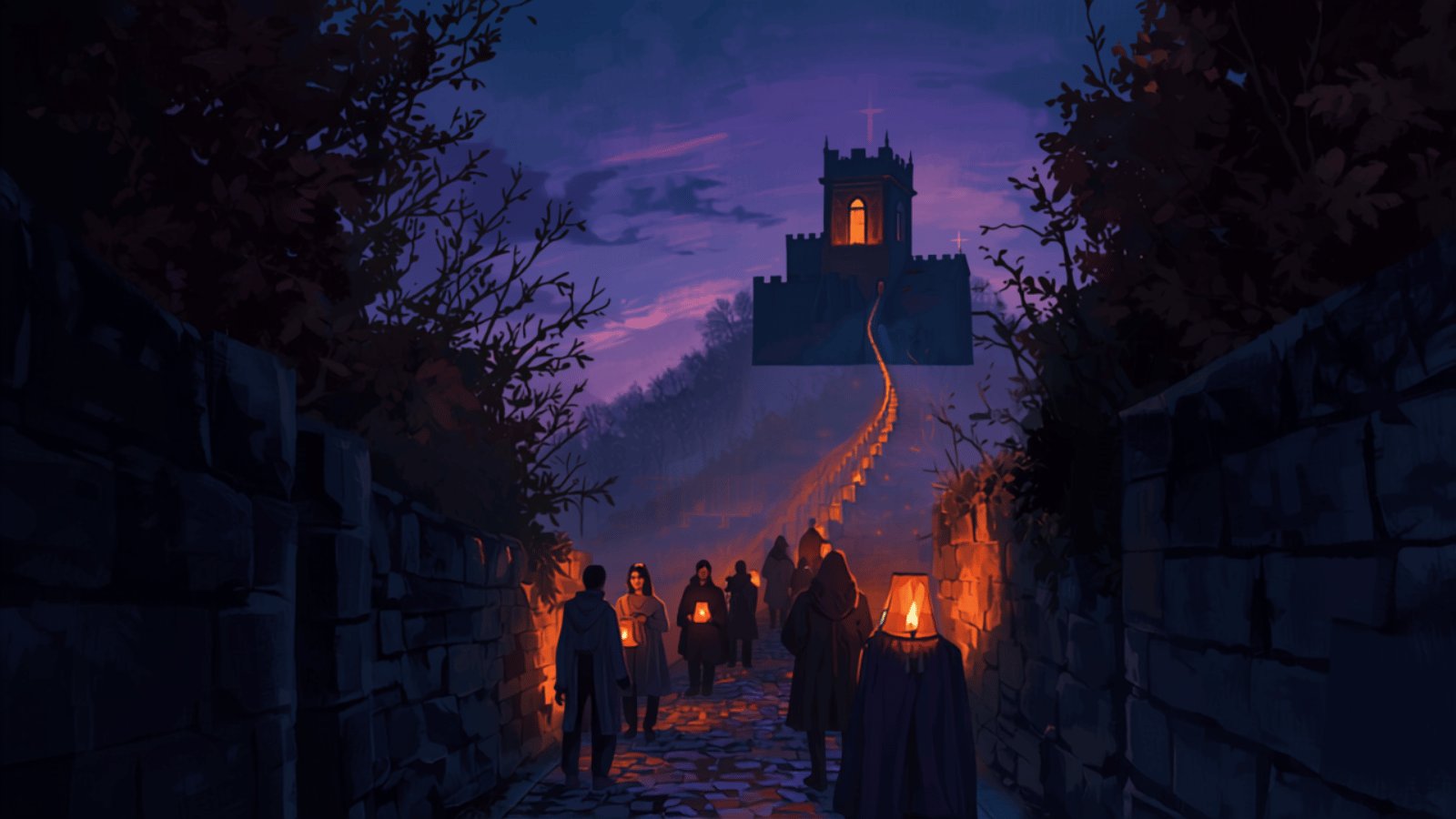
At dusk she stood at the edge of the procession and watched. Hundreds of people moved up the hill in the half-dark, each carrying a paper bell on a stick, each bell lit from inside by a tiny bulb. The paper bells trembled in the wind. They were ephemeral things — made in an afternoon, rained on, torn, thrown away the next morning — and yet, seen together, drifting up the hill in their hundreds, they made the most durable impression Nadia had ever received from any festival anywhere. At the top, beneath the tower, the crowd simply stood. Ten minutes, perhaps fifteen. A baby cried somewhere and nobody minded. Then, without any signal she could detect, the crowd turned and came down again, and the pubs opened their doors, and the town roared back into speech like a radio switched on mid-song.
“First time?” asked a man beside her, grinning. “You get used to the goosebumps. Or so they tell me. Fifty-one festivals, and I never have.”
2 · The custodian
The museum occupied two rooms above the old corn exchange, and its entire staff consisted of one man: Arthur Herron, custodian of the Alderwick collection for thirty-eight years. He was tall, stooped, and precise, with the air of a man who had spent his life apologising for taking up space. Had the town council given him a proper budget at any point in the last four decades, Nadia suspected, the collection would have been famous. Instead it was immaculate and unknown.
The collection he guarded was, Nadia saw at once, far better than the town deserved. Two rooms held a century and a half of Alderwick’s memory: photographs of the procession going back to the 1890s, paper bells preserved flat between sheets of glass like pressed flowers, the foundry’s account books, festival programmes, a drawer of mourning brooches. Everything was labelled in Herron’s small, upright hand; everything had a number; nothing had ever been properly published, because publishing costs money and the council had none. It occurred to Nadia — not for the last time — that the real custodian of a tradition is rarely the person giving speeches about it. It is usually somebody in a cold room upstairs, writing labels.
“You’ll want the official history first,” he said, laying a slim green book on the desk between them. “Everyone does. Fenwick’s version.”
The official history went like this. In 1875, an explosion at the Alderwick iron foundry killed nineteen men in a single morning. The town’s mayor, Josiah Fenwick — wealthy, energetic, and by every account fond of being seen to do good — commissioned a memorial bell from the same foundry, cast partly from metal recovered after the disaster. But when the bell was raised into the tower, Fenwick made an announcement that surprised everyone. The bell would not ring. It would hang in silence, he declared, “until the day this town has no one left who remembers” — at which point, presumably, it would ring at last. Since no town ever admits to having forgotten, the bell had stayed silent ever since, and the silence itself had become the memorial. It was a beautiful story. Nadia had believed every word of it until roughly eleven o’clock the following morning.
“The provenance of the bell is all documented?” she asked. “Foundry records, payment, installation?”
Herron hesitated — a small hesitation, no longer than a breath, but Nadia had interviewed enough retired schoolteachers and reluctant farmers to know what such pauses meant. “The provenance,” he said carefully, “is more complicated than the guidebook suggests. I’ll bring you the ledgers.”
3 · What the ledger said
The foundry ledgers filled a shelf: tall, leather-bound volumes smelling of dust and iron, every page ruled and inked in a clerk’s meticulous hand. Whoever he was, that clerk had recorded everything — wages, coal, copper, tin, funeral collections — with a care that bordered on devotion. Nadia, who had spent half her career squinting at careless records, could have kissed him.
It took her most of the morning to find the bell. When she did, she read the entry three times, then sat back and looked out of the window for a long while.
The bell had been paid for in 1876, in fourteen instalments. Not one of those instalments had come from Josiah Fenwick. The money had been raised by subscription — dozens of small payments, sixpence here, two shillings there — and the subscribers were listed by name, column after column of them. At the head of the list, recorded as the organiser of the fund and the person to whom the finished bell was formally released, was a name Nadia had never seen in any guidebook, on any plaque, in any of the seventeen newspaper articles she had read about the Festival of the Quiet Bell.
Eliza Marsh, widow, of Foundry Row.
Below the entry, in the same meticulous hand, the clerk had added a note that made the back of Nadia’s neck prickle: “Bell cast and finished complete, save the clapper, which Mrs Marsh has directed shall not be hung. Delivered without it, at her instruction, and the clapper released to her keeping.”
The bell was not silent because a mayor had made a poetic speech. The bell was silent because it had no clapper — because a widow from Foundry Row had ordered it built that way, and had taken the clapper home with her. Whatever Fenwick had announced from his platform, he had been describing a decision somebody else had already made.
Before saying anything to Herron, she spent two days testing the discovery against every other source she could find, because a single ledger entry, however meticulous, can mislead. It did not mislead. The local newspaper for November 1876 reported the bell’s arrival “by public subscription” — a phrase that had quietly disappeared from every later retelling. The tower’s own maintenance records, checked at five-yearly intervals for a century and a half, listed ropes, beams, and bronze, and never once a clapper, because there had never once been a clapper to list. Fenwick’s famous speech, when she finally located the original text, was three weeks younger than the first silent procession. The official story did not merely contain errors. It was constructed, plank by plank, over something quieter and truer.
“You knew,” Nadia said, when Herron brought her a cup of tea she had not asked for and clearly needed.
“I suspected. My predecessor suspected. Neither of us ever found the rest of the story, and a suspicion, as you know, is not an exhibit. There are letters, supposedly — Marsh family letters. I wrote to the last descendant I could trace, twenty years ago, and never had a reply.” He straightened a pile of papers that did not need straightening. “You have six months and an archive’s letterhead behind you, Miss Rahim. You may have better luck.”
4 · The letters
Luck, in the end, looked like this: a retired pharmacist in Nova Scotia named Joan Marsh-Reilly, great-great-granddaughter of Eliza Marsh, who answered Nadia’s email within a day and her follow-up video call within a week. Yes, there were letters. Her grandmother had kept them in a biscuit tin; Joan had kept the tin. Nobody in the family had ever quite known what to do with them, beyond knowing that throwing them away was unthinkable. Scanned copies arrived that Sunday, forty-one pages in a sloping Victorian hand.
Nadia read them in one sitting, the rain loud on the museum windows, and later she would say — to conference audiences, to journalists, once to a documentary camera — that it was the single most poignant afternoon of her working life.
Eliza Marsh had lost her husband Thomas in the foundry explosion. He had been the works clerk — and here Nadia stopped and looked again at the ledgers, at that meticulous, devoted hand, and understood that she had been admiring the handwriting of a dead man for a week. The letters were written to Eliza’s sister in Leeds over the two years that followed the disaster, and they recorded, step by patient step, the building of the memorial.
It was Eliza who had gone door to door among the widows collecting sixpences. Eliza who had bargained with the foundry manager for the recovered metal. Eliza who had insisted, against the vicar, against the newspaper, and eventually against the mayor, that the bell must never ring. Her reasoning survived in a passage Nadia would come to know by heart:
“They wish it to toll for the men each year, as bells toll for the dead everywhere, and I have told them no. A bell that tolls is finished with its grief — it rings, the sound dies away, and everyone goes home to supper. Our bell shall hold its sound the way we hold ours. Let them stand under it and listen to nothing, and in that nothing hear the men. The clapper I shall keep, so that no mayor in fifty years’ time may grow tired of the silence and undo it.”
The letters held small details that no memorial ever records. Thomas Marsh had been due to retire the following spring; the couple had planned to move inland, away from the smoke, to a village with apple trees. One widow, Sarah Pennock, had contributed her sixpence in farthings over four weeks because she could not spare it all at once, and Eliza had walked to her door each Friday rather than let her feel her contribution was smaller than anyone else’s. The foundry manager, expected to resist the whole project, had instead melted the recovered metal himself, at night, unpaid, and wept — according to Eliza, who noted it without comment — “as the pour began, which no man there pretended not to see.” It was these small, poignant details, more than any argument, that settled the question of what the archive was for. History with the small names removed, Nadia thought, is just publicity that has outlived its author.
And the first procession — the silent walk up the hill with lights, the standing beneath the bell, the whole grammar of the festival that Alderwick still performed a century and a half later — had been the widows’ own invention, held on the first anniversary of the explosion, three weeks before Fenwick made his famous speech. Fenwick had not created the tradition. He had attended it, seen which way the town’s heart was already moving, and stepped in front of the procession, as it were, just in time to be remembered as its leader. The letters were not even bitter about it. “The mayor has given our silence a fine speech,” Eliza wrote drily, “and men who make fine speeches are always believed. No matter. The bell knows whose it is.”
5 · The question of truth
What Nadia had, she realised, was a small bomb. Not a scandal exactly — Fenwick had stolen credit, not money — but a correction that would rewrite the festival’s entire origin story. And corrections of that kind, as any archivist learns early, are not automatically welcome. People do not merely tell their traditions; they live inside them, the way they live inside their houses. You cannot re-lay the foundations without shaking the rooms above.
“Suppose we publish,” said Herron. They were sitting in the museum after closing, the scanned letters spread between them. “Some people will be delighted. Others will feel the festival has been taken from them — that they’ve spent their lives honouring a lie. Had you brought me this thirty years ago, I’d have locked it in a drawer, and I want you to understand that I would have been wrong to. But I’d have done it.”
“And now?”
“Now I think a town is strong enough to be told the truth about itself. Besides —” he permitted himself a small, dry smile — “the truth is better than the story. That’s rarer than you’d think.”
The town, when it was finally told, behaved better than either of them had predicted — though not before one genuinely difficult evening. The parish council called a public meeting in the school hall, and the school hall filled. A retired teacher stood up to say, with visible emotion, that her grandfather had been named after Josiah Fenwick and she did not intend to apologise for it. A descendant of one of the nineteen replied, from three rows back, that nobody was asking her to — only to make room on the plaque. A man from the guesthouse association worried aloud about “what the papers will do with this”, and was answered, unexpectedly, by the town’s youngest councillor: if the papers wanted to write that Alderwick’s festival had been founded by working women rather than by a rich man’s speech, she said, the town should charge them for the privilege. There was laughter, then a silence of the practised, Alderwick kind — and somewhere inside it, Nadia felt the decision settle before any vote was taken.
He was right, and Nadia knew it. The apocryphal version gave Alderwick a generous mayor and a poetic speech. The true version gave it something far better: a community of working women who had built a monument with sixpences, invented a ritual out of their own grief, and defended its silence so fiercely that they removed the very possibility of undoing it. The festival did not lose its meaning under the correction; it gained a hundred and forty subscribers’ worth. Nevertheless, they proceeded carefully. Nadia wrote the paper; Joan Marsh-Reilly approved every quotation; the parish council read it before the press did. The museum — closing in the spring, unknown for four decades — mounted one final exhibition, and Herron, who had apologised for taking up space all his life, gave the opening speech to a room so full that people stood on the stairs.
6 · The hundred and fifty-first festival
On the last Thursday of the following October, Nadia stood once more at the edge of the procession. Outwardly, almost nothing had changed, and that was the point: the town had voted, with surprising unanimity, that the festival itself should stay exactly as it was. The silence was not Fenwick’s to give, the parish council chairwoman had said, and it is not ours to take away. But at the foot of the tower there was a new bronze plaque, and the name on it was not Josiah Fenwick’s, and all evening Nadia watched people stop in front of it, read it, and grow briefly, thoughtfully still. Schoolchildren now learned the story of Eliza Marsh and the sixpence subscriptions; the paper bells, ephemeral as ever, carried the names of the nineteen men written in the children’s handwriting; and if the tourists’ guidebooks needed a year or two to catch up, well, guidebooks always did.
She had wondered, privately, whether knowing the truth would thin the festival’s spell — whether a mystery explained becomes merely a fact, filed and finished. Standing under the tower that night, she had her answer. If anything, the silence had deepened. Before, the crowd had stood beneath a story about remembering; now it stood beneath the thing itself, the actual sixpences and the actual grief, and the difference was not loud but it was unmistakable, like the difference between a photograph of a fire and the warmth of one. A bell that could not ring, she thought, had somehow managed to toll every year for a century and a half — not in sound, but in the held breath of a whole town. Eliza Marsh had understood something that memorial committees rarely do: that what is withheld can outlast what is given.
Herron retired the day the museum closed. The collection, saved from dispersal by eight months of noisy publicity, went to the county archive with Nadia’s name on the transfer papers as consulting custodian — a title she suspected he had invented for her, and which she intended to keep for life.
One item, however, reached her by a different route. In November, a parcel arrived from Nova Scotia, heavy for its size, wrapped in brown paper and a great deal of tape. Inside, in a nest of wool, lay a piece of dark Victorian bronze about the length of her forearm — unmistakably, impossibly, a bell’s clapper — and a note in Joan’s round handwriting:
“Grandmother always said it must go to whoever looked after the bell’s story, when someone finally did. That appears to be you. Eliza left instructions with it — one condition under which the bell may ring at last. I’ve copied her words onto the card inside. Read them somewhere quiet.”
Nadia sat with the parcel on her knees for a long time. The card was still in its envelope, and the envelope was still sealed. Somewhere quiet, she thought. She knew a hill for that.
Check your understanding
Answer each question in your head — in full sentences, ideally — then click “Show answer” to compare.
Words to remember
The ten key words again, in fresh contexts. Try producing one sentence of your own for each before reading the examples.
- custodian — After the librarian retired, she remained the unofficial custodian of the town’s oral history.
- foundry — The cathedral’s new bells were cast at a foundry that has operated since the seventeenth century.
- ledger — Every transaction, however small, was entered in the ledger in fading brown ink.
- provenance — The auction house refused to sell the painting until its provenance could be established beyond doubt.
- apocryphal — The tale of the composer writing the symphony in a single night is almost certainly apocryphal.
- toll — Across the valley you could hear the church bell toll for the old shepherd’s funeral.
- clapper — With the clapper removed for repairs, the great bell hung uselessly mute all summer.
- meticulous — Her notes were so meticulous that the experiment could be repeated forty years later.
- poignant — The most poignant exhibit was a child’s shoe, catalogued but never claimed.
- ephemeral — Sand sculptures are deliberately ephemeral: the tide is part of the art.
Grammar in this story: participle clauses
This story leans heavily on participle clauses — shortened clauses built on an -ing or -ed form that let a writer pack two ideas into one elegant sentence. Look at these examples from the story:
Having spent three weeks preparing for this assignment, she could recite the official version in her sleep. · Stepping off the train, she was struck first by the quiet. · The collection, saved from dispersal by eight months of noisy publicity, went to the county archive.
Notice the three types: the perfect participle (having spent) for an action completed before the main verb, the present participle (stepping) for a simultaneous action, and the past participle (saved) with a passive meaning. The unspoken subject of the participle must match the subject of the main clause — get that wrong and you produce the infamous “dangling participle”.
👉 Master the full pattern here: Participle Clauses in English: Shorten Sentences Like a Native Writer.
Talk about it · Write about it
Talk about it: Every culture has traditions whose “official” origin story may be partly invented. Think of a festival or custom from your own country. Who gets the credit for it — and who might history have overlooked? Is an apocryphal origin story harmless, or does it matter who we remember?
Write about it: Write 200–250 words arguing for or against this statement: “When historians discover that a beloved tradition is based on a false story, they have a duty to publish the truth, whatever the cost to the community.” Use at least three participle clauses and three of the key words from this story.
🎉 That was a full-length C1 graded reader — roughly 3,300 words of controlled advanced English, and you finished it. Better still, you’ve now met words like provenance, apocryphal, and poignant in context, which is precisely how they stick.
But the envelope in Nadia’s hands is still sealed. Under what single condition did Eliza Marsh say the bell may finally ring — and will Nadia ever open the card on that quiet hill? Some silences, it seems, still have one more thing to say…
Choose Your Next Story
This is the last story in the traditions and imagined worlds group. Choose another C1 story from the reading collection when you are ready.
Other Story in This Group: The Ferryman of Willowmere (C1 Reading Story)
About this story: This is an original C1 graded reader (~3,300 words) written for englishteachersite.com. Vocabulary is controlled to an advanced (C1) headword level, with the full range of English grammar — participle clauses, inversion, and nuanced discourse markers — used naturally. The ten harder words essential to the plot are glossed before the story and deliberately reused inside it, following the graded-reader principle that you should recognise about 98% of the running words.

I’m Khamis Maiouf. I’m studying Health and Social Care and have completed Functional Skills Level 2 in English and Level 3 Hairdressing. I have taught ESOL in my community and helped students with GCSE English. I run English Teacher Site to help people learn and practise English.