
What the City Leaves Behind (C1 Reading Story)

C1 · ADVANCED Reading practice · ~3,300 words · 16-min read
This is an original story for advanced learners. The language is rich but controlled: before you begin, read the ten key words below, because each one appears more than once in the story. At the end there are comprehension questions, a grammar focus, and prompts for speaking and writing.
Before you read — 10 key words
- ledger — a large book in which official records are kept, entry by entry.
- mundane — ordinary and unexciting; part of everyday routine.
- derelict — (of a building) abandoned and falling into ruin.
- provenance — the origin of an object, and the record of who has owned it.
- meticulous — extremely careful and precise about small details.
- reticent — unwilling to reveal one’s thoughts or feelings; reserved.
- encroach (on) — to advance gradually into a place or space that belongs to something else.
- poignant — causing a sharp, bittersweet feeling of sadness or regret.
- vantage point — a position from which you can see something clearly.
- transient — lasting only a short time; passing quickly.
The story
1 · Nine million journeys
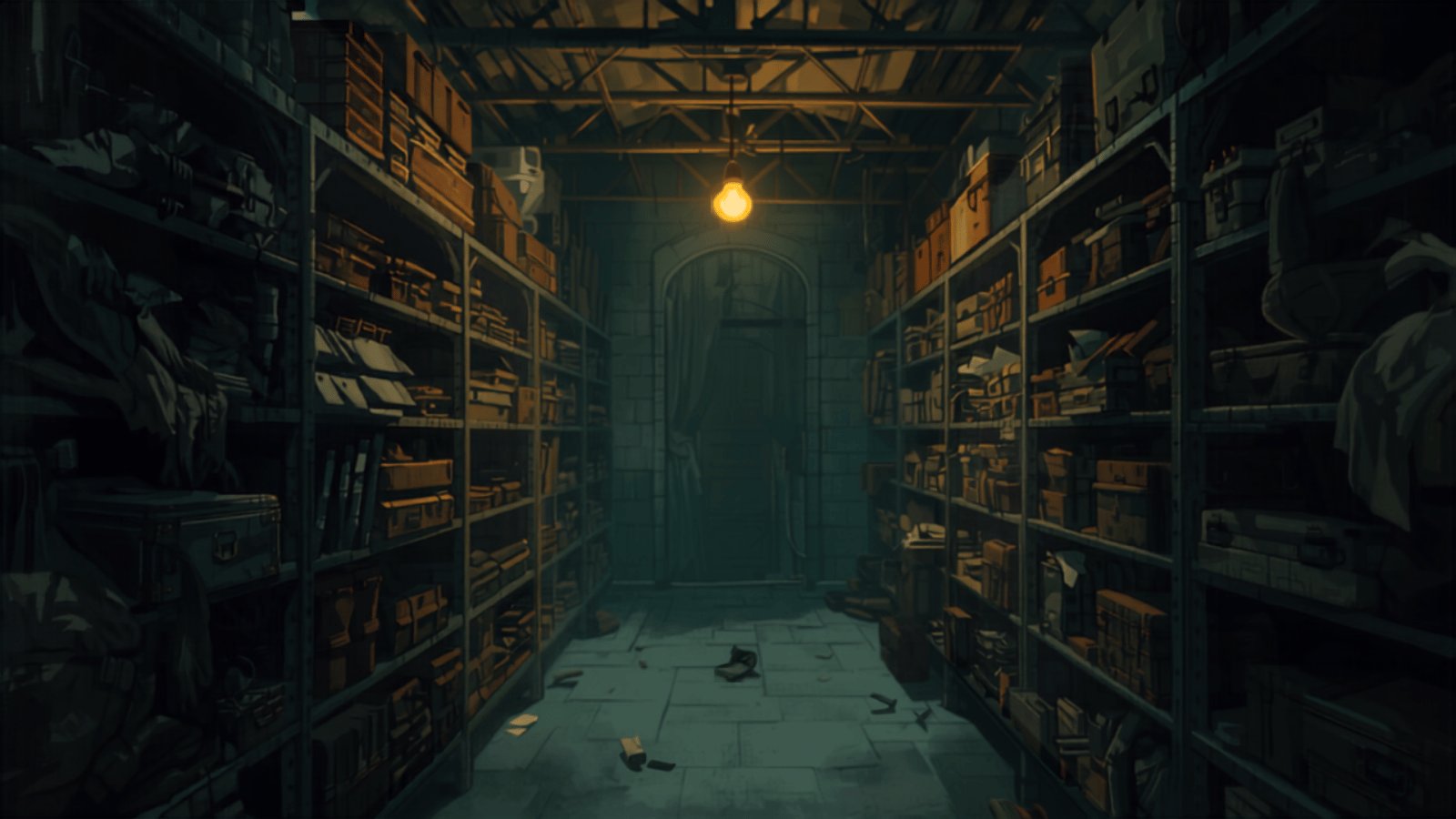
Every city keeps a secret museum of the things its people lose. In this city, the museum occupies a basement beneath Harcourt Street station, behind a grey door marked LOST PROPERTY, and for the past eleven years its unofficial curator has been a woman named Nadia Kassem.
Nine million journeys are made across the transport network every week, and each journey sheds a small residue of forgetfulness. Umbrellas, naturally — some four hundred a month, blooming in the racks like black flowers after every rainstorm. Phones, gloves, keys, and headphones by the boxful. But also stranger cargo: a tuba in a battered case, a wedding dress still wrapped in tissue paper, a jar of home-made lime pickle with a label in careful handwriting, a single ice skate, and, on one memorable Tuesday, a full-sized ship’s wheel that nobody ever came to claim.
Nadia recorded every item in the ledger. There was a computer system, of course — there had been three different computer systems in her time, each promising to make the last one obsolete — but the ledger came first, and the ledger was hers. Item number, date, line, description, distinguishing marks. She wrote in small, upright letters, and she took a quiet pride in finding the exact words for each object. Not just “umbrella” but “umbrella, wooden crook handle, initials T.O. scratched near ferrule”. If an object had a story, the least she could do was record its opening line.
Most of her colleagues considered the work mundane, and on the surface they were right. The routine rarely varied: sacks arrived from the depots each morning, items were logged, shelved, and tagged, and claimants appeared at the counter with that particular expression — half hope, half embarrassment — that Nadia had come to know so well. After three months, unclaimed items were sent to auction or to charity. The shelves emptied and refilled like a tide.
Yet Nadia had never once been bored. What her colleagues saw as mundane, she saw as intimate. People did not lose things at random; they lost things when their lives were too full to hold everything at once. New parents lost gloves. New lovers lost keys. The recently bereaved lost, again and again, the small necessary objects of daily life, as though grief demanded its own luggage allowance. The lost property office was not really an office at all. It was a seismograph, and it registered every private earthquake in the city.
The counter taught her things no university could have. She learned that people lie about umbrellas but almost never about photographs. She learned that the question “Can you describe the item?” is a small, accidental cruelty when the item is an urn. She learned that a man who has lost his wedding ring will describe his own hand before he describes the ring, holding it out over the counter as though the absence itself were on file somewhere, logged in some larger ledger she did not have access to.
She lived alone, in a rented flat above a shuttered piano shop, and if you had asked her whether she was happy she would have paused a moment too long before saying yes. The city she had grown up in was disappearing around her, block by block, and she felt the disappearances the way you feel a missing tooth. But she kept such thoughts to herself. At work she was brisk, kind, and unfailingly precise, and nobody guessed that the keeper of the city’s lost things had lost a few of her own.
2 · Item 4,471
The notebook arrived on a Thursday, in a sack from the Eastbourne Road depot, wedged between a yoga mat and a child’s raincoat. It was the sort of object Nadia might have logged in ten seconds: “Notebook, brown leather, elastic band, well used.” Instead, she opened it — checking for a name was standard procedure — and then she did not move for a quarter of an hour.
The notebook was full of drawings. Not casual sketches, but meticulous pen-and-ink studies of buildings, each one labelled in a slanting, old-fashioned hand. The draughtsmanship was extraordinary. Every course of brickwork was counted, every window glazed with a few economical strokes, every shadow laid down in patient cross-hatching. Whoever had made these drawings had not merely looked at these buildings. They had paid attention to them, the way you pay attention to a face you love.
And the buildings themselves — that was the strange part. There was no gallery of famous landmarks here, no cathedral, no bridges at sunset. The subjects were resolutely unglamorous: a boarded-up swimming baths on Corporation Street. A derelict cinema, the Regal, its canopy sagging, its letters missing like teeth. A tripe shop. A Victorian bathhouse. A row of railway cottages with washing strung between them. Beneath each drawing, the same slanting hand had written a date — and, in several cases, a second date followed by a single word: demolished.
Nadia turned the pages slowly. The dates spanned nearly forty years. The earliest drawings had browned at the edges; the most recent, near the back, could only have been weeks old. There was no name inside the front cover, no address, no telephone number. The notebook’s provenance was a perfect blank — and provenance, as Nadia liked to tell the trainees, was the whole business of lost property. An object without an owner is only half an object.
She logged it as item 4,471 and gave it a shelf near her desk, which was against her own rules. All day it pulled at her attention while she processed the mundane traffic of the counter: a man reunited with his laptop, a tearful teenager with her grandmother’s ring, three separate claimants for the same black umbrella, none of them convincing. At six o’clock, when the office closed, Nadia did something she had never done in eleven years. She took a lost item home.
Rarely did she break a rule, and never this one; the ledger was her conscience, and the ledger now contained a small lie of omission. She told herself it was research. She made a pot of tea, sat by the window above the silent piano shop, and read the notebook the way other people read novels — from the beginning, hungrily, losing track of time.
3 · The disappearing city
Over the following week, Nadia became an investigator. Each evening she chose a handful of drawings and searched for their subjects online: planning records, local history forums, digitised newspaper archives. The pattern that emerged was poignant in a way she had not anticipated. Of the ninety-one buildings in the notebook, sixty-eight no longer existed.
The swimming baths had come down in 1998 to make way for a car park. The Regal cinema, derelict for a decade, had finally been demolished for a block of luxury flats whose developer had named it, with breathtaking shamelessness, Regal House. The bathhouse was a gym. The railway cottages were a slip road. One by one, the glass towers of the new financial district had encroached on the old streets, the way a rising tide encroaches on a sandcastle — not maliciously, not even deliberately, but with a patient, total indifference.
The artist, whoever they were, had understood this long before the newspapers had. The drawings were not nostalgic postcards; they were testimony. Some pages carried small marginal notes — “caretaker says March”, “hoardings up”, “crane arrived today” — the field notes of someone racing an invisible clock. Whoever it was had spent forty years arriving at buildings just before the end, the way some people sit with the dying so that they will not be alone.
She began, almost without deciding to, walking home by different routes, matching the notebook’s pages against the streets that remained. Here, where the drawing showed the swimming baths, the car park’s third level now caught the evening light. There, where a music hall had once presented what its drawn poster called “twice-nightly wonders”, a sandwich franchise glowed. What was mundane on paper became strange on foot. It was one thing to know, abstractly, that a city rewrites itself; it was quite another to stand on a corner holding forty years of evidence and be unable to find a single brick of the original text.
It was on the ninth evening that Nadia turned a page and felt the floor tilt.
The drawing showed a short terrace of shops with flats above, a laundrette on the corner, a fig tree — improbable but real — growing from a crack beside the laundrette’s downpipe. The label read Verity Street, north side. The date was from twenty-six years ago. Nadia did not need the label. She had grown up in the flat above the laundrette. She had eaten figs from that impossible tree. Her mother had worked twelve-hour days amid the hot fog of the washing machines, and on winter evenings Nadia had done her homework on a folding chair between the dryers, warmed by other people’s laundry.
Verity Street had been demolished the year she turned nineteen. The compensation had been modest, the move to the estate had been hard, and her mother — Nadia was careful with this thought, she handled it like glass, even now — her mother had never really settled anywhere again. There were no photographs of the laundrette. The family had owned a camera, but you do not photograph the mundane; you assume it will always be there. Not once in twenty-six years had Nadia seen an image of her childhood home. And here it was, drawn with such meticulous tenderness that she could read the poster taped inside the laundrette window: a notice for a church jumble sale, in her mother’s own handwriting.
Nadia sat very still for a long time. Then she took out her own notebook and wrote, in her small upright letters: Find the artist.
4 · The stationer’s shop
She had two clues, both slender. The first was the paper itself: heavy, cream, faintly ridged, with a maker’s watermark she found by holding a page to the light — Alderman & Sons. The second was the sack the notebook had arrived in, which came from the Eastbourne Road depot, which served the number 43 route through the northern districts.
Alderman & Sons turned out to be one of the survivors: a narrow stationer’s shop on Milldam Lane that had somehow evaded every wave of redevelopment, its window a museum of fountain pens and sealing wax. Little did Nadia suspect, pushing open the door on her Saturday off, that she was about to have the strangest conversation of her adult life.
The proprietor was a small, silver-haired woman with the wary poise of a heron. Nadia introduced herself, produced photographs of two drawings on her phone — she had left the notebook itself locked in the office, restored to its shelf, its provenance still officially blank — and asked whether the shop sold notebooks of this kind, and whether she might know the customer who bought them.
The proprietor looked at the photographs for a long moment. Something moved behind her eyes; Nadia, who watched faces across a counter for a living, saw it clearly. But the woman was reticent to the point of silence. She confirmed the paper was theirs. She confirmed such notebooks had been bought “by a regular, over many years”. Beyond that she would not go. “If my customer wanted to be found,” she said, not unkindly, “he would put his name inside the cover, don’t you think?”
“He’s lost it,” Nadia said. “Forty years of work. He must be sick about it.” She heard her own voice climb, and steadied it. “I don’t want anything from him. I just want to give it back. And—” She had not planned to say the next part. “One of the drawings is my mother’s laundrette. Verity Street. There’s a jumble-sale notice in the window and it’s her handwriting. It’s the only picture of it in the world.”
The reticent heron studied her. Somewhere in the shop a clock ticked with an old, dry sound. “Tuesday mornings,” the woman said at last, as if against her better judgement. “The café at the top of the Observatory Gardens. He likes the view. If you go, take the notebook, and be gentle with him. He’s had a hard year, and he doesn’t know yet that he’s famous in a basement.”
5 · The vantage point
The Observatory Gardens climbed the city’s only real hill, and the café at the top was a plain glass pavilion that nobody ever photographed, though it offered the finest vantage point in twenty miles. On Tuesday morning the terrace held a dozen pensioners, two dog-walkers, and, at the railing furthest from the door, a tall old man in a fawn overcoat, drawing.
Nadia knew him by the way he looked at the city: not scanning it as sightseers do, but reading it, street by street, like a proofreader who knows an error has crept in somewhere. He was working in a cheap spiral-bound pad, and even from three metres away she could see that the cheap paper offended him.
“Mr—” she began, and realised she had no name to put after it. So she simply held out the notebook.
What happened to his face then was worth the whole eleven years in the basement. Never had she returned an object — not the wedding dress, not the grandmother’s ring — and seen anything quite like it. He took the notebook with both hands, the way you accept something living, and for a moment he could not speak at all.
His name was Elias Wren. He had been a surveyor’s draughtsman for the city corporation, forty years of measured drawings and demolition schedules, and the notebook — the notebooks; there were eleven more at home, he said — had begun as a private act of rebellion. “I was the man who drew the plans that pulled things down,” he said. “It seemed only decent that somebody should also draw what was being lost. The corporation kept meticulous records of everything except what mattered.”
They talked for two hours at that windy vantage point, the city spread below them like an unmade bed. He had left the notebook on the 43 bus the day he came back from his cardiologist, distracted by news he mentioned only briefly and would not enlarge upon; a reticent man, she understood, does not become talkative just because you have done him a kindness. He spoke instead about buildings. About how a city is transient by nature and always has been — “the Romans would find our sentimentality hilarious” — but that transience is no excuse for amnesia. “Everything goes,” he said. “That’s the deal. The crime isn’t that it goes. The crime is that it goes unrecorded, as if it had never held anybody’s life.”
Then Nadia told him about Verity Street, about the laundrette and the fig tree and her mother’s jumble-sale notice, and Elias Wren listened with his eyes closed, nodding slightly, like a man hearing a piece of music he had written long ago and assumed had never been performed.
“I remember the fig tree,” he said at last. “Nobody could explain it. Wrong climate, wrong soil, no business surviving there at all.” He opened his eyes. “It’s the survivors that break your heart, in the end. Not the losses. The losses you can grieve. The survivors just stand there, encroached on from every side, waiting their turn.”
He razored the Verity Street page out of the notebook with a penknife, there and then, and gave it to her. She protested; he overruled her. “A drawing of a laundrette is worth most,” he said, “to the person who did her homework between the dryers.” It was the most poignant gift anyone had ever given her, and she carried it home flat inside a hardback atlas, terrified of the rain.
6 · The last page
They fell into a habit, after that, as the solitary sometimes do: Tuesday mornings at the pavilion café, tea for her, black coffee he was not supposed to have for him. Nadia brought stories from the lost property office; Elias brought the city’s obituaries in pen and ink. She got the Verity Street drawing framed, and when she hung it above her table, the flat above the piano shop felt, for the first time in years, like somewhere she lived rather than somewhere she stayed.
At work, meanwhile, something in her had shifted. The trainees noticed she had started reading the shelves differently, pausing over items she would once have processed without a thought. “Everything here is a building somebody lived in,” she told one baffled nineteen-year-old, holding up a scratched cigarette case, and then had to laugh at herself, because eleven years in a basement will eventually turn anyone into a philosopher. Still, she was not wrong, and she knew it. The ledger was her own notebook of the transient city; she had simply been keeping it in objects instead of ink.
Her mother came to visit and stood in front of the frame without speaking. Then she touched the drawn window, where the jumble-sale notice was, and said, “I made those posters on the kitchen table. Your father said my Rs looked like they were falling over.” She laughed, and the laugh went wrong halfway, and mother and daughter stood together in the poignant, particular silence of people looking at a door that no longer exists anywhere but on paper.
On the last Tuesday of the month, Elias seemed lighter, almost mischievous. Only when Nadia had finished her tea did he slide the brown notebook across the table. “I want you to see the last page,” he said. “You returned it without reading to the end, I think. A ledger-keeper’s discipline. Seldom have I been so impressed with anyone’s restraint.”
She had not, it was true, looked at the final pages; somewhere around Verity Street, the notebook had stopped being an item and become a wound, and one does not browse in a wound. She opened it now. After the last of the dated drawings — a shuttered pie shop, hoardings up — there was a single study unlike all the others. Every other page in the notebook recorded something transient on its way out of the world. This drawing showed a building she did not recognise at all: modest, two storeys, wide welcoming windows, the fig tree — unmistakably that fig tree — standing beside its door. It had no date and no demolished. Beneath it, in the slanting hand, was written a single line: Verity Street, north side, as it could be again.
“There’s a consultation,” Elias said, watching her face from his vantage point across the table. “The car park comes down in the spring — even car parks are transient, it turns out, and nobody draws them. The site’s to be rebuilt, and the council, in a fit of imagination nobody predicted, is asking residents what should stand there. Old residents included.” He tapped the drawing. “I can propose a scheme. I’ve spent forty years learning exactly what this city throws away. But I’m one old draughtsman with a bad heart, and the developers will come to that meeting with lawyers and light shows.”
He closed the notebook and pushed it, gently, all the way across the table to her side.
“So. You spend your days returning lost things to the people who loved them,” he said. “I wonder, Miss Kassem — how would you feel about returning a street?”
Check your understanding
Read each question. Think about your answer. Then click “Show answer” to check.
Words to remember
Here are the ten key words again, in new sentences. Try to write one sentence of your own for each.
- ledger — Every payment was entered by hand in a leather-bound ledger.
- mundane — Great novels often find drama in the most mundane routines.
- derelict — The derelict factory has stood empty since the nineties.
- provenance — The auction house refused to sell the painting without proof of its provenance.
- meticulous — She kept meticulous notes on every experiment.
- reticent — He was famously reticent about his years abroad.
- encroach (on) — New housing continues to encroach on the green belt.
- poignant — The empty chair at the table was a poignant reminder of his absence.
- vantage point — From this vantage point you can see the whole harbour.
- transient — Fame, he discovered, is a transient thing.
Grammar in this story: inversion after negative adverbials
At C1, writers use inversion for emphasis: a negative or limiting adverbial moves to the front of the sentence, and the subject and auxiliary verb swap places, exactly as in a question. This story does it several times. Look:
Not once in twenty-six years had Nadia seen an image of her childhood home.
Rarely did she break a rule, and never this one.
Little did Nadia suspect that she was about to have the strangest conversation of her adult life.
Never had she returned an object and seen anything quite like it.
Seldom have I been so impressed with anyone’s restraint.
Compare the neutral order: She rarely broke a rule → Rarely did she break a rule. The inversion adds a formal, dramatic emphasis that suits storytelling.
👉 Learn the full rule here: Inversion in English: Never, Rarely, Seldom (and Why You Flip the Verb).
Talk about it · Write about it
Talk about it: Elias says the crime is not that cities change, but that change “goes unrecorded”. Do you agree? Is there a building or place from your own past that has disappeared? Who, if anyone, should decide what a city keeps and what it loses?
Write about it: Write 200–250 words describing a place from your childhood that no longer exists (or has completely changed), for a reader who will never see it. Try to use at least four of the key words, and include one sentence with inversion after a negative adverbial (Never had I…, Not once did we…).
🎉 Well done — that was a full-length C1 story, and you just read it in English. Notice how much of the advanced vocabulary you now recognise in context.
But the consultation is still months away. Will Nadia say yes? Can one draughtsman and one ledger-keeper really out-argue the developers and bring Verity Street back? That fight is a story of its own…
Next story: Read another advanced C1 story →
About this story: This is an original C1 graded reader (~3,300 words), written using the graded-reader method: vocabulary is controlled to an advanced learner’s range, and the full spread of English grammar — inversion, participle clauses, cleft sentences, discourse markers — appears naturally in context. The ten hardest words are glossed before the story and each is reused at least twice inside it, so you meet them, then meet them again.

I’m Khamis Maiouf. I’m studying Health and Social Care and have completed Functional Skills Level 2 in English and Level 3 Hairdressing. I have taught ESOL in my community and helped students with GCSE English. I run English Teacher Site to help people learn and practise English.