
The Last Tram (B2 Reading Story)

B2 · UPPER-INTERMEDIATE Reading practice · ~3,200 words · 21-min read
This is an original short story for upper-intermediate learners. It is a city story about an old tram line, a young planner with a difficult assignment, and a set of numbers that do not add up. Read the eight key words first. Then read the story slowly. There is a short comprehension quiz at the end.
Before you read — 8 key words
- ridership — the number of people who use a bus, train, or tram service. “Ridership fell” = fewer people were travelling.
- decommission — to officially take something out of service and close it down, especially a machine, a ship, or a transport line.
- depot — the large building or yard where buses or trams are kept at night and repaired.
- terminus — the very last stop at the end of a bus, train, or tram line, where the vehicle turns around.
- viaduct — a long, high bridge that carries a road or railway across a valley, a river, or other streets.
- petition — a written request, signed by many people, asking someone in power to do or change something.
- clipboard — a flat board with a metal clip at the top that holds paper, used for writing notes while standing up.
- rattle — to shake and make a series of short, sharp knocking sounds. Old windows and old machines often rattle.
The story
1 · A folder on a Monday morning
The memo was waiting on Dina’s desk when she arrived at eight thirty, placed exactly in the centre, the way her manager placed things when she wanted them noticed. Dina hung up her coat, sat down, and read it twice.
Re: Tram Line 6. The line is to be decommissioned at the end of the year. A closure report will be prepared by the Planning Department and presented to the council. Assigned officer: D. Petran.
D. Petran. That was her. Dina had worked at City Hall for only fourteen months, most of which she had spent measuring pavements and counting parking spaces. This was the first time anything with the word council in it had been given to her, and she felt a small, guilty thrill about it — guilty because, somewhere out there, a tram line was about to die, and its death was apparently her first real project.
Her manager, Mrs Rehn, appeared beside her desk before nine, holding a green folder and a cup of black coffee. Mrs Rehn had been at City Hall for twenty-two years. It was said, in the quiet way such things are said in offices, that she had never once lost an argument in a meeting.
“The Number 6,” said Mrs Rehn, dropping the folder onto the desk. “The oldest line in the city and, unfortunately, the least used. The figures are all in there. Ridership has fallen by forty-three per cent over the last two years. The trams are nearly forty years old, the rails need replacing, and the service loses money every single day it runs. The decision has already been taken, Dina. Your report simply explains it to the public in a clear, calm, professional way.”
“So the report doesn’t decide anything?” Dina asked.
“Reports never decide anything,” said Mrs Rehn, already turning away. “People decide. Reports explain. Three weeks. And Dina — ride the line at least once. It looks better if you can say you did.”
Dina opened the folder. Graphs, tables, costs per kilometre. The numbers marched down the page like soldiers, all pointing the same direction: down. A line that nobody rode, kept alive out of habit. It seemed simple enough.
She had lived in the city for three years, ever since she had left her small home town for university, and in all that time she had never once taken the Number 6. If she was honest, she was not completely sure where it went.
2 · Riding the Six
The southern terminus of Line 6 was down by the old harbour, squeezed between a fish warehouse and the tram depot — a long brick building with arched doors, where the trams slept at night. A faded sign above the depot gates read Municipal Tramways, est. 1931. The line, Dina had learned from the folder, was opened that same year, when the harbour was still the busiest place in the city.
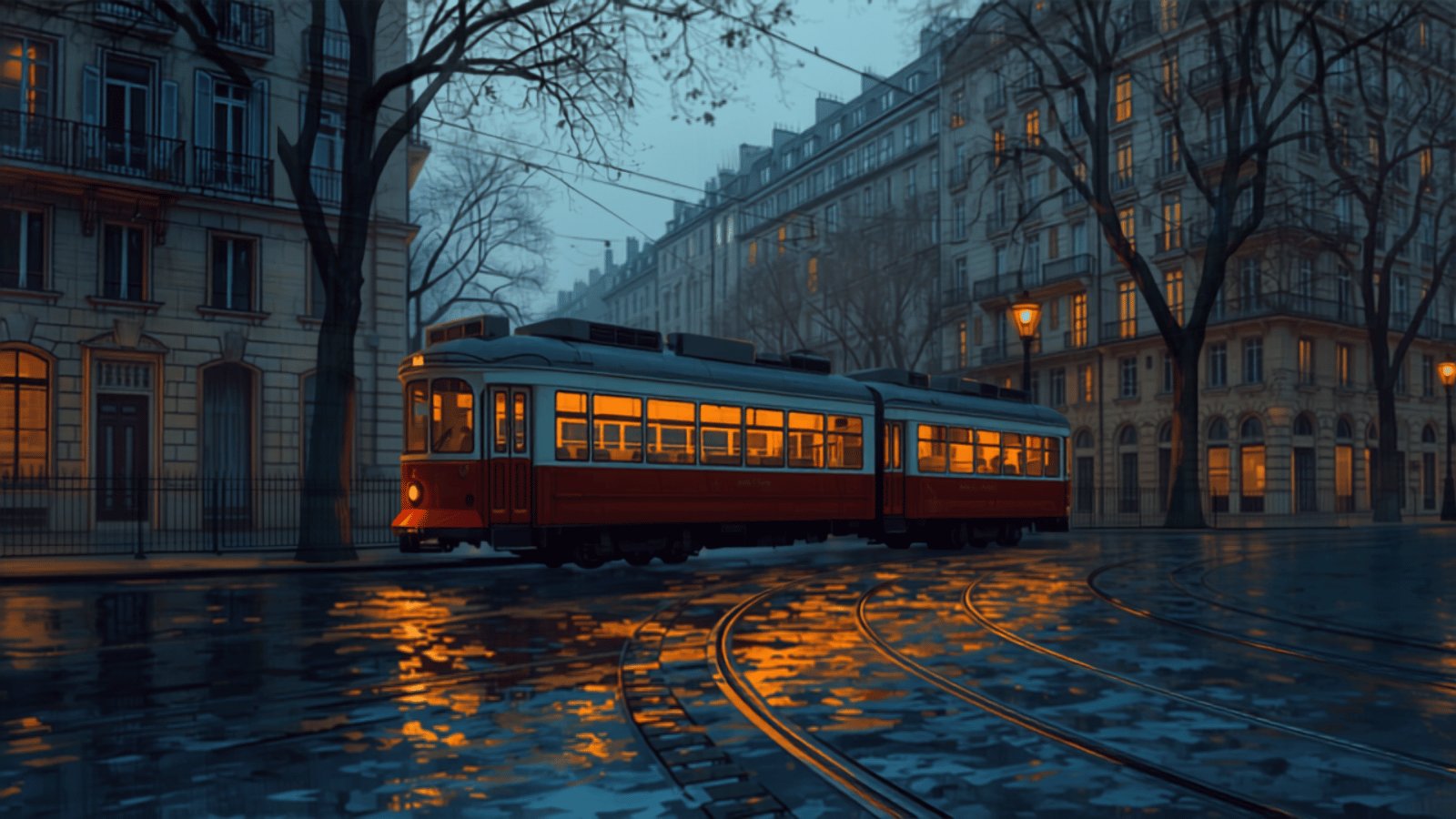
On Tuesday morning she stood at the terminus with a clipboard under her arm and watched her first Number 6 come rolling out of the depot. It was cream and dark red, with round headlamps like surprised eyes. It was, she had to admit, a beautiful old machine.
The driver leaned out of his window. He was around sixty, with a grey moustache and the kind of face that has spent decades being patient.
“You’re the one from City Hall,” he said. It was not a question. “News travels fast on this line. Tomas Brenner. Thirty-four years driving the Six. Come on, then. Sit where you can see.”
The tram pulled away with a long metallic sigh, and immediately it began to rattle — a cheerful, constant rattle, as if hundreds of teaspoons were being shaken somewhere under the floor. It rattled past the fish warehouse, past shuttered shops with flats above them, and into the market square, where traders were stacking oranges under striped awnings.
At each stop, something happened that Dina had never seen on the modern trams she took to work. People greeted each other. An old man in a brown coat was helped up the steps by a teenager without either of them saying a word about it. A woman handed Tomas a paper bag through the front window — “For your break, Tomas” — and he thanked her by name.
Inside, the tram was all wood and brass, polished smooth by ninety years of hands. A small enamel sign above the driver’s seat said Do not speak to the driver while the tram is in motion, and beneath it somebody had long ago added, in neat pencil, unless it is important. Tomas caught her reading it. “My first driver wrote that,” he said. “He trained me in 1992. His first driver trained him in 1961. It goes back like that, all the way to the beginning. A line is not rails and wires, Miss Petran. A line is the people who keep it alive.”
Past the market, the line climbed onto the viaduct, a long curve of dark stone arches built high above the old railway lands. From up there, the whole city arranged itself below the windows: cranes by the water, rooftops, washing lines, a school playground full of running dots. Passengers looked up from their phones as the tram crossed. Apparently the view never got old, even for people who saw it every day.
The northern terminus was at Veran Hill, a neighbourhood of steep streets and small houses that the folder had described, in one cold line, as an area poorly served by alternative transport. Dina stepped off and looked back down the hill. The tram had taken thirty-one minutes to cross the entire city. Her clipboard was still empty.
“Well?” said Tomas, resting his elbow on the window. “Did you count us? That’s what the last one from City Hall did. Stood at the front and counted.”
“The counting is done automatically,” said Dina. “There are sensors above the doors.”
Tomas looked at her for a long moment, and something in his expression changed — not anger, exactly. Something closer to pity.
“Is that so,” he said. “Then you’d better ride with us again tomorrow, Miss Petran. And this time, look up at the doors.”
3 · The little red boxes
She rode the Six again the next morning, and this time she looked up.
Above each of the three doors was a small red box — the automatic passenger counter. The counters had been installed across the whole network six years earlier, and every night they sent their numbers to a computer at City Hall. Those numbers became the graphs; the graphs became the folder; the folder had become the sentence ridership has fallen by forty-three per cent.
Above the front door, the red box showed a steady green light. Above the middle door — nothing. The box was dark. Above the rear door, dark again, and this one was hanging loose on its bracket, shaken half off the wall by year after year of that cheerful rattle.
“They stopped working two winters ago,” said Tomas, watching her in his mirror. “The vibration kills them. These old trams shake like washing machines — the new trams don’t, so their counters live long, happy lives. I reported it. Wrote it in the defect book, the proper way. Repairs were requested. Repairs were promised.” He shrugged. “Repairs were never made.”
“But the front counter still works,” said Dina slowly. “So the system still receives numbers from this tram. Just… small ones.”
“Now look at where people get on,” said Tomas.
She looked. At the market square, eleven people boarded. Two came in at the front. The other nine used the middle and rear doors, because that was where the shelter was, where the pram space was, where people had always boarded. Nine invisible passengers. At the next stop: one through the front, six through the middle. Six more ghosts.
Dina felt something cold slide down the back of her neck. If two counters out of three were dead, then only a fraction of the passengers were being counted — and the missing ones had not gradually disappeared over two years. They had disappeared overnight, on whatever day the boxes had failed.
That evening she stayed late at the office and pulled the maintenance records for Line 6. It took her three hours, because nobody had ever organised them properly. But it was all there, in dry official language. Defect reported: door counter, unit 2, not transmitting. Defect reported: door counter, unit 3, not transmitting. Repair requested. Marked low priority. Requested again four months later. Marked pending. Requested a third time by T. Brenner, driver. No reply recorded.
The date of the first defect report was the twelfth of March, two years ago.
She opened the ridership graph from the green folder and found the moment the line began to fall. The graph turned downwards in March, two years ago. The same month. Almost certainly the same week.
The Number 6 had not lost its passengers. It had lost its ability to prove they existed.
4 · Counting by hand
A more sensible officer, Dina told herself, would have sent one short email upstairs and let somebody else worry about it. Instead, she got up at half past five the next morning, took her clipboard, and began to count.
For five mornings and three evenings she rode the Six from terminus to terminus, standing by the middle door, counting every head that came aboard. It was slow, boring, old-fashioned work, and it was the most useful thing she had ever done with a clipboard.
And while she counted, the line introduced itself to her, passenger by passenger.
There was Karin, a night nurse at St Anna’s Hospital, who caught the 6.14 down the hill every evening and the 7.02 back up every morning, grey with tiredness. “If they cut the Six, I’d need two buses and a walk across the railway lands in the dark,” she said. “I’ve been told the buses will be reviewed. Wonderful. You can’t ride a review.”
There was Mr Anto, who had sold vegetables in the market square for thirty years and moved his empty crates home on the rear platform every afternoon, a privilege that no timetable mentioned and every driver allowed. There were the schoolchildren from Veran Hill, who filled the tram at eight o’clock with noise and dropped gloves. There was a dressmaker called Mrs Osei, small and upright, who rode down to the market every day with pinned-up sleeves and sharp, bright eyes.
On Saturday morning the tram changed its character completely. The schoolchildren were replaced by families going down to the market, by two young men carrying a sofa cushion each and arguing happily about football, by an elderly couple in their best coats who, Tomas explained quietly, rode to the harbour terminus every single Saturday, drank one coffee looking at the boats, and rode home again. “Been doing it since before I started,” he said. “If you asked the computer, those two don’t exist. The middle door has been their door for forty years.”
It was Mrs Osei who was organising the petition.
“Four hundred and twelve signatures,” she said, laying the pages on the seat beside Dina as the tram climbed onto the viaduct. “Everyone on this hill has signed it. We are not asking for anything new, you understand. No new roads, no new anything. We are asking to keep what our grandparents already paid for.” She looked out at the arches carrying them across the city. “They built this viaduct in eighteen months, in 1931, with shovels. Now we are told the city cannot afford to keep a counter working above a door.”
Dina said, carefully, that the petition would be presented to the council. What she did not say was what her own numbers were showing.
Because after five mornings, the pattern was unmistakable. Her hand counts were nearly three times higher than the official figures. When she adjusted for the season and compared her totals with the records from the years before the counters died, the result was flat — a straight, steady, stubborn line. Ridership had barely fallen at all. The Six was carrying almost exactly the same number of people it had carried five years ago.
The forty-three per cent collapse — the entire foundation of the closure — was a ghost. It was the shadow of two small red boxes, hanging dead above two doors, shaken to death by an old tram’s rattle and never repaired.
5 · What reports are for
She took it all to Mrs Rehn on Thursday afternoon: the maintenance records, the hand counts, the graphs she had rebuilt. She had rehearsed a small speech on the stairs. She never got to use it.
Mrs Rehn read in silence, turning the pages with one finger, her face perfectly still. Then she closed the folder, walked to the window, and looked down at the square for a long time.
“You’re right,” she said at last, which was not what Dina had expected. “And it changes nothing.”
“The figures are wrong,” said Dina. “The whole case is built on—”
“The case,” said Mrs Rehn, “was never really built on the figures.” She turned around. “Sit down, Dina, and I will tell you how a city actually works. The depot. That long, handsome brick building by the harbour, on the last piece of open land beside the water. It is worth more than every tram in this city put together. It is to be sold — the agreement has been drafted for months. Four hundred waterfront flats, a hotel, a marina. But you cannot sell a working depot, and you cannot decommission a depot while its line still runs. So the line must go first. The falling ridership made the closure easy to explain. Nobody asked where the numbers came from, because they were the numbers everybody needed.”
“You knew the counters were broken?”
“I knew the numbers were convenient. I have learned not to interview convenient numbers too closely.” Mrs Rehn sat down again, and for a moment she looked genuinely tired. “I was told, twenty years ago, that reports explain decisions. It was the most useful sentence anyone ever said to me. The people who wrote honest, inconvenient reports — I watched their careers, Dina. They all own very good principles and very small desks.”
“And if I put my counts in the report anyway?”
“Then it will be called incomplete, and it will be rewritten by somebody more sensible, and the vote will happen exactly as planned. The council meets on the twenty-eighth. The recommendation is already drafted.” She slid the folder back across the desk. “You did good work. Genuinely. Now do the wise thing with it.”
That night Dina walked home the long way, up onto the viaduct footpath, and stood over the sleeping city with the wind pulling at her coat. She thought about her home town, where she was from — where, years ago, the evening bus had been cut because a spreadsheet said nobody used it. She thought about how the chemist had closed the year after, and then the café, and how the square now belonged to parked cars and nobody at all. Nobody had planned any of that. It had simply followed, the way night follows evening.
Below her, a single late tram crossed the arches, lit up gold, rattling faithfully towards Veran Hill, carrying a night nurse to work.
6 · The twenty-eighth
The report was submitted on the twenty-fifth, three days early. It was, everyone agreed later, a very unusual document.
The first half was exactly what had been asked for: the history of the line, the age of the trams, the cost of new rails. The second half was not. It contained the maintenance records, photographed page by page. It contained fourteen days of hand counts, signed and dated. It contained one sentence that Dina had rewritten eleven times and finally left brutally simple: The reported fall in ridership coincides with the failure of two of the three passenger counters and is not supported by direct observation.
She sent it, as required, to Mrs Rehn. But the rules said that a closure report must be made available to council members on request — and it was remarkable how many council members requested it, once Mrs Osei’s petition committee began telephoning them, one by one, from a list Dina had absolutely no memory of providing.
On the evening of the twenty-eighth, the public gallery of the council chamber was full for the first time in years. The Veran Hill people had come down the hill together — on the Number 6, naturally, filling three trams. Karin the nurse was there in her uniform, sitting between Mr Anto and a row of schoolchildren whose teacher had decided, that afternoon, that democracy counted as homework. Tomas Brenner sat at the end of a bench with his driver’s cap on his knee, as still as a man in church.
Mrs Osei presented the petition — four hundred and twelve signatures, laid on the table in front of the chairman like a delivery of bricks. Then the closure recommendation was read aloud. Then a councilwoman from the north district stood up, put on her glasses, and said she had some questions about pages seventeen to thirty-one of the officer’s report.
The questions took two hours. Dina sat at the officers’ table, answering them one at a time, her voice steadier than her hands. From the front row, Mrs Rehn watched her without any expression at all — though once, just once, when the maintenance dates were read out and a low murmur crossed the gallery, Dina thought she saw something at the corner of her manager’s mouth that was almost, impossibly, a smile.
At ten minutes past nine, the chairman called for the vote. “The motion before the council,” he said, “is to decommission Tram Line 6 and to authorise the sale of the harbour depot. Members will now vote.”
Before the papers were passed around, there was one more small piece of theatre. The councilwoman from the north district asked whether the department could confirm, for the record, when the passenger counters on Line 6 would finally be repaired. There was a pause. Somebody from the transport office said the repairs had been scheduled. “Scheduled,” the councilwoman repeated, taking off her glasses. “By whom, and for when? Or is that another sentence with no person in it?” A ripple of laughter ran along the gallery, and Dina, staring hard at the table, understood that her report had been read far more carefully than she had dared to hope.
The chamber went quiet. Papers were passed, marked, folded, collected. The city clerk counted them at his little desk, wrote a number on a card, and carried the card to the chairman.
The chairman looked at the card. Then he looked up at the crowded gallery, and frowned, as if the result surprised even him.
“Well,” he said, and leaned towards the microphone.
Check your understanding
Read each question. Think about your answer. Then click “Show answer” to check.
Words to remember
Here are the eight key words again, in new sentences. Try to use each one in a sentence of your own.
- ridership — After the new night service started, ridership on the metro rose by twenty per cent.
- decommission — The navy plans to decommission the old warship and turn it into a museum.
- depot — The first bus leaves the depot at five o’clock, before the city wakes up.
- terminus — Stay on the train until the terminus — it’s the last stop, so you can’t miss it.
- viaduct — The railway crosses the valley on a Victorian viaduct with twenty stone arches.
- petition — More than a thousand residents signed a petition against the closure of the library.
- clipboard — The inspector walked through the factory with a clipboard, ticking boxes as she went.
- rattle — Every time a lorry passes, the old windows rattle in their frames.
Grammar in this story: the passive voice
This story is full of the passive voice — and that is no accident. The passive is the natural voice of officials and institutions, because it hides who did something. Look at these lines from the story:
“The line is to be decommissioned at the end of the year.” · “Repairs were requested. Repairs were promised. Repairs were never made.” · “The decision has already been taken.” · “It is to be sold.”
In every sentence, the action is clear but the actor is invisible. Who decided? Who promised the repairs? Who is selling the depot? The passive lets the speaker avoid saying. Notice the form each time: be (in the right tense) + past participle — was opened, were installed, has been taken, is to be sold. When Tomas says “Repairs were never made,” he is using grammar to make a point: nobody at City Hall wanted to be the subject of that sentence.
👉 Learn the full rule, with more examples and a short quiz, here: Active vs Passive Voice Explained.
Talk about it · Write about it
Talk about it: Has anything in your city ever been closed down — a bus route, a market, a cinema, a library? Who decided, and did local people have a voice? Do you trust official statistics about your city? Why or why not?
Write about it: Imagine you are a council member who has just read Dina’s report. Write a short speech (100–150 words) explaining how you will vote and why. Try to use the passive voice at least three times — for example, the figures were produced by a broken machine, or the community was never consulted.
🎉 Well done — you have just read more than three thousand words in English, and along the way you picked up eight new words and watched the passive voice do its quiet political work. That is serious reading practice.
But the chairman is still leaning towards the microphone. Was the Six saved, or did the depot win? And what happens to Dina’s career either way? Some votes echo for years…
Next story: Read another B2 story →
About this story: This is an original B2 graded reader (~3,200 words). The vocabulary is controlled to upper-intermediate level, so you should recognise about 98% of the words. The eight harder words that the story needs are explained before you read and repeated inside the text. The grammar includes passives, reported speech, and conditionals — the structures a B2 reader is learning to handle.

I’m Khamis Maiouf. I’m studying Health and Social Care and have completed Functional Skills Level 2 in English and Level 3 Hairdressing. I have taught ESOL in my community and helped students with GCSE English. I run English Teacher Site to help people learn and practise English.