
The Rooftop Garden (B1 Reading Story)

B1 · INTERMEDIATE Reading practice · ~3,100 words · 15-min read
This is an original story for B1 (intermediate) readers. The sentences are a little longer and the story uses the present perfect tense a lot. First, read the ten key words. Then read the story — it is in six short chapters. At the end, there are questions to check your understanding, and a small writing task.
Before you read — 10 key words
- rooftop — the flat top of a building, where you can sometimes go outside.
- allotment — a small piece of land where people grow plants, often shared with neighbours.
- community — a group of people who live in the same place and help each other.
- soil — the top layer of the earth where plants grow.
- notice — an official letter or message that tells you something will happen.
- landlord — the person who owns a building and lets other people live in it for money.
- developer — a company that buys land or buildings and puts up new ones.
- lease — a paper agreement that lets you use a place for a set time.
- petition — a paper that many people sign to ask for a change or a decision.
- protest — to say strongly, in public, that you do not agree with something.
The story
1 · New in the city
Nadia has lived in the city for three months now. Three months of grey mornings on the underground train. Three months of noisy nights on Cambridge Road. Three months of not knowing a single person’s name.
She moved here in April, when she got her first real job. It was a good job — an office job with a small company that makes phone apps. She was proud when they said yes to her. Her mother cried. Her friends took her out for pizza. Then she packed two suitcases and got on the train.
The city was bigger than she had thought. It had a station with twelve platforms. It had streets so long that you could walk for an hour and still not see the end. It had rain that came from the side, and buses that were always late. And it had people. Millions of people. All of them, it seemed, had somewhere to go and someone to meet.
Nadia’s flat was on the fourth floor of an old building on Cambridge Road. The building had been there since 1920. The stairs made a loud noise when you walked on them. The kitchen was very small, and the window did not close properly. But it was hers.
She spent most evenings alone in that little kitchen. She cooked simple things — rice, eggs, soup — and ate at the table by the window. Sometimes she watched a film on her laptop. Sometimes she called her mother. Sometimes she just looked at the wall and thought about home.
“Give it time,” her mother always said on the phone. “You have only been there three months. In six months, you will have friends. You will love the city.”
Nadia was not sure. She wanted to believe her mother, but the city felt too big. She was only one small person inside it.
One Friday in July, something unusual happened. She came home tired from work. It was a hot evening. She opened her post box in the hall, and there was one small envelope inside.
The envelope had no stamp. There was no address on the front — only three words, written in dark blue ink:
“To Flat 4C.”
That was her flat. Somebody had put the envelope in her box by hand. Nadia carried it upstairs and put her bag on the kitchen table. She sat down and opened it slowly.
Inside, there was a small piece of yellow paper. On it, in the same blue writing, was a short message:
“If you like plants, please come up to the rooftop this Saturday morning at ten o’clock. Bring an old T-shirt and something to drink. We would like to meet you. — Ana, Mr Costa, and the 27 Cambridge Road allotment.”
Nadia read the message three times.
Rooftop was the flat top of the building. She had never been up there. Allotment — she was not sure. She looked the word up on her phone. An allotment is a small piece of land where people grow plants, often shared with neighbours.
She looked out of her small kitchen window. From here, she could not see the roof. But she knew there were four floors above her, and above those, only sky.
She sat with the note in her hands for a long time. She had told nobody her flat number. Somebody in this building knew who she was. Somebody in this building had noticed the new person and wanted her to come.
For the first time in three months, Nadia smiled at the city.
2 · The stairs to the sky
Saturday morning was clear and bright. Nadia put on an old white T-shirt and jeans. She filled a big bottle with cold water. Then she left her flat and started to climb the stairs.
The building only had four floors. But there was a small door at the end of her corridor, near the top. She had walked past that door many times and never opened it. Today she pushed it. Behind the door, she found a narrow set of stairs — thin and grey, with no window. The steps went straight up.
She climbed. Her heart beat a little faster. Then she pushed a second door — and the sky opened above her.
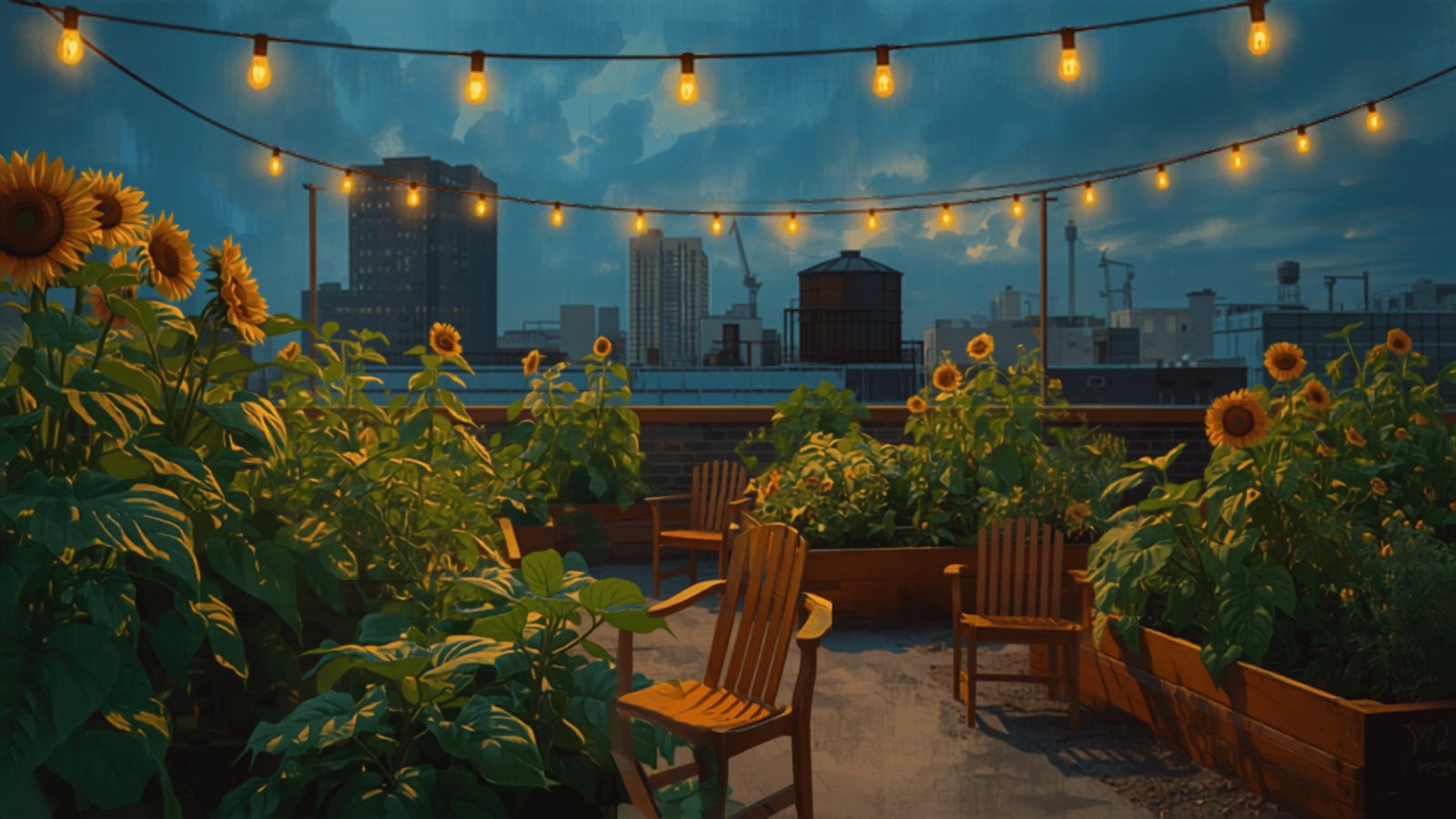
It was the rooftop. The wind touched her hair. The city noise felt far away. And in front of her, on top of an old grey building on Cambridge Road, there was a garden.
Nadia was not ready for the colours. Green. So much green. Long wooden boxes, low and neat, were full of plants. Tomatoes hung red and heavy on soft green branches. Beans climbed up wooden sticks. There were three small trees in big pots. There were flowers — yellow, purple, and orange — that Nadia could not name. In one corner, there was a small greenhouse — a little glass house for young plants. In another corner, there was a wooden table, four chairs, and a red umbrella.
An old man was on his knees near the tomatoes. He wore a straw hat and gardening gloves. He looked up when he heard the door.
“Ah!” he said, and his face lit up. “Flat 4C, yes?”
“Yes,” Nadia said. “I’m Nadia.”
“I am Mr Costa.” He stood up slowly. He was not tall. His skin was brown from the sun. “I have lived in this building for forty-one years. I have grown plants on this roof for the last twelve of them. Welcome, Nadia. Welcome to our little world.”
He offered her a strong, dry handshake. Then he showed her around.
“This is soil,” he said, taking a handful of dark earth from one of the boxes. “The top layer of the earth. Plants need good soil to grow. We make ours from kitchen waste — fruit peel, egg shells, coffee. Everybody in the building brings a little in a small bag. Nothing is wasted.”
He showed her the tomato plants. He showed her the herbs — mint, basil, parsley. He showed her the beans and the small potato plants and the flowers that the bees loved.
“Twelve years ago,” he said, “there was nothing up here. Only wind, dust, and old bottles. My wife had died, and I did not know what to do with my Sundays. So I began to bring up soil, one bag at a time. My knees were younger then.” He laughed. “Now other people help. That is the best part.”
Behind them, the small rooftop door opened again. A young woman came out. She had short dark hair, big silver earrings, and a bag with a loaf of bread inside.
“Nadia, meet Ana,” Mr Costa said. “Ana wrote the note for you. Ana lives one floor above you, in 5C.”
“Hi,” Ana said, and she smiled. She had a warm, quick smile. “Welcome. I saw your name on the postbox last month. I’ve been meaning to say hello for weeks.” She looked around at the garden. “Sorry it took me so long. This place is my Saturday every week.”
“How did you know I like plants?” Nadia asked.
Ana laughed. “I didn’t! But the note works for everybody. If you don’t like plants, you at least get a coffee and meet your neighbours. Nobody says no to that.”
3 · The Saturday people
Slowly, other people came up. Every ten minutes, the small door opened, and a new face stepped onto the roof.
There was Sam, a father in his forties, who came with his young daughter, Ellie. Ellie was six years old and had a small watering can shaped like an elephant. Her job, she told Nadia very seriously, was to water the flowers.
There was Mrs Kim, who lived on the second floor. She had lived in the building for thirty years, and she brought fresh bread and sweet cakes every Saturday. “I bake,” she said simply. “You eat. That is my job.”
There was Tomás, a student who lived in a shared flat downstairs. Tomás had a guitar on his back and headphones round his neck. He came, he said, “for the tomatoes and the good silence.”
And there was Mrs Ali, a small woman in a long red dress, who did not speak much English. But she smiled a lot, and she knew every plant in the garden by its first name.
By eleven o’clock, there were eight of them on the roof. It was a small community — a group of people who lived in the same place and helped each other. Nadia had never known that such a thing could grow four floors above her own kitchen.
Mr Costa gave her a small job. “See these young plants?” he said, pointing to a row of tiny green shoots in a long wooden box. “They are our winter salads. They need water, but not too much. Slowly. Like a soft rain. Ana will show you.”
Nadia watered the little plants. Ana watered next to her. They talked. Ana was a nurse. She worked at the big hospital near the station. She had moved to Cambridge Road two years ago.
“Were you lonely?” Nadia asked. “When you first came, I mean.”
“Very,” Ana said. She did not look up from her plants. “The first six months, I cried on the bus home more times than I want to remember. Then Mr Costa left a note in my postbox.” She smiled at Nadia. “The same note, in the same blue ink.”
“He does this for everybody?”
“Every new person in the building. He says it is the small rent he pays for having so much sky above his head.”
Around them, the garden worked. Sam and Ellie watered the flowers. Mrs Kim cut the bread. Tomás sat on an old wooden crate and quietly tuned his guitar. Mrs Ali picked tiny green leaves of basil and put them on a plate.
At twelve o’clock, they all sat down at the wooden table under the red umbrella. Mrs Kim’s bread was still warm. Mr Costa cut fresh tomatoes and a little onion. Tomás started to play soft music. Ellie asked Nadia if she knew any songs about elephants.
Nadia looked around the table. Two hours ago, none of these people had a name for her. Now they were passing her bread and asking about her job.
She looked over the low wall at the edge of the roof. Down there, the city was still noisy. But up here, four floors above the traffic, there was a small square of green, a red umbrella, and eight people eating bread together in the sun.
4 · The brown envelope
Nadia went back to the rooftop the next Saturday, and the Saturday after that. She learnt the names of the plants. She learnt to make compost from kitchen waste. She learnt that mint grows very fast and beans grow slowly. She learnt that Mrs Kim’s grandmother had a garden in Korea, and that Tomás wrote songs when he could not sleep.
The city, slowly, began to feel smaller.
Then, on the last Saturday of August, everything changed.
Nadia came up to the roof at ten o’clock as usual. But something was different. Mr Costa was not on his knees near the tomatoes. He was sitting at the wooden table, alone. In his hand, he held a brown envelope. He was not moving.
“Mr Costa?” Nadia said quietly.
He looked up. His eyes were tired. He did not smile.
“Sit down, Nadia,” he said. “We have a problem.”
The others came up one by one, and one by one they sat down. Nobody spoke. Mr Costa opened the brown envelope and put a long white letter on the table. On the top of the letter, there was a company name in big black letters: NORTH RIVER PROPERTIES.
“A notice,” Mr Costa said. A notice, he explained, is an official letter that tells you that something is going to happen. Ana read the letter aloud. Her voice was quiet, but she read every word.
The company had bought the building.
The building’s owner — the old landlord who had let Mr Costa use the roof for twelve years — had sold it. A landlord is the person who owns a building and lets other people live in it. The new owner was a developer. A developer is a company that buys land or buildings and puts up new ones. North River Properties wanted to knock down 27 Cambridge Road. In its place, they would build a new tower with more flats — flats that would be sold, not rented. The current people had six months to leave.
At the bottom of the letter, in smaller writing, there was one more sentence: “The rooftop space is not covered by any residents’ lease and will be closed with immediate effect.” A lease, Ana explained, is a paper agreement that lets you use a place for a set time. The rooftop garden had no lease. In the eyes of the developer, it did not exist.
For a long time, nobody spoke. A pigeon landed on the wall of the roof and looked at them.
Ellie, six years old, was the one who asked. “Are we going to lose the roof?”
“No, sweetheart,” Sam said. But his voice was too fast.
Mr Costa put his hand flat on the table. “Yes,” he said. He looked slowly around the table at every face. “If we do nothing, we will lose the roof. We have six months. That is not much time.”
Then he took a long breath. “But we have not done nothing before,” he said. “And I do not think we will start today.”
5 · The petition
That Sunday, Ana came to Nadia’s flat with a laptop and a plan.
“I’ve been reading,” Ana said. She sat at Nadia’s small kitchen table. “The city council has an old rule. If a building has been used by the local community for more than ten years — really used, not just planned — the council can protect it. The garden has been here for twelve. Mr Costa has records.”
“Records?”
“Photos. Old ones. Newspaper cuttings. He has kept everything.” Ana smiled a small, tight smile. “He is that kind of man.”
“What can we do?”
“Two things,” Ana said. She opened her laptop. “First, we write a petition.” A petition, she explained, was a paper that many people sign to ask for a change or a decision. “We ask everybody in the neighbourhood to sign it. Then we take it to the council meeting on the seventh of October. We show them the garden. We show them the community. We ask them to give us a lease for the roof.”
Nadia had never signed a petition, and she had never written one either. But that afternoon, she sat with Ana at the kitchen table and together they wrote one. They typed the words carefully. They printed twenty copies at the corner shop.
Over the next two weeks, the whole building went to work.
Mrs Kim baked bread with the words “Save the Rooftop” pressed into the top in seeds. She sold it outside the market on Saturday morning. Every buyer signed the petition.
Tomás wrote a short song about the garden. He played it in the small square outside the underground station in the evenings, with an open guitar case at his feet. People who stopped to listen also signed the petition.
Sam took the petition to Ellie’s school. He put a photo of the roof on a board in the school hall. Ellie herself, in a very serious voice, asked every parent she met to sign the paper.
Mr Costa knocked on every door on Cambridge Road. Some doors did not open. Some doors opened and closed again quickly. But many people invited him in, made him a cup of tea, and listened to his story. Most of them signed.
Nadia, who had once thought that she did not know a single person in the city, now spent her evenings on the doorsteps of strangers. It was tiring. It was sometimes cold, and sometimes people were rude. But when somebody signed the paper, they usually smiled at her too. And every smile made her feel a little bit lighter.
By the last day of August, they had 400 signatures. By the middle of September, they had 940. By the end of September, they had 1,400.
On the first of October, they sent the paper to the council. They also sent a letter, six pages long, with photos of the garden through the years. They asked to speak at the council meeting on the seventh of October.
Two weeks later, a small white envelope arrived at 27 Cambridge Road.
Their request had been accepted.
6 · The night before
The evening before the council meeting, the rooftop garden had a different kind of light. The sky was orange over the city. The wind was cool. The tomatoes had finished for the year, but the little winter salads that Nadia had watered in July were now full and green.
Everybody was on the roof. Mr Costa. Ana. Mrs Kim. Sam and Ellie. Tomás. Mrs Ali. And Nadia — no longer the new person. In one more day, they would find out if the council would listen. In one more day, they might have to say goodbye to this place.
Mrs Kim had baked one last loaf of the “Save the Rooftop” bread. They ate slowly. Nobody talked much.
Mr Costa stood up. His knees, everybody could see, hurt him more than usual now.
“Tomorrow,” he said, “I am going to speak. I have never been good with words. But I have written down what I want to say. My hands may shake, so if my hands shake too much, will one of you finish for me?”
“I will,” Ana said, before anybody else could.
“So will I,” said Sam.
“And me,” said Nadia, quietly. She had never spoken in a big room before. She was not sure she could. But she was sure she would try.
Mr Costa smiled. “Good,” he said. “Then we cannot lose.”
Ellie, who was not yet seven, took Nadia’s hand under the table. Tomás played a very quiet song on his guitar. And Nadia thought — as she looked at the small green plants, the red umbrella, and the seven faces around her — that whatever happened tomorrow, this had already been worth every step of every stair.
She had come to the city looking for a job. She had found a job. And, four floors above the traffic, she had also found something that no advert had promised her: a family, a piece of sky, and a reason to protest — to say strongly, in public, that she did not agree — when somebody tried to take her home away from her.
Check your understanding
Read each question. Think about your answer. Then click “Show answer” to check.
Words to remember
Here are the ten key words again, in new sentences. Say each one out loud.
- rooftop — In summer, we sometimes have dinner on the rooftop of our building.
- allotment — My uncle has grown potatoes on his allotment for twenty years.
- community — A strong community is one where neighbours know each other’s names.
- soil — Good soil is dark, soft, and full of small living things.
- notice — The school sent a notice to all parents about the new opening times.
- landlord — I have called my landlord three times about the broken heater, but nobody has come.
- developer — A big developer has bought the old cinema and wants to turn it into flats.
- lease — Before you move in, please read your lease carefully.
- petition — We have signed a petition to keep the small library open.
- protest — Hundreds of people came to the square to protest against the new road.
Grammar in this story: the present perfect
This story uses the present perfect tense many times. We use it when the past connects to now. It shows how long something has continued, or that an action happened at some time before now and is still important. The form is have / has + past participle.
Look at these examples from the story:
• Nadia has lived in the city for three months.
• Mr Costa has grown plants on this roof for twelve years.
• Mrs Kim has lived in the building for thirty years.
• “I have been meaning to say hello for weeks.”
• The company has bought the building.
Notice the words for (a length of time) and since (a starting point). Both are common with the present perfect:
has lived for three months · has grown plants since 2013.
👉 Learn the full rule here: What is the Present Perfect Tense?
Talk about it · Write about it
Talk about it: Do you know the people in your building or on your street? Is there a place in your city where the community meets — a garden, a café, a park? Would you sign a petition to save it if a developer wanted to knock it down?
Write about it: Write 6–8 sentences using the present perfect about your own city or town. For example: “I have lived here for five years. I have made two very good friends. The council has closed our nearest park…” Try to use for and since at least once each.
🎉 Well done — you have just read a 3,000-word story in English. That is a real achievement at B1. You also met ten new key words, and you saw the present perfect in action many times.
But wait — the council meeting is tomorrow morning. Will 1,400 signatures be enough? Will Mr Costa’s hands shake too much? And what will Nadia say when it is her turn to stand up and speak? Write your own ending, using details from the story to explain your choice.
More reading: Read another B1 story →
About this story: This is an original B1 graded reader (~3,100 words). It uses controlled B1 vocabulary (~1,000 headwords), the present perfect tense, relative clauses, and the first conditional, so intermediate learners can understand about 98% of the running words. Any harder word (rooftop, allotment, community, soil, notice, landlord, developer, lease, petition, protest) is explained before the story and re-used inside it. Original plot — not adapted from any existing book.

I’m Khamis Maiouf. I’m studying Health and Social Care and have completed Functional Skills Level 2 in English and Level 3 Hairdressing. I have taught ESOL in my community and helped students with GCSE English. I run English Teacher Site to help people learn and practise English.