The Plural of Wolf: Why It’s Not Wolves for Everyone

Quick Answer
The plural of wolf is wolves. The word “wolfs” is not correct in English.
One: There is one wolf in the forest.
More than one: There are three wolves in the forest.
Wolf Becomes Wolves — See the Pattern
Look at these words. Can you see what happens?
- one wolf → two wolves
- one knife → two knives
- one life → two lives
- one elf → two elves
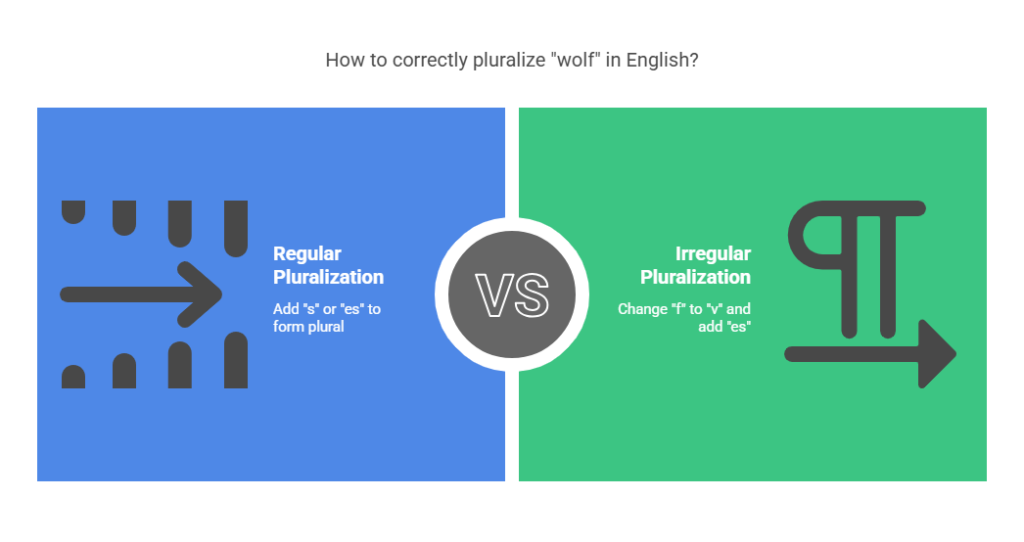
Did you see the pattern? The -f at the end changes to -ves. This is a rule in English for many words that end in -f or -fe.
| One (singular) | More than one (plural) |
|---|---|
| wolf | wolves |
| leaf | leaves |
| half | halves |
| shelf | shelves |
| knife | knives |
Why It Is Wolves and Not Wolfs
In English, many words that end in -f or -fe change to -ves when you make them plural:
- wolf → wolves (not “wolfs”)
- knife → knives (not “knifes”)
- life → lives (not “lifes”)
This pattern is very old — it comes from how English was spoken hundreds of years ago. The -f sound was softer between two vowel sounds, so it became a -v sound.
Easy way to remember: Think of knife → knives. Everyone knows that one. The word wolf works the same way: wolf → wolves.
The Rule in One Line: Wolf ends in -f, so the plural is wolves (-f → -ves).
How to Use Wolves in Everyday English
- A pack of wolves was seen near the village. (more than one wolf)
- The wolves howled at the moon all night. (more than one)
- There is one wolf in the zoo near my house. (just one)
- In the story, the wolves chased the sheep across the field. (more than one)
- My son loves to watch films about wolves. (more than one)
You are doing great. Now let’s look at the mistake most learners make with this word.
The Most Common Mistake With Wolf
Many learners write “wolfs” because most English plurals just add -s. That is a smart guess — but it does not work here. Even native speakers’ children say “wolfs” when they are learning to talk. So if you get it wrong, you are not alone.
✗ We saw three wolfs in the mountains.
✓ We saw three wolves in the mountains.
✗ The wolfs were running through the snow.
✓ The wolves were running through the snow.
✗ A group of wolfs is called a pack.
✓ A group of wolves is called a pack.
How to remember: Think of it like this — if the word ends in -f, ask yourself: “Does knife become knifes?” No! It becomes knives. The word wolf follows the same rule.
Other words like this: leaf → leaves, shelf → shelves, half → halves, elf → elves, life → lives.
Test Yourself: Wolves or Wolfs?
Choose the correct answer for each sentence. Click Check to see if you are right.
1. A pack of _______ was seen near the village.
2. There is only one _______ left in this area.
3. The _______ howled at the moon all night.
4. The farmer was worried about _______ near his sheep.
5. My favourite animal is the _______.
Keep Going — You Are Building Something
You just learned that wolf becomes wolves. That is one more plural you will never get wrong again.
But here is something interesting. You now know the rule: words ending in -f change to -ves. But what about the word scarf? Does it become “scarves” or “scarfs”? The answer might surprise you.
Next lesson: What Is the Plural of Scarf?
Sources
Definition of wolf — Cambridge Dictionary


My name is Khamis Maiouf. I am the creator of the English Teacher Site, dedicated to providing valuable resources and insights for students around the world. With a passion for education and a commitment to helping students enhance their skills, I aim to make English teaching more effective and enjoyable for both educators and students.