What’s the Plural of Addendum: Understanding Linguistic Variations

Quick Answer
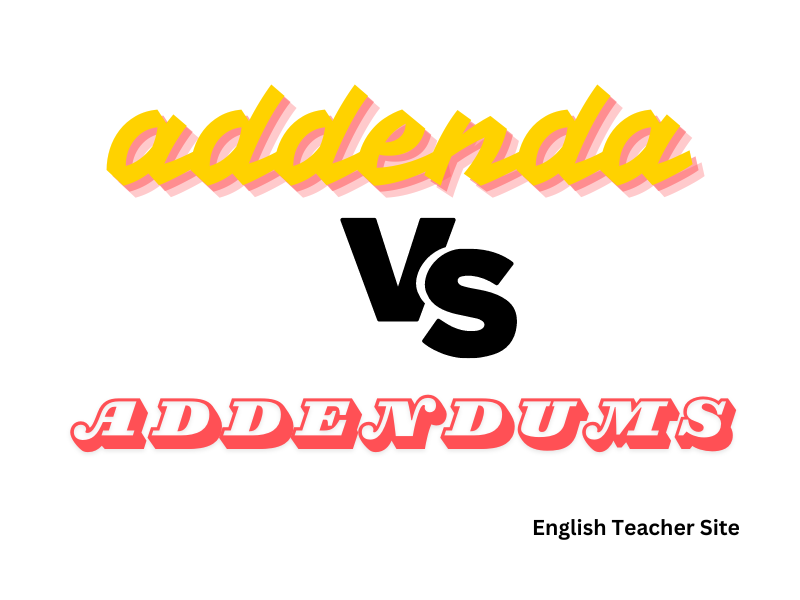
The plural of addendum is addenda or addendums. Both are correct. Addenda follows the Latin rule, and addendums follows the normal English rule.
Addendum, Addenda, Addendums — See the Pattern
The word addendum comes from Latin. It means something extra that is added to a document, book, or report. In Latin, words that end in -um change to -a in the plural. That is why we say addenda. But in English, many people also just add -s and say addendums. Both are fine.
Look at these examples:
- The contract has two addenda at the end. (more than one addendum)
- The teacher added several addenda to the course book. (more than one)
- Some companies prefer to write addendums instead. (the English-style plural)
- There is one addendum about the new price. (just one — singular)
Did you see the pattern? When you mean more than one addendum, you change -um to -a to get addenda. Or you can add -s to get addendums.
| Singular | Plural (Latin) | Plural (English) |
|---|---|---|
| addendum | addenda | addendums |
When to Use Addenda and When to Use Addendums
Both addenda and addendums are correct, but they are used in different places:
- Addenda is more common in law, business, and formal writing.
- Addendums is more common in everyday English and casual writing.
If you are not sure which one to use, addenda is the safer choice. It works in every situation.
Easy way to remember: Think of the word data. It follows the same Latin pattern: datum (one) → data (more than one). Addendum works the same way: change -um to -a.
The Rule in One Line: The plural of addendum is addenda (formal) or addendums (everyday) — both are correct.
How to Use Addendum and Addenda in Everyday English
- Please read the addendum before you sign the contract. (one extra section)
- The book has three addenda at the back. (three extra sections)
- We wrote an addendum to fix a mistake in the report. (one extra note)
- All the addenda were about safety rules. (several extra notes)
- The final addendum explains the new price. (one — singular)
You are doing great. Now let us look at the mistakes many learners make.
Two Mistakes to Avoid With the Plural of Addendum
Even native speakers sometimes hesitate before saying the plural of addendum — so if you have felt unsure, you are not alone. Latin words can be confusing for everyone.
Mistake 1: Writing “addendas” instead of “addenda”
✗ The lawyer reviewed the addendas before the meeting.
✓ The lawyer reviewed the addenda before the meeting.
How to remember: Addenda is already plural. You do not need to add -s to it. It is like the word data — you would never say “datas.” The -a ending already means “more than one.”
Mistake 2: Using the plural when you need the singular
✗ There is a short addenda at the end of the book.
✓ There is a short addendum at the end of the book.
How to remember: Look for clue words. If you see “a” or “one” before the word, you need the singular: addendum. If you see “several”, “all”, “the” + a number, or “many”, you probably need the plural: addenda or addendums.
Other Latin words that follow the same -um → -a pattern: datum → data, medium → media, erratum → errata, curriculum → curricula.
Test Yourself: Addendum, Addenda, or Addendums?
Choose the correct answer for each sentence. Click Check to see if you are right.
1. There is one _______ at the end of the report.
2. The contract includes several _______.
3. She wrote a short _______ about the new rules.
4. All three _______ must be signed before Friday.
5. The team reviewed all the _______ before the meeting.
Keep Going — You Are Building Something
You just learned the plural of addendum. That is one more Latin plural you will never get wrong again.
You now know that addendum becomes addenda by changing -um to -a. But what about the word virus? It also comes from Latin — so does it become viri? Or vira? The answer might surprise you.
Next lesson: What’s the Plural of Virus?
Sources

My name is Khamis Maiouf. I am the creator of the English Teacher Site, dedicated to providing valuable resources and insights for students around the world. With a passion for education and a commitment to helping students enhance their skills, I aim to make English teaching more effective and enjoyable for both educators and students.