
The Green Suitcase (A2 Reading Story)

A2 · ELEMENTARY Reading practice · ~1,700 words · 11-min read
This is a short travel story for A2 (elementary) learners. It uses the past simple tense and simple, everyday words. First, read the ten key words. Then read the story in five short chapters. At the end, there is a small quiz to check your understanding.
Before you read — 10 key words
- suitcase — a big bag for your clothes when you travel.
- platform — the place at a train station where you wait for a train.
- passenger — a person who travels on a train, a bus, or a plane.
- journey — a long trip from one place to another.
- mistake — when you do something wrong by accident.
- hurry — to move very quickly because you do not have much time.
- label — a small piece of paper on a bag with a name or an address.
- address — the words that tell you where a person lives.
- return — to give something back to the person who owns it.
- stranger — a person you do not know.
The story
1 · The train to Marseille
Sara was twenty-six years old. She lived in Paris and worked in a small bookshop. Every summer, she took the train to Marseille to see her mother by the sea. It was her favourite journey of the year. A journey is a long trip from one place to another.
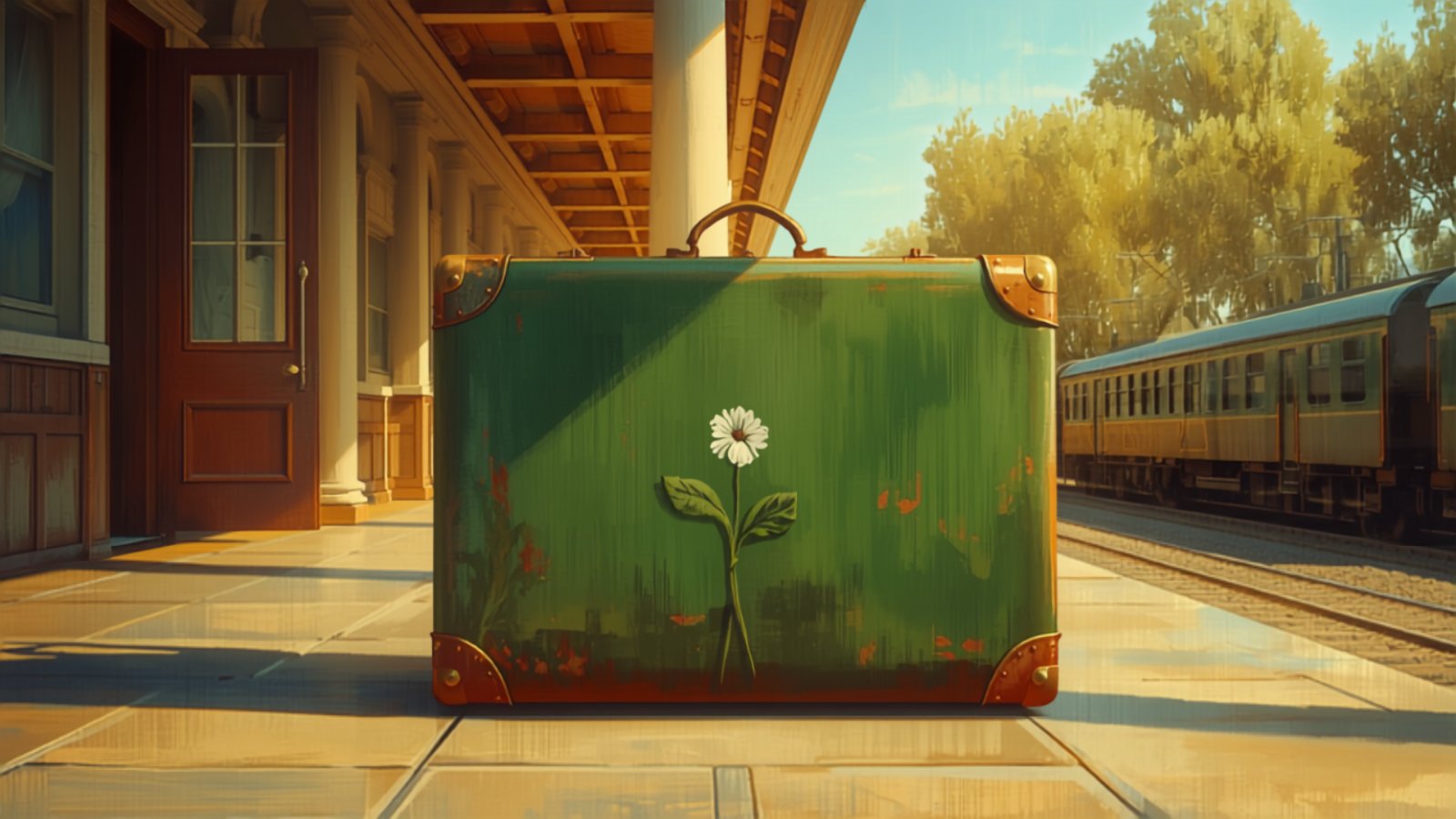
This summer, Sara was very tired. She wanted the sea, the sun, and her mother’s cooking. She bought her ticket and packed her clothes in a big green suitcase. A suitcase is a big bag for your clothes when you travel. Her suitcase was old. It had a small white flower painted on the side. Her mother gave it to her many years ago.
At half past ten in the morning, Sara arrived at the busy Paris train station. Hundreds of passengers walked with bags and coffee cups. A passenger is a person who travels on a train, a bus, or a plane. Children ran between the seats. A small dog barked at a big red suitcase.
Sara looked up at the big sign. Her train to Marseille was on platform seven. A platform is the place at a train station where you wait for a train. She walked to platform seven and put her green suitcase down next to her feet. Then she went to the little shop to buy a bottle of water.
When she came back, the train was ready. Sara stood on the platform with the other passengers. She was happy. Soon, she would see her mother’s kind face again.
Then she noticed him — an old man with white hair and a long brown coat. He was walking slowly to platform seven, too. And in his hand, he had a big green suitcase. It looked exactly like hers.
“How strange,” Sara thought. “Two green suitcases on the same platform.”
She did not think much about it. She got on the train. She found her seat by the window. She put her small handbag on her lap. She was ready to go.
Then she looked out of the window — and her heart stopped.
2 · A big mistake
Down on the platform, the old man was walking away. He was in a hurry. To hurry means to move very quickly because you do not have much time. And in his hand, he had a green suitcase with a small white flower on the side.
“That is my suitcase!” Sara said loudly.
She stood up fast. She looked at the floor next to her seat. There was a green suitcase there — but it was not hers. It had no white flower. It had a small blue label with an address written on it. A label is a small piece of paper on a bag with a name or an address.
The old man took her suitcase by mistake. A mistake is when you do something wrong by accident. And now she had his suitcase.
Sara ran to the door of the train. But it was too late. The doors closed with a long loud beep. The train started to move. Sara knocked on the window with her hand.
“Stop! Stop! My suitcase!” she called.
But nobody could hear her. Down on the platform, the old man walked slowly to the exit. He did not look back. He did not know he had the wrong suitcase.
Sara sat down. Her face was red. Her heart was fast. All her clothes, her book, her sister’s birthday present — everything was inside that green suitcase. And now the suitcase was walking out of the station in the hands of a stranger. A stranger is a person you do not know.
The train moved faster. Paris slowly disappeared behind the trees. Sara looked at the green suitcase next to her — the wrong suitcase. What was inside it? Who was the old man?
She had a long journey to Marseille. She had many hours in front of her. And she had one big question: what should she do now?
3 · Inside the suitcase
For twenty minutes, Sara did nothing. She looked out of the window. The green trees ran past. The sky was blue. But her heart felt heavy.
Then she looked at the suitcase again. Maybe the old man had a phone number inside. Maybe he had an address. An address is the words that tell you where a person lives. If she had his address or his number, she could return the suitcase to him. To return means to give something back to the person who owns it.
Sara was a little afraid to open a stranger’s suitcase. But she had no other choice. She lifted the suitcase onto the empty seat next to her. She opened it slowly.
Inside, she found the clothes of an old man. There were three white shirts, two pairs of dark trousers, and a warm brown sweater. Everything was folded very carefully. On top of the clothes, there was a small brown box.
Sara opened the box. Inside, she found three things.
First, there was an old photograph. In the photo, a young man in a wedding suit stood next to a young woman in a long white dress. They were both smiling. The photo was very old — maybe forty years old. On the back, someone wrote in blue pen: “Antoine and Céline, 1985.”
Second, there was a small notebook. Sara opened it. Inside, there were many addresses and phone numbers, all written by hand. On the first page, someone wrote in careful letters: “This book belongs to Antoine Moreau, Paris.”
Third, there was a letter. It was in a white envelope. On the front, in the same careful writing, it said: “For my daughter Céline — Saint-Marie Hospital, Marseille.”
Sara held her breath. The old man’s name was Antoine. He was travelling to Marseille to bring this letter to his daughter Céline. And now Antoine was in Paris with the wrong suitcase, and his letter was in Sara’s hands.
She looked at the blue label on the outside of the suitcase again. It had an address in Paris. There was a phone number too.
Sara took out her phone. Her hands were shaking a little. She typed the phone number and pressed “Call”.
A tired voice answered. “Hello?”
“Hello. Is this Mr Moreau? Mr Antoine Moreau?”
“Yes… who is this, please?”
“My name is Sara. I have your suitcase. And I think you have mine.”
4 · A new journey
There was a long silence on the phone. Then the old man laughed — a small, sad laugh.
“Oh no,” he said. “I did not look at the suitcase. I was in a big hurry. I only wanted to get home.”
“Where do you live now, Mr Moreau?” Sara asked.
“I live in Paris, near the station. But I needed to be in Marseille tomorrow morning. My daughter is in the hospital there. I have a letter for her — a very important letter.”
Sara looked at the white envelope in her hand. “I can see it, Mr Moreau. Your letter is safe with me.”
The old man was quiet for a moment. “But how can we return the suitcases? I cannot go to Marseille tonight. There are no more trains today. And I am too old to hurry to a new station.”
Sara thought for one minute. Then she said, “I have an idea. I am going to Marseille now. When I arrive, I will find your daughter at Saint-Marie Hospital. I will give her your letter. Then I will send your suitcase back to you in Paris by post.”
“But… my clothes! My photograph!”
“I will keep them all safe,” Sara said. “And your clothes are only clothes, Mr Moreau. Your letter is much more important. Your daughter is much more important.”
The old man cried a little. Sara could hear him softly on the phone. “Thank you,” he said. “Thank you, thank you. I will send your green suitcase back to you too. Your address is on the label, yes?”
“Yes,” Sara said. “The one with the small white flower.”
“You are a very kind stranger, Sara.”
“I am not a stranger anymore,” she said. “I am your friend now.”
Sara ended the call. She sat back in her seat. Outside, the sun was low over the fields. It was orange and pink. The train ran fast to the south, to the sea.
Sara looked at the old photograph again — Antoine and Céline, 1985. She thought about the letter in her hand. She could not read it, of course. It was not for her. But she felt the weight of it. Some words, you carry for another person. Some journeys, you take for another person too.
She closed the suitcase carefully. She was tired. But she was not sad anymore. Her holiday was different now. Her mother would understand.
5 · At the hospital
The train arrived in Marseille very late. It was almost eleven o’clock at night. The stars were bright over the city. The warm air smelled of the sea and of orange trees.
Sara walked out of the station with two green suitcases — hers and Antoine’s. It was not easy. Her arms hurt. But she smiled to herself.
She took a taxi to Saint-Marie Hospital. She walked in through the big glass doors. Inside, the lights were bright and the corridors were quiet.
“Excuse me,” she said to a nurse at the desk. “I have a letter for a patient — Céline Moreau.”
The nurse looked at her, surprised. “Céline is sleeping now. But her sister is here, in the waiting room. She is waiting for a message from Paris. Please — go through.”
Sara’s heart jumped.
She walked into the waiting room. There, on a plastic chair, sat a young woman in a blue dress. She had tired eyes and a small piece of paper in her hands. On the paper, in big black letters, she had written one word:
“PAPA.”
The young woman looked up. She saw Sara. She saw the two green suitcases.
“You are not my father,” the young woman said quietly. “But… you have his suitcase. Where is he? Is he all right?”
Sara sat down next to her. She gave her a gentle smile.
“Your father is safe in Paris,” she said. “But he sent me. And he sent this.”
She took out the white envelope.
The young woman’s hands started to shake. She looked at the letter. She looked at Sara. And she asked one small question — the biggest question of all.
“How did you know we were waiting?”
Sara opened her mouth to answer.
But that is a story for another day.
Check your understanding
Read each question. Think about your answer. Then click “Show answer” to check.
Words to remember
Here are the ten key words again, in new sentences. Say each one out loud.
- suitcase — I packed my clothes in a small black suitcase for the weekend.
- platform — The train to London leaves from platform three at nine o’clock.
- passenger — The bus was full. Every passenger had a bag.
- journey — The journey from Paris to Madrid takes ten hours by train.
- mistake — I got off at the wrong bus stop. It was a big mistake.
- hurry — I need to hurry! My plane leaves in one hour.
- label — Write your name on the label so you do not lose your bag.
- address — Can you write your address on this piece of paper, please?
- return — I want to return this book to the library today.
- stranger — A kind stranger helped me carry my bags up the stairs.
Grammar in this story: the past simple
This story uses the past simple tense. We use it for things that started and finished in the past. Look at these sentences from the story:
Sara bought her ticket. The old man took her suitcase. The train started to move.
Many past simple verbs just add -ed: walk → walked, open → opened, arrive → arrived. But many common verbs are irregular. You have to learn them: go → went, take → took, find → found, buy → bought, see → saw.
Try it now: change these actions into the past. I open the bag. I find a letter. Check your answers: I opened the bag. I found a letter. One verb adds -ed; the other has an irregular past form.
Talk about it · Write about it
Talk about it: Have you ever lost something on a journey — a bag, a phone, or a ticket? What happened? Did a stranger help you?
Write about it: Write 6–8 sentences about a real (or imaginary) train, bus, or plane journey. Use the past simple. Where did you go? Who did you meet? What did you see?
🎉 Well done — you read a whole A2 story in English! That is a real step up from A1. And you have ten new travel words in your pocket now.
But wait — how did Céline’s sister know that someone was coming? Who told her? What happens next? Write your own ending in five short sentences.
Amira works far from her new flat. Read about the last bus home and follow the choices made on the journey. Next story: The Last Bus Home (A2 Reading Story)
About this story: This is an original A2 graded reader (~1,700 words). It uses controlled elementary-level vocabulary and mostly the past simple tense, so A2 learners can understand about 98% of the words. Any harder word is glossed before the story and reused inside it, following the Oxford Bookworms graded-reader method.

I’m Khamis Maiouf. I’m studying Health and Social Care and have completed Functional Skills Level 2 in English and Level 3 Hairdressing. I have taught ESOL in my community and helped students with GCSE English. I run English Teacher Site to help people learn and practise English.