
The Yellow Door (A2 Reading Story)

A2 · ELEMENTARY Reading practice · ~1,700 words · 10-min read
This is a warm A2 story about a new flat, a bright yellow door, and a promise between a mother and her son. First, read the eight key words. Then read the story in five short chapters. At the end, there is a small quiz to check what you understand.
Before you read — 8 key words
- neighbour — a person who lives near you, often in the next flat or house.
- landlord — the person who owns a flat or house and rents it to other people.
- hallway — the small area inside a building, between the flats or rooms.
- paint — a coloured liquid you put on a wall or a door to change its colour.
- promise — when you say something and it is true; you will do it, for sure.
- welcome — kind and friendly words for a person who arrives; also, to say hello nicely.
- cousin — the son or daughter of your uncle or your aunt.
- postcard — a small card with a picture on one side; you write a short message and send it in the post.
The story
1 · A new flat
Nina moved to the city in March. She was twenty-six years old, and it was her first flat alone. The flat was small, but it had a good window, a warm kitchen, and a soft light in the evening. Nina liked it very much.
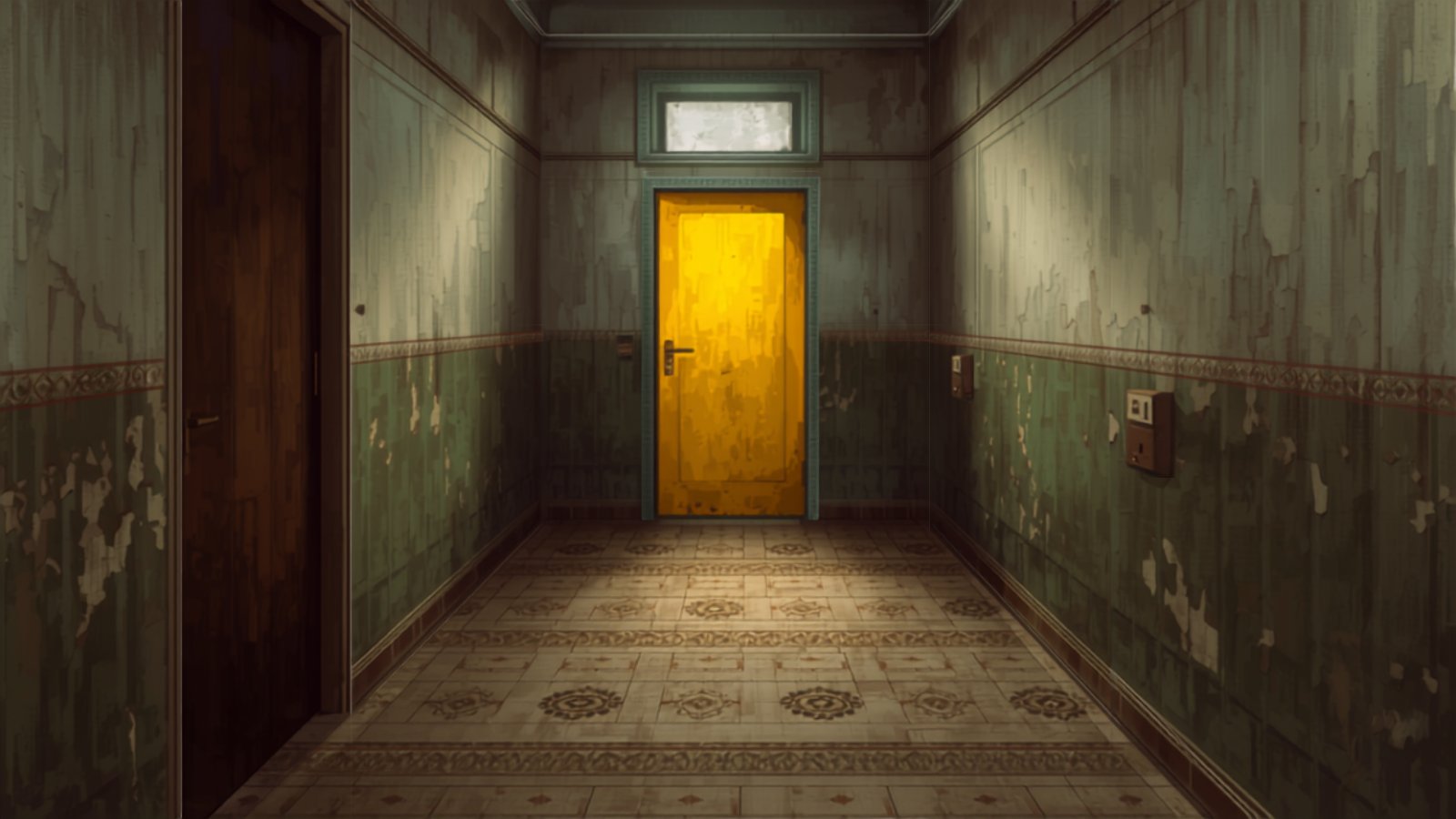
The building was old. It had five floors and no lift. Nina lived on the third floor, in flat number seven. Her door was brown. The door of her neighbour, across the hallway, was a bright, happy yellow. It was not a small yellow, like a lemon. It was a big, strong yellow, like the sun in summer.
On her first morning, Nina met the landlord in the hallway. The landlord was a tall man with grey hair. He carried a heavy box up the stairs.
“Welcome to the building,” he said. “I hope you are happy here.”
“Thank you,” said Nina. Then she pointed to the yellow door. “Who lives there? The door is so bright.”
The landlord smiled. “That is Mrs Bello,” he said. “She lives there for many years. She is a good neighbour. The door — well, she paints it every spring. Ask her about it. It is her story, not mine.”
Nina looked at the yellow door again. It looked friendly. It looked like a door that wanted to say hello. But nobody opened it that day, and Nina went into her own flat. She started to open her boxes and put her books on the shelves. But she thought about the yellow door many times.
2 · Fresh paint
On Saturday morning, Nina heard a soft sound in the hallway. It was the sound of a brush on wood. She opened her door and looked out.
An older woman was in the hallway. She wore an old blue shirt with paint on it. She held a big brush in one hand and a small can of yellow paint in the other. She was painting the door.
“Good morning,” said Nina.
The woman turned. She had kind brown eyes and a warm smile. “Good morning, dear,” she said. “You are my new neighbour. I am Mrs Bello. Please forgive me — I did not visit you this week. I always paint my door in the first week of spring, and this year, I was a little late.”
Nina walked closer. “It is a beautiful colour,” she said. “Really bright. I like it.”
“Thank you,” said Mrs Bello. She smiled again. “It must be bright. That is important.” Then she looked at Nina. “You are new in the building. Do you want a cup of tea when I finish? I have some cake, too. Real cake, from a real oven, not from a shop.”
Nina laughed. “Yes, please,” she said. “I love real cake.”
An hour later, Nina sat at Mrs Bello’s kitchen table. The kitchen was small but full of nice things — old cups, small pictures, a red radio, and flowers in a jar. The cake was lemon and it was very good.
Nina wanted to ask about the yellow door. But she did not want to be rude. So she waited. Mrs Bello poured the tea and put a big piece of cake on Nina’s plate.
“You are looking at my door with big questions in your eyes,” said Mrs Bello. She laughed. “It is all right. Everybody asks about the door. I will tell you the story. But first, drink your tea.”
3 · The promise
Mrs Bello sat down. She looked out of the window for a moment. Then she began to speak.
“I have a son,” she said. “His name is Marco. He is a good boy, but he is not a boy any more. He is a man now, forty years old. Ten years ago, Marco moved to another country. He got a good job, far, far away. Six thousand kilometres away.”
“That is far,” said Nina softly.
“Yes,” said Mrs Bello. “It is very far. On the day he left, we came to the airport together. He was sad. I was sad, too. But I did not cry, because I did not want to make him sad.”
She drank a little tea. Then she went on. “Before he got on the plane, Marco stopped. He hugged me, and he said: ‘Mama, I am going far. But I will come back. I promise. And when I come, you must help me find the door. Paint the door yellow — very yellow. Then, when I walk up the stairs, I will know I am home.'”
Mrs Bello smiled a small, quiet smile. “It was a game between us. He was a big man, but he made a little joke, like a child. And I said, ‘All right, Marco. I promise. Every spring, I will paint the door yellow. So when you come, you will know.'”
“So you paint it every year?” asked Nina.
“Every year,” said Mrs Bello. “Ten times now. Every spring, I open the can of yellow paint. I paint the door. It takes me two hours. And every year, in April, on his birthday, Marco sends me a postcard from his city. He always writes the same three words at the end: ‘Is the door yellow?’ And every year, I write back and I say, ‘Yes, my son. Yellow, like the sun. You will find your way home.'”
Nina did not say anything for a moment. Then she said, “That is a beautiful promise. Really beautiful.”
“It is only paint,” said Mrs Bello. She smiled. “But sometimes paint is more than paint. Sometimes it is a hand on your shoulder, from far away.”
4 · The lost cousin
Two weeks later, Nina’s cousin Lena came to visit. Lena lived in a small town, three hours away by train. She did not know the big city well.
Nina gave her the address on the phone. “It is easy,” said Nina. “You take the bus from the station. You get off at Rose Street. Then you walk one hundred metres and you look for a green sign that says ‘Central Bakery’. The building is right next to the bakery.”
“All right,” said Lena. “I understand. See you soon!”
But an hour later, Nina’s phone rang. It was Lena. Her voice was worried.
“Nina!” she said. “I am on Rose Street, but I cannot find the bakery. There is a shop, and it is closed. It has a big grey cover on the window. I do not see a green sign. There are lots of buildings, and they all look the same. Every door is brown. I don’t know which building is yours.”
Nina thought quickly. She looked at her own brown door. Then she remembered the door across the hallway.
“Lena, listen,” she said. “Go into every building on that street. Walk up to the third floor. Look for a bright yellow door. Really yellow, like the sun. My flat is right next to it.”
“A yellow door?” said Lena. “OK. I will look for it.”
Twenty minutes later, Nina heard a knock at her door. She opened it, and there was Lena — hot, tired, and a little wet from the rain. But she was smiling.
“I found it!” said Lena. “I walked up the stairs in three buildings. I saw many brown doors. Then, in the fourth building, I saw it — bright, bright yellow. I knew straight away. ‘That is Nina’s neighbour,’ I said. And here I am!”
Nina hugged her cousin. “Welcome,” she said. “Come in. I will make you tea.”
Just then, Mrs Bello opened her yellow door. She looked at Lena and she smiled a big smile.
“Ah!” said Mrs Bello. “So my little door helped a new person today. That is a good day.”
Nina laughed. “It really did, Mrs Bello. It really did.”
5 · A postcard in April
Three weeks passed. April came. The weather got warmer. Nina and Mrs Bello were good friends now. They had tea together on Wednesday afternoons. Sometimes Mrs Bello brought a small piece of cake to Nina’s door. Sometimes Nina brought fresh bread to Mrs Bello.
One Thursday morning, Nina heard a soft cry in the hallway. She opened her door. Mrs Bello stood in front of her yellow door. She held a small postcard in her hand. Her eyes were wet, but she was smiling — a very big, happy smile.
“Mrs Bello,” said Nina. “Are you all right?”
Mrs Bello turned. She gave Nina the postcard. “Read it, dear,” she said. Her voice shook a little. “Read it out loud.”
Nina took the postcard. On one side, there was a picture of a bridge in a faraway city. On the other side, there was a short message in blue ink:
“Mama, happy spring. This year, I am not writing to ask about the door. This year, I am writing to tell you: I bought my ticket. I am coming home. I will arrive on the 12th of May. Please, don’t tell anyone. I want to see your face when I walk up the stairs. Is the door yellow? — Marco.”
Nina looked up. Mrs Bello had one hand on her heart.
“Ten years, Nina,” she whispered. “Ten years, and only one more month.”
Nina hugged the old woman. Then she looked at the door.
“Mrs Bello,” she said. “The door is yellow. But maybe — maybe we can make it more yellow. The brightest yellow in the whole city. What do you think? A little help from a neighbour?”
Mrs Bello laughed and cried at the same time. “Yes, dear,” she said. “I think we need to buy some new paint.”
And in that moment, in the small hallway, in front of a bright yellow door, Nina understood something important. Sometimes a home is not only walls and windows. Sometimes it is also a promise, a colour, and a friend across the hall.
Check your understanding
Read each question. Think about your answer. Then click “Show answer” to check.
Words to remember
Here are the eight key words again, in new sentences. Say each one out loud.
- neighbour — My new neighbour plays the piano every evening. It is lovely.
- landlord — I paid the rent to my landlord on Monday.
- hallway — Please put your umbrella in the hallway, not in the living room.
- paint — We painted the bedroom wall a soft blue colour last weekend.
- promise — I promise I will call you tomorrow after work.
- welcome — Come in, come in! Welcome to our home.
- cousin — My cousin lives in London. She works at a big hospital.
- postcard — I sent my mother a postcard from the beach.
Grammar in this story: the past simple
This story uses the past simple tense a lot. We use the past simple for finished actions in the past — things that happened yesterday, last week, or ten years ago. Look:
Nina moved to the city in March. Marco got a good job far away. Lena walked up the stairs and saw a yellow door.
Some past simple verbs are regular — you just add -ed: move → moved, walk → walked, paint → painted. But many common verbs are irregular — they change in a special way: get → got, see → saw, go → went, come → came. You have to learn the irregular ones one by one.
👉 Learn how regular and irregular past-tense verbs work here: Regular and Irregular Verbs: the Basics.
Talk about it · Write about it
Talk about it: Do you have a kind neighbour? What do they do? Is there a small thing in your street — a colour, a sign, a tree — that helps people find your home?
Write about it: Write about 8 sentences about a promise you made, or a promise somebody made to you. Who made the promise? When? Did the promise come true? Use the past simple tense.
🎉 Well done — you read a whole A2 story in English! You met Nina, Mrs Bello, and one very yellow door. And you saw the past simple in action, again and again.
But wait — the 12th of May is coming. Marco will walk up those stairs after ten long years. What will he say when he sees his mother? And what will he say when he sees Nina’s new brown door across the hall? That story is for another day…
Sara feels lonely in a new town. Follow a note found in a library book and notice what it changes. Next story: The Note in the Library Book (A2 Reading Story)
About this story: This is an original A2 graded reader (~1,700 words). It uses controlled A2-level vocabulary (about a 700-headword ceiling) and mainly the past simple tense, so elementary learners can understand about 98% of the words. Any harder word is explained before the story and used again inside it.

I’m Khamis Maiouf. I’m studying Health and Social Care and have completed Functional Skills Level 2 in English and Level 3 Hairdressing. I have taught ESOL in my community and helped students with GCSE English. I run English Teacher Site to help people learn and practise English.