
The Nest in the Lemon Tree (A1 Reading Story)

A1 · BEGINNER Reading practice · ~1,350 words · 9-min read
This is a short, easy story for beginners. It is about a girl, a tree, and a family of birds. The sentences are simple. First, read the eight key words. Then read the story. At the end, there is a small quiz to check what you understand.
Before you read — 8 key words
- nest — a bird’s home. Birds make it from small pieces of trees and grass.
- branch — a small piece of a tree. Leaves grow on branches.
- egg — a baby bird starts life inside this. It is round and small.
- hatch — when a baby bird breaks the egg and comes out.
- worm — a small, long animal that lives in the ground. Birds eat worms.
- feather — birds have these on their bodies. They are soft and light.
- wing — the part of a bird’s body that it uses to fly.
- storm — very bad weather, with strong wind and heavy rain.
The story
1 · Two small birds
Sara is nine years old. She lives in a small house with her mother and her grandad. Behind the house, there is a little garden. In the garden, there is one tree — a lemon tree.
Sara loves the lemon tree. In summer, she sits under it and reads. Grandad loves it too. He is an old science teacher. He knows a lot about plants, birds, and the sky.
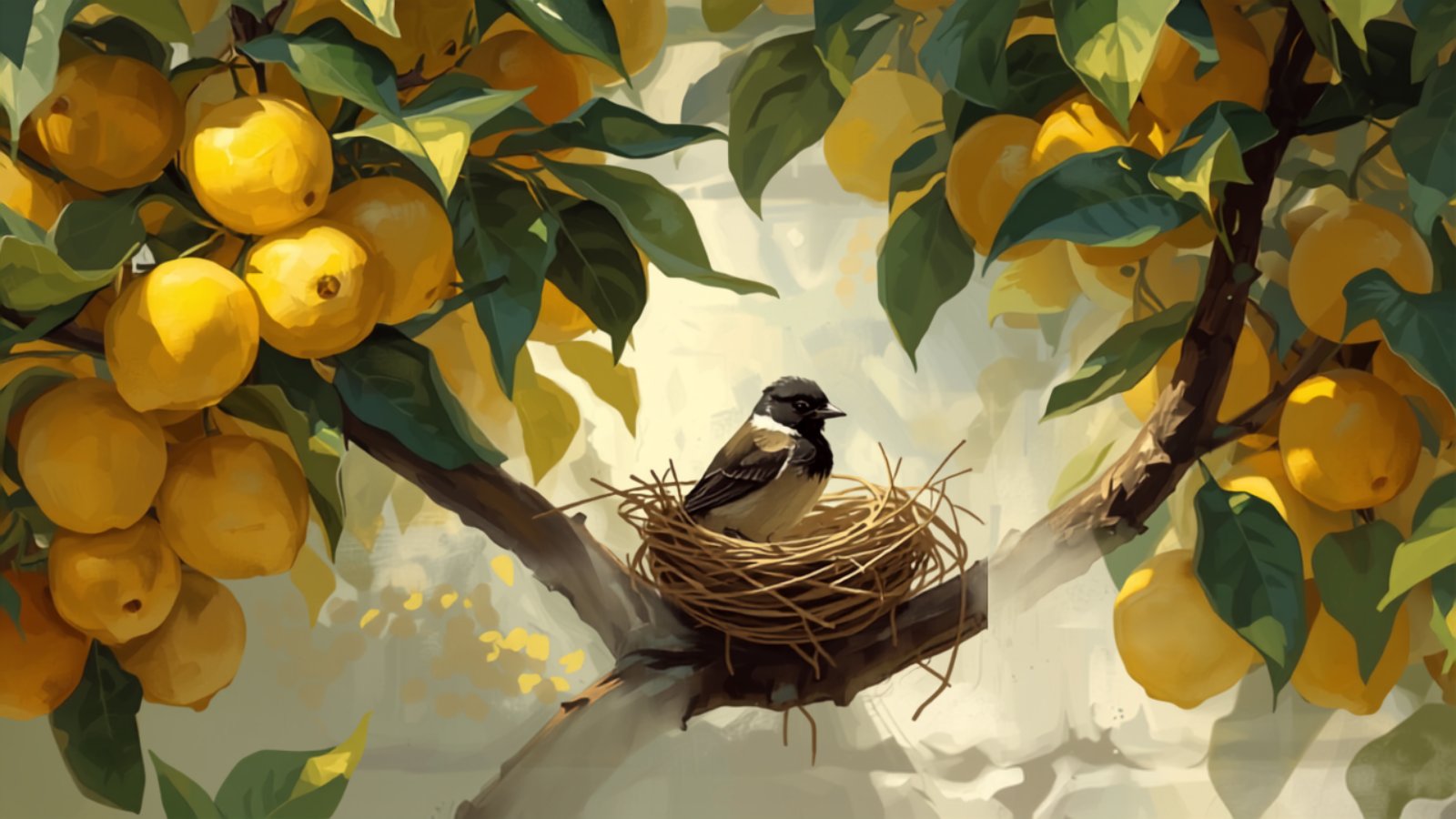
One morning in April, Sara looks out of the kitchen window. She sees a small brown bird in the lemon tree. The bird has a black head and bright little eyes. It jumps from branch to branch.
“Grandad!” Sara calls. “There is a bird in our tree!”
Grandad comes to the window. He smiles. “Look again,” he says. “There are two birds. A mother and a father.”
Sara looks again. Yes — there is a second bird. It carries a small dry branch in its mouth. It puts the branch between two big branches of the tree. Then it flies away and comes back with grass.
“What are they doing?” Sara asks.
“They are building a nest,” Grandad says. “A nest is a bird’s home. Birds make it from small branches and dry grass. Soon, the mother bird puts her eggs in it.”
All week, the two birds work. They bring branches. They bring grass. They bring soft things too — a white feather, a little piece of paper. Day by day, the nest grows. It is round, like a small bowl.
Sara wants to climb the tree and see the nest. But Grandad says no. “Birds need quiet,” he says. “When people come near, the birds are afraid. Sometimes they leave the nest and never come back. We watch from the window. That is the rule.”
So Sara watches from the kitchen window. It is like a TV, but real.
“Why do the birds build the nest now?” Sara asks one day. “Why in April?”
“Because it is spring,” Grandad says. “In spring, the sun is warm again. There is a lot of food — new plants, new insects. It is a good time for baby birds. Nature has a plan for everything.”
2 · Four blue eggs
One morning, the mother bird sits in the nest and does not move. She sits all morning. She sits all afternoon. She sits all night.
“Why does she sit there?” Sara asks. “Is she tired?”
“No,” Grandad says. “There are eggs under her now. An egg needs to be warm. The mother’s body is warm, like a little blanket. She keeps the eggs warm for about two weeks. Then the baby birds hatch — they break the eggs and come out.”
That evening, the mother bird flies away for a short time. She needs food and water. Sara looks from the window, very fast. Inside the nest she sees them: four small eggs. They are blue, with little brown spots.
“Four eggs!” Sara says. “When do the babies come? Tomorrow?”
Grandad laughs. “Not tomorrow. In about two weeks. Nature is not fast, Sara. Nature takes its time.”
Sara starts a little notebook. She calls it The Bird Book. Every day, she writes one line and draws one picture.
Day 1: The mother sits on the eggs.
Day 2: Rain. The mother still sits.
Day 3: The father brings food to the mother.
The father bird works hard. He flies to the garden and looks in the ground. He finds worms and small insects. Then he flies to the nest and gives the food to the mother. She cannot leave the eggs for a long time, so he brings breakfast, lunch, and dinner to her.
“See?” Grandad says. “The mother and the father work together. That is how a bird family lives.”
3 · The storm
On day ten, the sky changes. In the evening, big grey clouds come. The wind gets strong. The lemon tree moves left and right. Then the rain starts — heavy, loud rain. It is a storm.
Sara cannot sleep. She hears the wind. She hears the rain on the window. She thinks about the nest and the four blue eggs.
She goes to Grandad’s room. “Grandad, the storm is very strong. Can we bring the nest inside the house? Please?”
“No, Sara,” Grandad says softly. “We never touch a nest. Never. The mother bird is there. She sits low in the nest and covers the eggs with her body and her wings. And look — the birds are clever. They build the nest deep inside the tree, where the big branches stop the wind. Birds choose safe places. They know.”
“But she is so small,” Sara says.
“Small, yes,” Grandad says. “But strong. Go to sleep. In the morning, we look.”
In the morning, the sky is blue again. Sara runs to the kitchen window. The garden is wet. There are leaves and small branches on the ground. And the nest?
The nest is there. The mother bird sits in it, wet but fine. The father bird stands on a branch and sings a loud, happy song.
Sara writes in her Bird Book: Day 11: The storm goes away. The birds are safe. Birds are small, but they are strong.
4 · Fly!
On day fourteen, Sara hears something new. A very small sound comes from the tree: peep, peep, peep.
“Grandad! Come! I hear babies!”
It is true. The eggs hatch, one by one. Now there are four baby birds in the nest. They are very small. They have no feathers, and their eyes are closed. But their mouths are big and open. They want food, food, food.
Now the mother and the father fly all day. They come and go, come and go. They bring worms and insects to the babies. Grandad says, “Baby birds eat all the time. The parents feed them maybe one hundred times in one day. That is why the babies grow so fast.”
Sara writes new lines in her Bird Book every day. Day 15: The babies are pink and small. Day 18: I see small feathers! Day 21: The babies are big and loud now. Grandad looks at the book and says, “You watch, and you write what you see. That is what a scientist does, Sara.”
The days pass. The babies open their eyes. Small feathers grow on their bodies. Their wings get bigger and stronger. Soon, the nest is too small for four young birds. They stand on the side of the nest and move their wings up and down, up and down. They are not flying. They are learning.
Then, one sunny morning, it happens. The first young bird jumps — and flies! It flies to the garden wall. The second bird flies. The third bird flies too.
But the fourth bird — the smallest one — does not fly. It sits on the side of the nest. It looks down. It is afraid.
Sara watches from the window. “You can do it,” she says quietly. “Fly, little bird.”
The mother bird sits on the wall with a worm in her mouth. She calls: peep, peep! It means, “Come! Breakfast is here!”
The little bird moves its wings. One, two, three… and it jumps. For one second, it falls. Then its wings open — and it flies! It flies to the wall, next to its mother. Sara jumps too, in the kitchen. “Yes!” she says. “You fly!”
Weeks pass. The young birds get big. Then, one cold morning in autumn, the tree is quiet. The bird family is not there. “Where are they?” Sara asks. “The days are cold now,” Grandad says. “Many birds fly away to warm countries. They come back when the sun comes back.”
Sara is a little sad. She looks at the empty nest in the lemon tree. Inside it, she sees one small thing: a little feather. She keeps it in her Bird Book, on the last page.
“Do they come back in spring?” she asks.
“Wait and see,” Grandad smiles.
Winter comes and goes. Then, one morning in March, Sara sits in the kitchen. And she hears a small sound in the lemon tree…
Check your understanding
Read each question. Think about your answer. Then click “Show answer” to check.
Words to remember
Here are the key words again, in new sentences. Say each one out loud.
- nest — The bird makes a nest in the tree next to my school.
- branch — A cat sits on a branch and looks down at me.
- egg — A chicken egg is white or brown, but this bird’s eggs are blue.
- hatch — The eggs hatch after two weeks, and the babies come out.
- worm — After the rain, I see a worm on the wet ground.
- feather — I find a soft white feather in the park.
- wing — The bird opens its wings and flies to the tree.
- storm — The storm is loud at night, but in the morning the sky is blue.
Grammar in this story: the present simple
This story uses the present simple tense. We use it for things that are true, and for things that happen again and again in nature. Look:
The mother bird sits on the eggs. The father brings food. The babies grow fast.
See how the verb adds -s for he, she, and it: sit → sits, bring → brings, fly → flies.
👉 Learn the full rule here: Present Simple for Beginners.
Talk about it · Write about it
Talk about it: Do you see birds near your home? Where do they live? What do they eat? Do you have a favourite animal in nature?
Write about it: Write 5 simple sentences about one animal you know. Where does it live? What does it eat? What does it do every day? Use the present simple.
🎉 Well done — you read a whole story in English! And you learned some real science too: how birds build nests, why eggs need warm bodies, and how baby birds learn to fly.
But wait — what is that sound in the lemon tree in March? Is the bird family back? What happens next? Write your own ending in five short sentences.
Something is happening to Mr Sam’s tomatoes. Look for clues as you read this garden story. Next story: The Missing Tomatoes (A1 Reading Story)
About this story: This is an original A1 graded reader (~1,350 words). It uses simple, controlled vocabulary and the present simple tense, so beginners can understand about 98% of the words. Any harder word is explained before the story and used again inside it.

I’m Khamis Maiouf. I’m studying Health and Social Care and have completed Functional Skills Level 2 in English and Level 3 Hairdressing. I have taught ESOL in my community and helped students with GCSE English. I run English Teacher Site to help people learn and practise English.