
The Silent Garden (A2 Reading Story)

A2 · ELEMENTARY Reading practice · ~1,650 words · 11-min read
This is an original story for A2 learners. It is about nature — and a small mystery in a garden. First, read the ten key words. Then read the story. At the end, there is a quiz, a grammar point, and a writing task.
Before you read — 10 key words
- bee — a small yellow-and-black insect that makes honey.
- hive — the box or home where bees live together.
- insect — a very small animal with six legs, like a bee or an ant.
- nectar — the sweet juice inside a flower. Bees drink it.
- pollen — the yellow powder inside a flower. Bees carry it from flower to flower.
- buzz — the sound a bee makes: bzzz.
- wildflower — a flower that grows by itself, not in a garden.
- meadow — an open field full of grass and wildflowers.
- notice — to see something and think about it.
- experiment — a careful test to learn if an idea is true.
The story
1 · Grandfather’s garden
Amira was twelve years old, and she lived with her mother and her grandfather in a small house at the end of Green Lane. The house was old, but the garden was famous. Everybody on the street knew Grandfather Sami’s garden.
Why was it famous? Because of the bees.
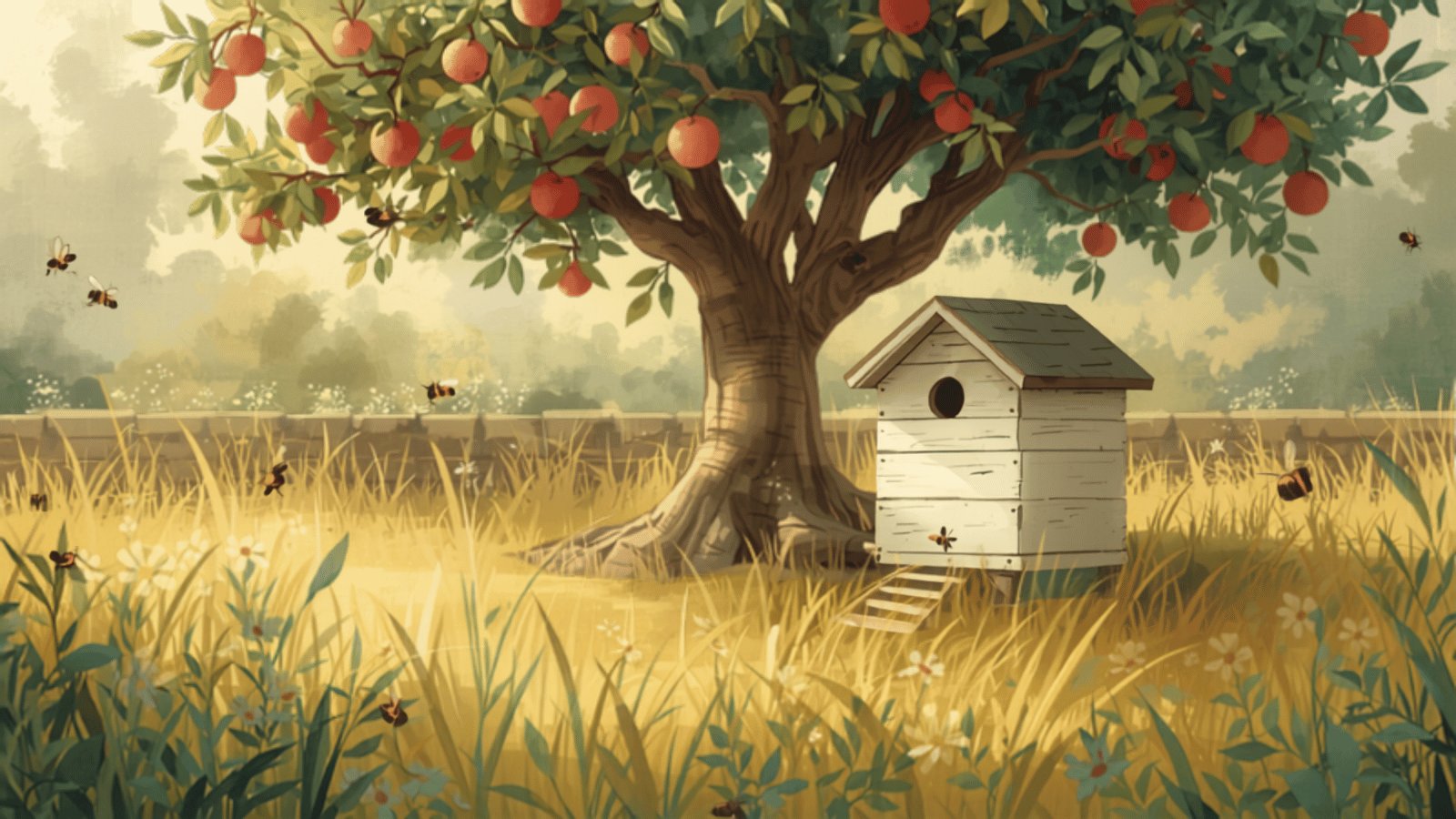
At the back of the garden, under the apple tree, there was a white wooden box. This box was a hive — the home of about fifty thousand bees. Grandfather Sami kept bees for forty years. He knew everything about them.
“A hive is like a city,” he told Amira. “There is one queen. She is the mother of all the bees. The other bees work all day. Some clean the hive. Some look after the babies. And some fly out to the flowers.”
“What do they do at the flowers?” Amira asked, when she was small.
“They collect two things,” Grandfather said. “They drink nectar — that is the sweet juice inside a flower. At home, they change the nectar into honey. And they carry pollen — the yellow powder inside a flower — from one flower to the next. That is how flowers make seeds. No bees, no seeds. No seeds, no fruit.”
Amira loved the garden in summer. The air was warm and full of sound. Hundreds of bees buzzed between the roses and the lavender. Bzzz, bzzz. To Amira, the buzz of the garden was the sound of summer itself.
Every August, Grandfather opened the hive and took some honey. He always left enough for the bees. Amira helped him put the golden honey into small glass jars. They gave jars to the neighbours, to the postman, and to Amira’s teacher, Miss Chen.
“Best honey in town,” the postman always said. “Your bees are hard workers, Mr Sami.”
Sometimes Amira sat very close to the hive and watched the door. Bees flew out, one after another, fast and straight, like little planes from an airport. Other bees came home slowly, heavy with yellow pollen on their back legs. Grandfather taught her not to be afraid. “Move slowly,” he said. “A bee is not interested in you. She is interested in flowers.”
Grandfather smiled. “They only need one thing from us,” he said. “Flowers. Give bees flowers, and they will give you everything.”
2 · The silent morning
One morning in June, Amira went into the garden with her breakfast. She sat under the apple tree and waited for the sound of summer.
But the garden was quiet.
She looked at the roses. No bees. She looked at the lavender. One bee — only one — moved slowly from flower to flower. Amira noticed something else, too. In front of the hive, there was almost no movement. On a normal June day, the door of the hive was like a busy airport. Today it was nearly empty.
Amira put down her breakfast and walked closer. She watched the one bee on the lavender. It moved slowly, like a tired old man. It landed on a flower, waited, then flew to the next one. It did not buzz. Something was wrong — she felt it.
She ran into the kitchen. “Grandfather! Come quickly! The bees — the garden is silent!”
Grandfather Sami came out. He stood by the hive for a long time and said nothing. His face was serious.
“Are they ill?” Amira asked. “Is the queen dead?”
Grandfather opened the top of the hive carefully and looked inside. “No,” he said slowly. “The queen is well. The babies are well. But the workers came home with empty legs. No pollen. Almost no nectar. Amira, the bees are not ill. The bees are hungry.”
“Hungry? But the garden is full of flowers!”
“One garden is not enough for fifty thousand bees,” he said. “Bees fly far — two kilometres, sometimes three. They need flowers everywhere, all summer. Something changed out there.” He pointed over the fence, at the town. “The problem is not in our garden. The problem is out there.”
Amira looked at the quiet hive, and then at the roofs of the town. “Then we are going to find it,” she said. “We will do an experiment.”
Grandfather smiled for the first time that morning. “Spoken like a scientist,” he said.
3 · The town without flowers
The experiment was simple. Every evening for one week, Amira counted the bees that came home to the hive in ten minutes. She wrote the numbers in a notebook. Monday: 31. Tuesday: 28. Wednesday: 24. The numbers went down and down.
On Saturday, Amira and Grandfather walked through the town with the notebook. They wanted to answer one question: where did the flowers go?
First, they went to the old meadow behind the school. Amira remembered it well. Last summer, the meadow was a sea of wildflowers — white, yellow, purple. Bees and other insects were everywhere.
The meadow was gone. In its place, there was a new car park. Flat, grey, and hot.
Amira stood at the edge of the car park and remembered the sound of last summer — the buzz of a thousand insects in the tall grass. Now she heard only cars. “Oh no,” she said quietly. She wrote in her notebook: Meadow — gone. Now a car park.
“When did this happen?” she asked.
“In the spring,” Grandfather said. “The supermarket needed more space for cars. Nobody asked the bees.”
Next, they walked along the river. The town workers were there with big machines. They cut all the grass on both sides of the river — and with it, every wildflower. The ground was short, tidy, and empty.
“People think short grass looks clean,” Grandfather said. “But for a bee, this is a supermarket with empty shelves.”
Last, they looked at the gardens on their own street. Amira noticed it for the first time: stones, plastic grass, and wooden floors. Beautiful for people, maybe. But there was almost nothing for an insect to eat.
Amira sat down on a wall and read her notebook. “So that is the answer,” she said. “The meadow became a car park. The river flowers are cut. The gardens have no flowers. The bees have no food. Our experiment worked — but I don’t like the answer.”
“A good scientist finds the problem,” Grandfather said. “A great scientist does something about it.”
Amira was quiet for a minute. Then she stood up. “The bees fly everywhere, right? Two or three kilometres. So we can’t fix one garden. We have to fix the town.” She smiled. “Grandfather, we are going to build a road of flowers.”
4 · A road of flowers
On Monday, Amira went to school early and told Miss Chen everything: the silent garden, the hungry bees, the notebook, the car park.
Miss Chen listened carefully. Then she said, “Amira, this is real science. Will you tell the class?”
So Amira stood in front of thirty students and told the story of the bees. She showed her numbers. At the end she said, “Bees carry pollen from flower to flower. Without them, there are no apples, no strawberries, no tomatoes. The bees helped us for years. Now they need our help. Every pot of wildflowers is a little restaurant for a bee. If every family plants one pot, we will build a road of flowers across the town.”
The class loved the idea. They made posters. They put them in the school, in the library, and in the supermarket — the one next to the new car park. The posters said: HUNGRY BEES NEED FLOWERS. PLANT ONE POT!
Grandfather Sami did his part, too. He bought hundreds of little bags of wildflower seeds. Amira and her friends gave them to the neighbours, to the postman, and to every child at school. Most people smiled and took a bag. Some people said, “It’s only one pot. Will it really help?” And Amira always answered, “One pot won’t. A thousand pots will.”
Then they waited. Seeds are slow, and June became July. Every evening, Amira still counted the bees and wrote the numbers in her notebook. For two weeks, the numbers stayed low, and she started to worry. “Maybe it isn’t going to work,” she said one night. “Give it time,” Grandfather answered. “Nature is slow, but nature does not forget.”
Slowly, the town changed. Flowers appeared in pots by front doors. They appeared in window boxes, in old buckets, even in a broken boat in Mr Petrov’s garden. The school planted a wildflower corner behind the gate. And after many letters from Miss Chen’s class, the town workers agreed to an experiment of their own: this summer, they cut the grass by the river only once, not every week.
One warm evening in August, Amira sat under the apple tree with her notebook. She counted the bees that came home in ten minutes. She counted 47. Then she stopped counting and just listened.
Bzzz. Bzzz. The buzz was back. The sound of summer was back.
“Listen to that,” Grandfather said. He gave her a piece of bread with new honey. “This jar is yours. The first jar of the year always goes to the best scientist in the house.”
Amira laughed and ate the bread. The honey tasted like flowers.
But then Grandfather looked up at the apple tree, and his eyes grew wide. “Amira,” he said quietly. “Don’t move. Look.”
Above them, on a low branch, hung a big, dark, moving ball. It was made of thousands of bees — and it was not from their hive. “New bees,” Grandfather whispered. “A whole family, looking for a home. They followed your road of flowers.” He turned to her. “Tomorrow, we are going to need a second hive. But first we must answer one question: where did they come from?”
Check your understanding
Read each question. Think about your answer. Then click “Show answer” to check.
Words to remember
Here are the key words again, in new sentences. Say each one out loud.
- bee — A bee visited every flower on my balcony this morning.
- hive — The farmer keeps three hives behind his house.
- insect — An ant is a very small insect with six legs.
- nectar — Butterflies also drink the sweet nectar inside flowers.
- pollen — In spring, yellow pollen covered our car.
- buzz — I heard a buzz near my ear and jumped!
- wildflower — We picked no wildflowers — we left them for the bees.
- meadow — The children played football in the meadow behind the farm.
- notice — Did you notice the new flowers next to the bus stop?
- experiment — We did an experiment in class with water and salt.
Grammar in this story: the past simple
This story uses the past simple tense, because it tells us about finished actions in the past. Look:
Amira lived with her grandfather. She counted the bees and wrote the numbers in a notebook. They walked through the town.
Regular verbs add -ed: live → lived, count → counted, walk → walked. But many common verbs are irregular — they change completely: write → wrote, go → went, buy → bought, make → made.
👉 The most important irregular verb is go. Learn it here: Went or Gone? The Past Tense of Go.
Talk about it · Write about it
Talk about it: Are there many bees, birds, or other insects where you live? Is there a green place in your town that changed in the last few years? What happened to it?
Write about it: Write 6–8 sentences about a small thing people in your town can do to help nature. What is the problem? What is your idea? Use the past simple to describe the problem, and going to or will for your plan.
🎉 Well done — you finished a whole story in English, and you learned some real science too! Bees really do visit hundreds of flowers a day, and towns really can help them with wildflowers.
But wait — thousands of new bees are hanging in the apple tree. Where did they come from? And what will happen when Amira and Grandfather open the second hive? What happens next? Write your own ending in five short sentences.
More reading: Read another A2 story →
About this story: This is an original A2 graded reader (~1,650 words). It uses controlled elementary vocabulary and mainly the past simple tense, with going to and will for plans, so A2 learners can understand about 98% of the words. Any harder word is explained before the story and used again inside it.

I’m Khamis Maiouf. I’m studying Health and Social Care and have completed Functional Skills Level 2 in English and Level 3 Hairdressing. I have taught ESOL in my community and helped students with GCSE English. I run English Teacher Site to help people learn and practise English.