
The Lost Wallet (A1 Reading Story)

A1 · BEGINNER Reading practice · ~1,300 words · 9-min read
This is a short, easy story for beginners. The sentences are simple. First, read the eight key words. Then read the story. At the end, there is a small quiz to check what you understand.
Before you read — 8 key words
- wallet — a small flat bag for your money and cards.
- earn — to get money for your work.
- save — to keep money and not spend it now.
- count — to say numbers to know how many: one, two, three…
- boss — the person you work for.
- honest — an honest person does not lie and does not take things that are not theirs.
- pocket — a small bag inside your trousers or coat.
- delivery — the job of taking food or things to people’s houses.
The story
1 · The tin under the bed
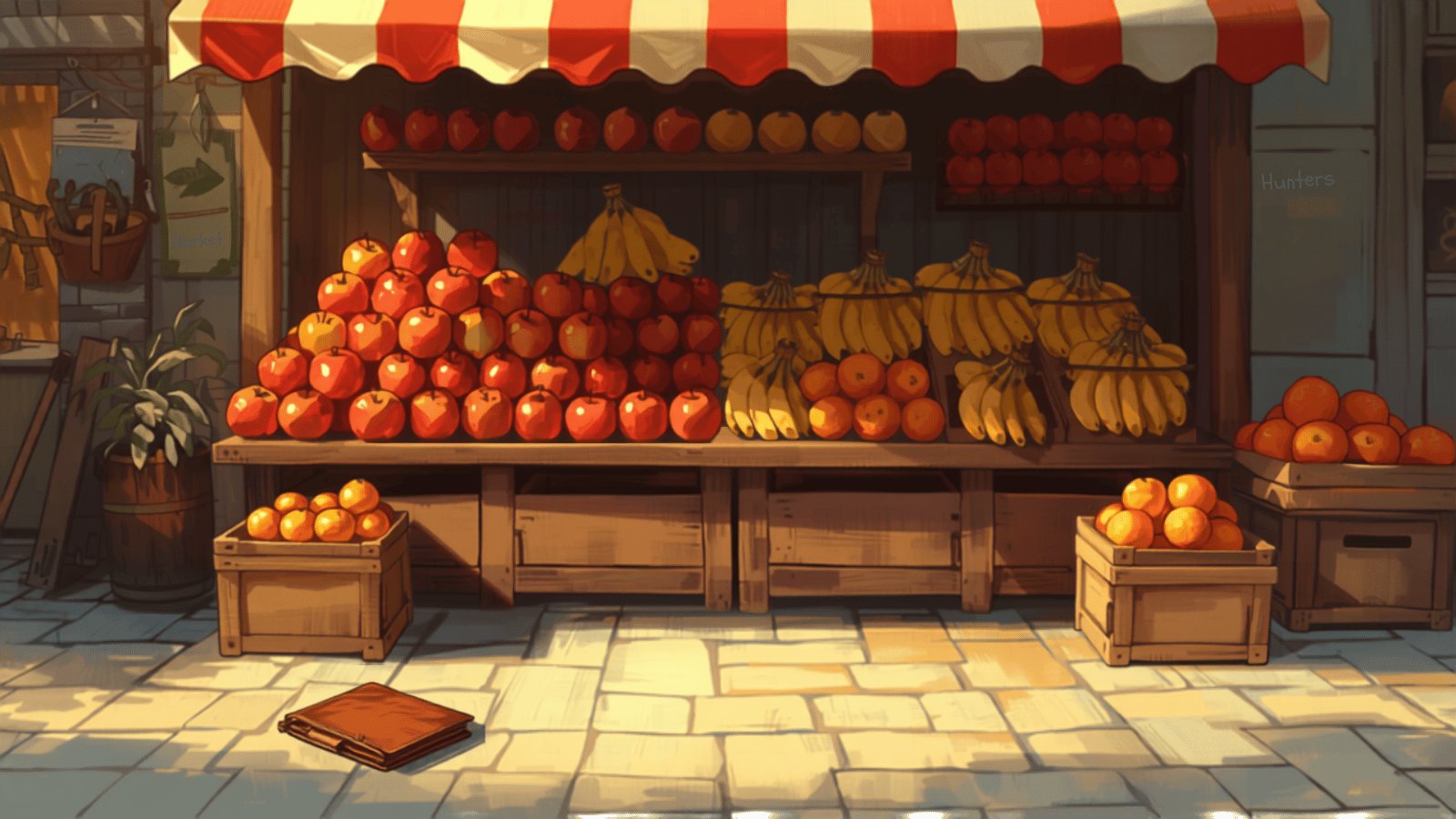
Omar is nineteen years old. He works in a small shop in the market. The shop sells fruit and vegetables. It is a busy little shop, with red apples, yellow bananas, and big boxes of oranges.
Omar’s boss is Mr Sami. A boss is the person you work for. Mr Sami is a big man with a big voice, but he is kind. He teaches Omar many things: how to talk to customers, how to make the fruit look nice, and how to give the right money back.
Omar works six days a week. He starts at eight o’clock in the morning. He finishes at five o’clock in the evening. It is a long day, but Omar does not mind. He likes his job.
He likes the colours of the fruit in the morning sun. He likes the old men who talk about football. He likes the children who point at the strawberries and say, “Please, Mum, please!” The market is noisy and happy, and Omar is happy in it.
Every Friday, Mr Sami gives Omar his money. “Here you are, Omar,” he says. “You work hard. You earn this.” To earn money means to get money for your work.
Omar does not spend all his money. He saves it. To save money means to keep it and not spend it now. At home, Omar has an old tea tin. He keeps it under his bed. Every Friday night, he puts some money in the tin. Then he counts it all, slowly, note by note.
Why does Omar save his money? Because of a bicycle.
There is a bicycle shop next to the market. In the window, there is a beautiful red bicycle. It costs ninety pounds. Omar looks at it every morning on his way to work.
The bicycle is not just for fun. There is a new café on King Street. It has a sign in the window: “Delivery rider wanted. Evenings. You need your own bicycle.” A delivery job means you take food to people’s houses. With a bicycle, Omar can work in the shop in the day and do deliveries in the evening. He can earn more money and send some to his mother in his home town.
On Friday night, Omar counts his money again. Seventy-one pounds. “Nineteen more,” he says quietly. “Maybe four more weeks.” He puts the tin back under the bed and smiles in the dark.
2 · The busy Saturday
Saturday is the big day at the market. Everybody comes on Saturday. The street is full of people, bags, dogs, and noise.
Omar is very busy. He weighs tomatoes. He counts out change. He carries heavy boxes. “Two kilos of apples, please!” “How much are the oranges?” “One banana for the baby!” The morning flies past.
At three o’clock, the shop is quiet for a moment. Mr Sami goes to buy tea. Omar takes the big brush and starts to clean the floor.
Then he sees it.
Under a box of oranges, there is a small brown wallet. A wallet is a small flat bag for money and cards. It is old and soft, and it is fat with money.
Omar looks left. He looks right. Nobody is watching. He picks up the wallet and opens it.
Inside, there is a lot of money. Omar counts it with his eyes: twenty, forty, sixty… one hundred and eighty pounds. There is no name and no phone number. There is only one small photo of a man with white hair and a kind smile.
Omar’s heart beats fast. One hundred and eighty pounds. With this money, he can buy the red bicycle today. Today! And there is money left for his mother too.
He puts the wallet in his pocket. His pocket feels very heavy. It feels hot, like a little sun.
“Nobody sees me,” he thinks. “Nobody knows.”
3 · The long night
That evening, Omar sits on his bed. The wallet is on the table. The tea tin is next to it. He does not open the tin. He does not count his money. He only looks at the wallet.
He thinks about the red bicycle. He thinks about the delivery job on King Street. He thinks about the money he can send home.
Then he thinks about the photo. The man with white hair and the kind smile. Who is he? Whose wallet is it? Maybe it is an old woman’s money. Maybe it is her money for food. Maybe she is at home now, looking in every bag and every pocket, and crying.
Omar remembers his mother’s words. She says them every time he visits: “Omar, money comes and money goes. But your good name stays. Be honest.” An honest person does not lie and does not take things that are not theirs.
Omar looks at the wallet for a long time. Then he says, out loud, to the empty room: “It is not my money.”
He puts the wallet under his pillow. He turns off the light. He does not sleep well, but his heart feels lighter.
4 · The woman in the green coat
On Monday morning, Omar gives the wallet to Mr Sami and tells him everything. Mr Sami listens. Then he puts his big hand on Omar’s shoulder.
“You are a good man, Omar,” he says. “We keep it safe. The owner always comes back.”
Mr Sami is right. At ten o’clock, an old woman in a green coat comes into the shop. She is not looking at the fruit. She is looking at the floor. Her eyes are red.
“Excuse me,” she says. “I am here on Saturday. I buy oranges. And I lose my wallet. It is brown and old. Please — is it here?”
“What is inside it?” Mr Sami asks softly.
“Money,” she says. “A lot of money. It is for my rent. And a photo. A photo of my husband. It is my only one.”
Omar takes the wallet from the drawer and gives it to her. “Here it is,” he says. “I find it under the oranges.”
The woman opens the wallet. She counts the money. It is all there — one hundred and eighty pounds. She holds the photo to her heart. Then she starts to cry, right there, next to the bananas.
“Thank you,” she says. “Thank you, thank you. What is your name, young man?”
“Omar.”
She takes out a twenty-pound note. “Please, take this.”
Omar shakes his head. “No, thank you,” he says. “It is your money. All of it.”
The woman looks at him for a long moment. She smiles a small, clever smile. “Omar,” she says. “Do you know the new café on King Street?”
Omar’s eyes open wide. “Yes,” he says. “I know it.”
“It is my son’s café,” she says. “Come on Saturday at ten o’clock. There is something for you there.”
All week, Omar thinks about her words. What is at the café? A job? A thank-you tea? Something else?
The week goes very slowly. On Wednesday, Omar walks past the bicycle shop. The red bicycle is still in the window. “Four more weeks,” he tells it. On Friday, Mr Sami gives him his money and winks. “Big day tomorrow,” he says. Omar puts his money in the tea tin and counts it one more time. Seventy-eight pounds now. He cannot sleep.
On Saturday, Omar walks to King Street. His heart beats fast again — but this time it is a happy fast. He stops in front of the café. In the window, there is a big sign. And on the sign, there is his name.
Omar reads the first word… and starts to laugh.
Check your understanding
Read each question. Think about your answer. Then click “Show answer” to check.
Words to remember
Here are the key words again, in new sentences. Say each one out loud.
- wallet — My wallet is in my bag. It has ten pounds inside.
- earn — She works in a hospital. She earns good money.
- save — I save five pounds every week for my holiday.
- count — The little boy can count from one to twenty.
- boss — My boss is friendly. She says “good morning” every day.
- honest — He is an honest man. He always tells the truth.
- pocket — My keys are in my coat pocket.
- delivery — The delivery man brings pizza to our door.
Grammar in this story: present simple negatives with don’t and doesn’t
This story uses the present simple. To say no in the present simple, we use do not (don’t) and does not (doesn’t). Look:
Omar does not spend all his money. He does not open the tin. He does not sleep well. An honest person does not lie.
Use doesn’t with he, she, and it. Use don’t with I, you, we, and they: I don’t spend, he doesn’t spend.
👉 Learn the full rule here: Present Simple for Beginners.
Talk about it · Write about it
Talk about it: Imagine you find a wallet with a lot of money. Nobody sees you. What do you do? Why?
Write about it: Write 5 simple sentences about money. What do you save for? What do you want to buy? Use the present simple, and try one sentence with don’t or doesn’t.
🎉 Well done — you read a whole story in English! That is a big step. And did you notice? You now know the eight new words too.
But wait — what is on the sign in the café window? Why does Omar laugh? What happens next? Write your own ending in five short sentences.
More reading: Read another easy A1 story →
About this story: This is an original A1 graded reader (~1,300 words). It uses simple, controlled vocabulary and the present simple tense, so beginners can understand about 98% of the words. Any harder word is explained before the story and used again inside it.

I’m Khamis Maiouf. I’m studying Health and Social Care and have completed Functional Skills Level 2 in English and Level 3 Hairdressing. I have taught ESOL in my community and helped students with GCSE English. I run English Teacher Site to help people learn and practise English.