
The Sugar Bird Festival (A2 Reading Story)

A2 · ELEMENTARY Reading practice · ~1,900 words · 13-min read
This is an original short story for elementary learners (A2). The sentences are simple, and most of the story uses the past simple tense. First, look at the ten key words. Then read the story. At the end, you can check your understanding with a small quiz.
Before you read — 10 key words
- festival — a special day when many people do the same fun thing together.
- tradition — something people do every year in the same way.
- neighbour — a person who lives near you.
- dough — flour, butter, and water mixed together, before you cook it.
- oven — the hot box in the kitchen where you bake bread and cakes.
- basket — a bag with a handle, often made of thin wood, for carrying things.
- shy — feeling not brave in front of new people.
- shape — the form of something (a circle, a square, a bird).
- recipe — instructions that tell you how to cook something.
- lonely — sad because you are alone.
The story
1 · The village on the hill
Marco moved to Riverstone two months ago. Riverstone was a small village in the mountains. It had one shop, one school, one bakery, and one long, quiet street. Marco lived with his mother in a small yellow house at number seven.
Marco was ten years old. His father worked in a big city, far away, so Marco only saw him on the weekend. From Monday to Friday, it was just Marco and his mother, and the mountains, and the cold wind that came down from the top.
The old people in Riverstone were kind. They smiled at Marco in the street. The children at school were friendly too. But Marco was shy. Shy means you do not feel brave in front of new people. He did not know how to make friends yet. He ate his lunch alone. He walked home alone. In the evening, he sat by the window and watched the birds fly over the mountains.
One Saturday morning, Marco saw something strange. His neighbour was outside. A neighbour is a person who lives near you. Her name was Mrs Kaur, and she lived in the pink house across the street. She was hanging small paper birds — pink, blue, yellow — from a rope in her garden.
Marco went to the kitchen. “Mum,” he asked, “why has Mrs Kaur got paper birds in her garden?”
His mother was busy on her laptop. She looked up and smiled a little.
“Oh, of course,” she said. “It is next Sunday. The Sugar Bird Festival.”
2 · The tradition
“The what?” Marco said.
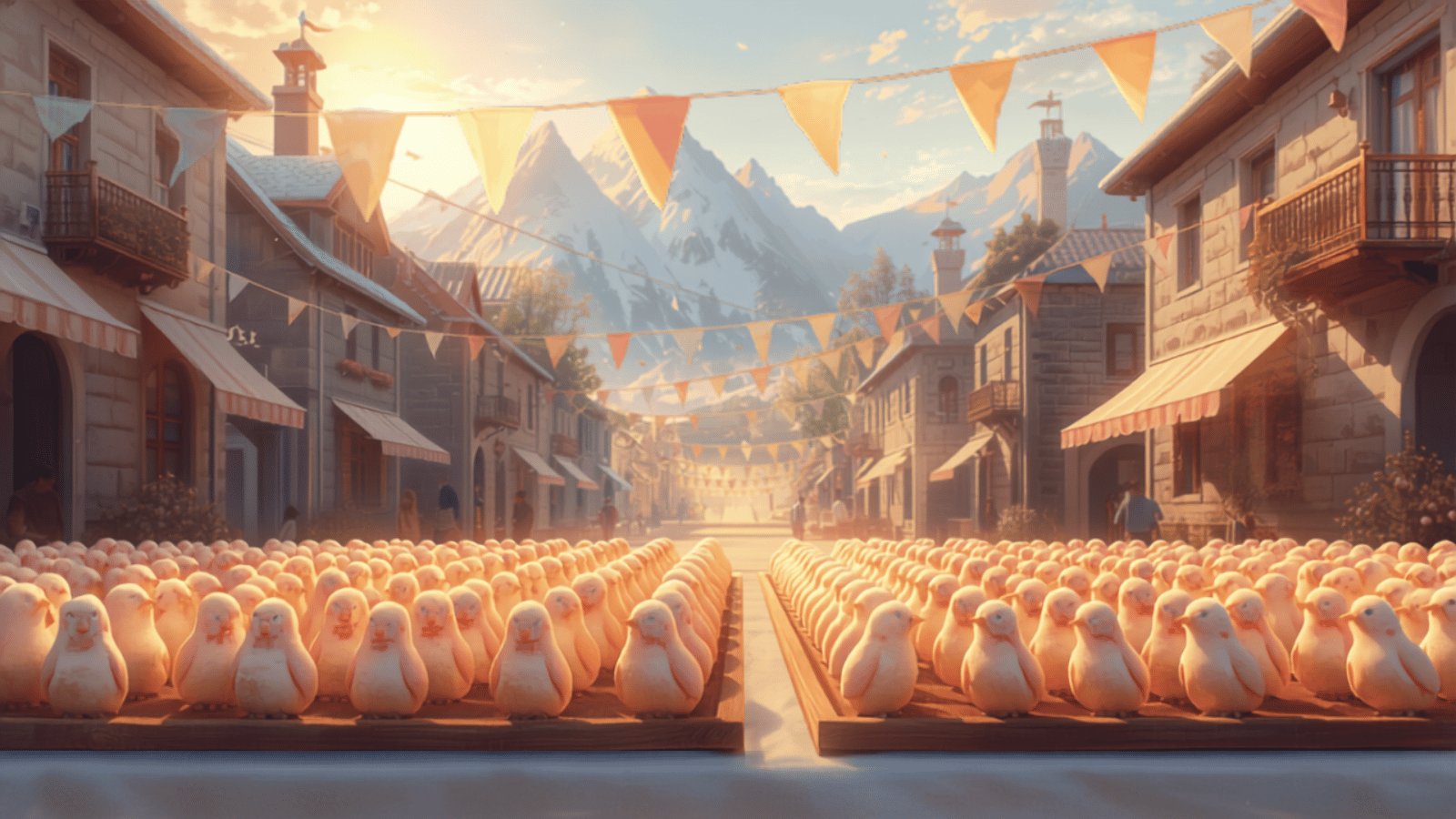
“The Sugar Bird Festival,” his mother said again. “It is a tradition here in the mountains. A tradition is something that people do every year in the same way. In the spring, when the birds fly back from the warm countries, every family in Riverstone bakes little cakes. The cakes are in the shape of a bird. Then, on Sunday morning, everybody walks down the street with a basket of sugar birds, and they give one to every neighbour. It is their way of saying, ‘Welcome, spring. And welcome, everyone.'”
Marco’s eyes were wide. “Everybody?” he said. “Even… us?”
His mother looked tired. She looked at the pile of boxes in the corner. She looked at her laptop. She looked at the cold kitchen.
“Marco, we only moved two months ago,” she said. “We do not have an oven yet — the men will bring it next week. The kitchen is a mess. And I have so much work this week. I am sorry, but this year, we cannot join the festival. Next year, I promise.”
Marco did not say anything. He went upstairs to his room. He closed the door quietly. From his window, he could see all the little houses on the street. In front of every door, there was a small paper bird — a sign for the festival. He counted them. Fifteen houses, fifteen birds. And in front of his own house — nothing.
For the first time since he came to Riverstone, Marco felt truly lonely. Lonely means sad because you are alone. He wanted to bake sugar birds. He wanted to walk down the street with a basket in his hand. He wanted to knock on doors and give people something warm and sweet. But he could not.
He put his head on his pillow. And he closed his eyes.
3 · A knock on the door
Sunday morning came. The sun was bright. Outside, Marco could hear voices, and laughing, and the sound of many feet on the street. The festival was starting.
Marco sat in the kitchen. His mother worked at the small table on her laptop. On the plate in front of Marco, there was only cold toast. He did not want it.
Then — knock, knock, knock.
Marco jumped a little. Who was it? He looked at his mother. She looked at him.
“You go, Marco,” she said gently.
Marco walked to the door. He opened it slowly. There, on the doorstep, was Mrs Kaur. She was small, with grey hair and kind brown eyes. In her hand, she carried a big empty basket. A basket is a bag with a handle, often made of thin wood, for carrying things.
“Good morning, Marco,” Mrs Kaur said. “I saw your face at the window last week. And this morning, I do not see any paper bird in front of your door. So I have a question for you.”
Marco could not speak. He just looked at her.
“Come to my kitchen,” Mrs Kaur said. “Come and help me bake. Every new family in Riverstone needs a first festival. This one will be yours.”
Marco turned to his mother. She was standing in the hall now. Her eyes were bright. She smiled — a real smile, the first real smile in a long time.
“Go, Marco,” she said. “Go and bake.”
4 · In Mrs Kaur’s kitchen
Marco followed Mrs Kaur across the street and into her pink house. Her kitchen smelled of butter and sugar and warm bread. On the table, there was a big white bowl of dough. Dough is flour, butter, and water, all mixed together, before you cook it. It was soft and heavy and it smelled wonderful.
“First, we make the dough,” Mrs Kaur said. “But I did that already, because I am old and I wake up at five o’clock. Now, you and I, we shape the birds. Shape means the form of something — a circle, a square, or, today, a little bird.”
She took a small piece of dough. She rolled it slowly in her hands. And slowly, slowly, it began to look like a bird. A little round body. A tiny pointed head. Two small wings. Then she took a fork and pressed it gently on the wings, so they had lines like real feathers.
“Now you try,” she said.
Marco took a piece of dough. His hands shook a little. His first bird was not very pretty. Its head was too big. One wing was too small. It looked more like a small brown stone than a bird. Mrs Kaur laughed — but it was a kind laugh, not a mean one.
“That is a beautiful bird,” she said. “It looks strong. Now, another one.”
They worked for a long time. Marco made ten birds. Then twenty. Then thirty. Some were fat, and some were thin. Some had big eyes made of small black seeds, and some had small ones. But they were all birds. And, slowly, they got better.
When the birds were ready, Mrs Kaur opened the oven — the hot box in the kitchen where you bake bread and cakes. She put a big tray of birds inside. Together, they waited. The clock on the wall said tick, tick, tick.
The kitchen filled with a warm, sweet smell.
“Mrs Kaur,” Marco said quietly, “why do you do this every year?”
Mrs Kaur sat down slowly on a wooden chair. She looked at her hands. Then she looked at Marco.
“I moved to Riverstone forty years ago,” she said. “I was young then. I did not know anyone in this village. My first spring here, I was so alone. I did not know about the festival. I sat by my window, just like you did last week. Then a woman from this street — her name was Nadia — she came to my door. She had a basket of sugar birds. She said, ‘You are new, but you are not alone. Take a bird.’ And I took one. I still remember the sugar on my fingers. I remember her smile. And I said to myself, one day, I will do this for another new person.”
She smiled at him.
“And today, Marco, that person is you.”
5 · Down the street
Fifteen minutes later, the sugar birds were ready. They were golden and warm and sweet. Mrs Kaur put half of them in a basket for herself, and half in a small basket for Marco. She gave him a piece of blue ribbon to tie around the handle.
“Now,” she said, “we walk. Slowly, and with a big smile. Ready?”
Marco nodded. He held his basket carefully. It was heavier than he expected.
They stepped out into the sunshine. All along the street, other families were walking with baskets too. Old people, young people, children, babies in pushchairs. Everybody carried sugar birds. The whole street smelled of sugar and butter.
The first door they came to was a big blue door at number three. Mrs Kaur knocked. An old man opened it. He looked at Marco and his eyes went bright.
“A new face!” he said. “Welcome, welcome. What is your name, young man?”
“Marco,” Marco said. His voice was very small.
“Marco. A strong name. Here, take one of mine.” He gave Marco a beautiful bird with pink sugar on its wings. Then Marco gave him one bird from his basket. The old man laughed and looked at it carefully. “Ah, Mrs Kaur’s recipe! Very good. Thank you, young man.” A recipe is a set of instructions that tells you how to cook something.
They walked to the next door. And the next. At each door, Marco met someone new. A woman with a small brown dog. A man who fixed cars in his front garden. A tall baker with a white apron, who wrote his recipe on a small card and gave it to Marco. “For next year,” the baker said, “when you bake for yourself.”
At number fourteen, a girl about Marco’s age opened the door. She had long dark hair and a serious face. She looked at Marco very carefully. Then she took a bird from her own basket and put it in his hand.
“See you at school on Monday,” she said. Then she went inside and closed the door.
Marco held her bird for a moment. It was small and neat, and there was something white under one wing. But he did not look yet. He just put it in his basket and walked to the next door with Mrs Kaur.
By the end of the morning, Marco’s basket was empty of his own birds — and full of new ones from other people. Fifteen birds from fifteen families. Every one was different. Every one was made by different hands. Every one was a small, warm hello.
6 · The note under the wing
Marco walked home slowly. Mrs Kaur waved from her door. “Come again soon!” she called.
At number seven, Marco pushed his door open. His mother was in the hall. She saw the big basket, and her eyes went wet.
“Oh, Marco,” she said. “Oh.”
She lifted a bird carefully. She bit off a small piece.
“It is beautiful,” she said quietly. “It is the best cake I ever ate.”
Marco laughed. Then he remembered — the bird from the girl at number fourteen. He took it out of the basket. Under its little wing, there was a folded piece of white paper. His fingers shook a little as he opened it.
There was only one line, written in careful pencil:
I sit at the back of the class. Come and sit with me on Monday. — Sofia
Marco read the note twice. Then he smiled — a big, real, happy smile. It was the first one in a long time.
He put the note in his pocket. He put Sofia’s bird carefully on the plate, next to all the others. And he looked at his mother.
“Next year,” he said, “I want us to bake, too. Together. All three of us — you, me, and Dad.”
His mother sat down. Her eyes were still wet, but now she was smiling.
“Next year,” she said, “we will.”
Check your understanding
Read each question. Think about your answer. Then click “Show answer” to check.
Words to remember
Here are the ten key words again, in new sentences. Say each one out loud.
- festival — Every summer, our town has a big music festival in the park.
- tradition — In my family, it is a tradition to eat fish on Fridays.
- neighbour — My neighbour is very kind. She helps me with the shopping.
- dough — My grandmother mixed the flour and water, and made a soft dough.
- oven — Please open the oven and take out the cake. It is ready.
- basket — She carried a big basket of apples home from the shop.
- shy — On his first day at school, my brother was very shy. He did not speak.
- shape — The cake was in the shape of a heart.
- recipe — My mother writes every family recipe in a small blue book.
- lonely — When I moved to a new city, I felt lonely for one month.
Grammar in this story: the past simple
Almost the whole story uses the past simple tense. We use it for actions that started and finished in the past. Look at these examples from the story:
Marco moved to Riverstone two months ago. Mrs Kaur knocked on the door. Marco opened it slowly. They walked down the street together.
Regular verbs add -ed: move → moved, walk → walked, look → looked. But watch out — some verbs are irregular and change their shape completely: go → went, take → took, give → gave, see → saw.
👉 Learn the full rule here: Past Simple for Beginners.
Talk about it · Write about it
Talk about it: Is there a festival or a special day in your country where people give food to their neighbours? What do they cook or bake? Who joins in?
Write about it: Write 6–8 sentences about a time you moved to a new place, or a time you met a new friend. Use the past simple. Try to include three of the key words from this story (for example, neighbour, shy, lonely).
🎉 Well done — you read a real short story in English! That is not a small thing. And did you notice? You now know ten new words too, and you saw the past simple in action many times.
But wait — Sofia’s note is in Marco’s pocket. Monday morning is coming. Will Marco go and sit at the back of the class? Will he say hello, or will his shy feet stop at the door? What happens next? Write your own ending in five short sentences.
More reading: Read another A2 story →
About this story: This is an original A2 graded reader (~1,900 words). It uses a controlled A2 vocabulary (~700 headwords) and mostly the past simple tense, so elementary learners can understand around 98% of the words. Harder words are explained before the story and used again inside it, so you can learn them naturally as you read.

I’m Khamis Maiouf. I’m studying Health and Social Care and have completed Functional Skills Level 2 in English and Level 3 Hairdressing. I have taught ESOL in my community and helped students with GCSE English. I run English Teacher Site to help people learn and practise English.