
The Fifth Bottle (B2 Reading Story)

B2 · UPPER-INTERMEDIATE Reading practice · ~3,250 words · 22-min read
This is an original short story for upper-intermediate learners. It is a quiet mystery about a bookshop, an old man, and a stranger who has been leaving glass bottles on his doorstep for two years. Read the eight key words first. Then read the story slowly. There is a small comprehension quiz at the end.
Before you read — 8 key words
- pier — a long walkway of wood or stone that goes out from the land into the sea, used by boats and by people who want to walk over the water.
- handwritten — written by hand with a pen or pencil, not typed on a computer or a phone.
- estranged — no longer close to a family member or friend, usually after a serious argument or a long silence.
- coastline — the line or shape where the land meets the sea; you can follow a coastline by driving along the coast road.
- inscription — a short message written or carved into something like the front of a book, a stone, or the inside of a ring.
- reluctant — unwilling; slow to do something because you are afraid or unsure. “He was reluctant to answer” = he did not really want to answer.
- fragile — easily broken or damaged; needing very careful handling. Old books and thin glass are both fragile.
- reunion — the moment when two people (or a group) meet again after being apart for a long time, especially after years of silence.
The story
1 · The bottle on the doorstep
Nadia had worked at Whittle’s Books for nearly three years, and she thought she knew every strange thing that could happen in a small coastal town. Old sailors came in and left without buying anything. A grey cat lived on the top shelf and slept on the poetry section. Once, a woman had bought a book, walked to the door, and thrown it straight into the sea. Nothing surprised Nadia any more.
But on the last Tuesday of October, when she opened the shop at half past nine, she found something on the doorstep that made her stop and stare.
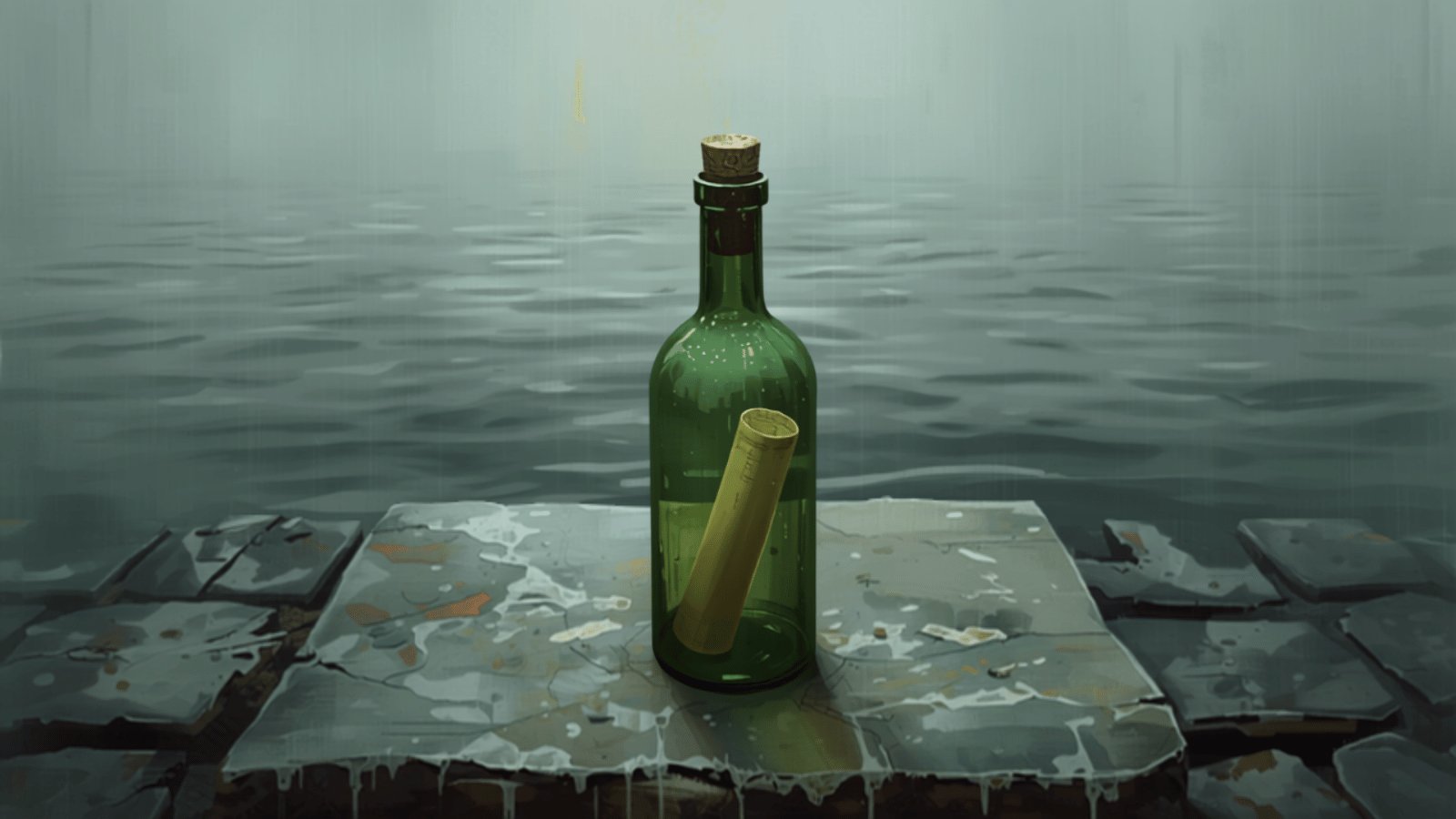
It was a glass bottle, about the size of a small vase. It was sealed with a cork and tied with a piece of thin red string. Inside, she could see a folded piece of paper, yellow at the edges. The paper had been wet at some point — she could see the pale marks where the sea had touched it — but the ink was still dark and clear. Someone had put a handwritten note inside.
Nadia looked up and down the narrow street. There was nobody there. The wind moved through the town, and gulls cried above the harbour. She picked up the bottle very carefully, as if it might break in her hands, and carried it into the shop.
Mr Vincent was already inside. He was the owner of Whittle’s Books, an old man of seventy-two with silver hair and eyes the colour of the winter sea. He had lived in the small flat above the shop for most of his life. He was reading the newspaper at his desk when she came in, and he did not look up.
“Mr Vincent,” she said. “Did you see anyone this morning?”
“Anyone where?”
“On the doorstep. Someone left this for us.”
She placed the bottle on the counter. For a moment, Mr Vincent did not move. Then, very slowly, he lowered his newspaper. His face turned a strange shade of grey.
“Where,” he asked quietly, “did you find that?”
“Outside. Just now.”
He stood up. His hand was shaking a little. Nadia had never seen him look nervous before. He walked to the counter and stared at the bottle without touching it.
“Do you know what it is?” she asked.
He did not answer at first. He just kept looking at it. Then he said, “Open it. But be gentle.”
Nadia untied the red string. The cork came out with a soft pop. Inside, she found the folded paper — and something else. A small piece of blue ribbon, the kind that a child might wear in her hair. She unfolded the paper carefully. The handwritten message was neat and old-fashioned, and this is what it said:
If you are reading this, please come to the west end of the pier at three o’clock on Thursday. Bring the book with the blue cover. I have waited a long time.
There was no signature.
Nadia read it twice. Then she read it out loud. Mr Vincent said nothing. His face was still very pale.
“Well,” she said, trying to sound calm, “somebody must have thrown this into the sea a long time ago, and now it has come back to us.”
“No,” Mr Vincent replied, in a voice that was almost a whisper. “That is not what has happened.”
“Then what?”
He sat down heavily at his desk. For a long moment, he was silent. Then he said, “This is the fourth one.”
“The fourth one?”
“The fourth bottle. There have been three others, over the past two years. Each one was left on the doorstep. Each one contained a note. Each one asked for the same thing — meet me at the pier, bring the blue book.”
Nadia stared at him. “You never told me.”
“No.”
“But why not?”
Mr Vincent did not answer. He looked down at the small piece of blue ribbon on the counter, and Nadia saw that his eyes were shining.
2 · The blue book
For most of the day, Mr Vincent said very little. Customers came in, bought paperbacks, asked about local histories. He served them politely, took their money, and returned to his desk. But Nadia noticed that he kept glancing at the bottle, which she had placed on the small shelf behind the till. He was thinking about something, and he did not want to talk.
At six o’clock, when the light outside began to fade, Nadia locked the front door and turned the sign to CLOSED. She made two cups of strong black tea, placed one in front of Mr Vincent, and sat down opposite him.
“Mr Vincent,” she said gently, “I think I have a right to know.”
He nodded slowly. “You do.”
“So — what is the blue book?”
He was quiet for a long time. Then he stood up and walked to the back of the shop, to the small room where they kept the rarer books. Nadia followed him. He climbed a low ladder, reached for the top shelf, and took down a book that was old and worn. The cover was a deep, dusty blue, and the corners were soft with age. It looked fragile, as though it might fall apart if he held it too tightly.
He carried it back to the counter and placed it between them.
“This is the blue book,” he said. “It is a children’s story called The Cat Who Lost the Sea. I read it to my daughter every night, from the time she was five until she was ten. It was her favourite. I told her that when she got married and had children of her own, I would give it to her, so she could read it to them.”
“And did you?”
“No. I never did.”
He turned the book over in his thin hands. “My daughter’s name is Marianne. She left home when she was nineteen years old. There was an argument — a stupid argument — about her studies, and about a young man she wanted to marry. I said many things that I did not mean. I told her that if she left the house that night, she should not come back. She left. That was more than thirty years ago. I have not seen her since.”
Nadia did not know what to say. She had never heard Mr Vincent speak about a daughter, or about any family at all.
“You did not try to find her?”
“I did. Twice. Once, five years after she left, I went to the city where I thought she was living. I could not find her. She had already moved. The second time was about ten years ago. I went to see an old friend of hers, who still lived in our town. She told me that Marianne had married, and was living in a small place further down the coastline. I asked for her address. Her friend said that she would ask Marianne first. A week later, she wrote to me. She said that Marianne did not want to see me.”
“So the two of you have been estranged for thirty years?”
“That is the word for it, yes. Estranged. It is a cold word, but it is the true one.”
“And now, suddenly, she wants to meet.”
He looked at the bottle on the shelf. “It seems so. Or somebody does. I do not know for certain.”
“Why did you not go, when the first bottle came?”
“Because I was afraid.” He said it simply, without shame. “I thought — what if it is not really her? What if it is some cruel joke? What if she comes, and I say the wrong thing again, and I lose her a second time?”
He sighed. “So I did nothing. The first bottle came, and I did not go. The second one came, and I did not go. The third one came, and I put all three in a drawer. I told myself that I was too old for this now. And then the fourth one came, and here I am, still afraid.”
Nadia picked up the blue book. It was surprisingly light. She opened it, and on the first page, in the same neat handwriting from the note, was an inscription:
For Marianne. All the sea is a story. — Papa.
She looked up at him.
“You are going to the pier on Thursday,” she said. “And I am coming with you.”
He smiled — a small, tired smile.
“Perhaps,” he said, “that would be a good idea.”
3 · The coastline
Thursday was two days away. In the time between, Nadia found that she could not think about anything else.
At night, she sat on the small balcony above her flat and watched the lights on the water. She thought about Mr Vincent, who had been her employer and her quiet friend for three years. She had known him as a solitary man — a man of routines, of small kindnesses, of few words. But she had never once considered the shape of his life outside the shop. He had seemed to have no family. He had seemed to have no story. Now, suddenly, he had both, and it was as if she had been reading a book without knowing that half of the pages had been torn out.
The next morning, she asked him about the earlier bottles.
“When did the first one come?” she said.
He counted on his fingers. “In January of the year before last. I remember because there had been a storm the night before. I thought at first that the sea itself had brought the bottle up onto the doorstep. But of course the shop is not on the seafront. Somebody had walked here and left it.”
“And the second?”
“About eight months later. September, I think. The third one came last spring.”
“So every eight or nine months, a bottle.”
“Yes. As if she was giving me time to think, and then coming back to ask me again.”
Nadia found this idea unbearably sad. “Or as if she was trying to be patient,” she said. “But her patience is not going to last forever.”
Mr Vincent looked down. “No. It will not.”
She spent the rest of the day quietly researching. She asked him where along the coastline Marianne might live. He told her the name of the town where he thought she had married. It was called Cormorant Bay, about forty miles south along the coast. Nadia found it on the map. It was a small fishing town with a harbour and a lighthouse — exactly the kind of place a person might choose if they wanted to live near the sea, but far from their past.
She thought about writing to Marianne first, to warn her that they were coming. But she decided against it. If the bottles had been Marianne’s way of asking, then answering by turning up at the pier in person was, perhaps, the right kind of reply. Words on paper had already been said, and had already done harm. It was time for something else.
That evening, Mr Vincent brought out a small wooden box from his desk. Inside were the three earlier notes — each one nearly identical to the fourth — and three more small tokens.
“The dry flower was in the first bottle,” he said. “The paper boat, folded from an old bus ticket, was in the second. The photograph was in the third. And now the ribbon.”
The photograph was of a small girl of perhaps eight years old, standing on a beach with her father. Both of them were laughing. Mr Vincent looked so much younger that Nadia hardly recognised him.
“Little pieces of your life together,” she said.
“Yes.”
“She has kept these things for thirty years. That means something.”
“I know. That is what has been so hard.”
“What has?”
He put the photograph down and looked at her. His eyes were tired, but very clear.
“Knowing that she never forgot.”
Nadia was quiet for a long moment. Then she asked, “Are you still afraid?”
“Yes,” he said. “But I would be more afraid to stay here and let another bottle come.”
He was reluctant, she saw, in every part of him — his slow steps, his heavy hands, the way he sat in his chair. But he was going. That was what mattered.
4 · The west end of the pier
Thursday morning was cold and bright. The wind had died, and the sea was as flat and grey as a stone. They closed the shop at midday and drove south along the coast road in Nadia’s small car. Mr Vincent sat in the passenger seat with the blue book on his lap. He hardly spoke for the whole journey. Once, he asked her to open the window; once, he asked her to close it again. Otherwise, he only watched the coastline go past.
They reached the pier at Cormorant Bay at twenty past two. The town was quiet. A few fishing boats bobbed in the harbour, and a small group of tourists stood at the far end of the pier, looking at the lighthouse in the distance.
The west end was almost empty. There was a wooden bench, a rusted lamp post, and the wide sea. Nadia parked the car nearby, and they walked out together, slowly. Mr Vincent held the blue book against his chest as if it were something fragile, though the book itself was strong enough for its age.
They sat down on the bench. The clock on the harbour building said quarter to three.
“What if she does not come?” Mr Vincent asked.
“Then we will come back next Thursday,” Nadia said. “And the Thursday after that. Until she does.”
He nodded but did not answer.
Three o’clock came. A gull landed on the rail beside them. In the distance, the tourists began to walk back towards the town. The lamp post rocked gently in the small wind.
At four minutes past three, a woman appeared at the far end of the pier.
She was in her early fifties. She wore a dark green coat and a scarf the colour of the winter sea. Her hair was silver, though not yet entirely white, and it was tied back neatly. She walked slowly. As she came closer, Nadia saw that she was carrying something under her arm — a book, wrapped in a brown paper bag.
Mr Vincent stood up. His whole body was shaking now.
The woman stopped about ten feet away. She did not smile. She did not speak.
They looked at each other for a long time. Then she said, very quietly, “Hello, Papa.”
He tried to answer, but no sound came. Nadia stepped back a little, so as not to be in the way.
The woman came closer. She took the paper bag off the book. Inside was another copy of The Cat Who Lost the Sea — a much newer edition than his own, printed perhaps only a year ago. She held it out.
“I bought a new one for my daughter,” she said. “But I have never been able to read it to her. Not without you.”
Mr Vincent held out the old book. His hand was still unsteady. “I kept this one,” he said. “I always kept it.”
She took the old book. She did not cry, but her fingers trembled. She turned to the first page and read the inscription. When she looked up again, her mouth was tight.
“I nearly did not come today,” she said. “I thought — three bottles, and no answer. What is a fourth?”
“I am sorry,” Mr Vincent said. It came out almost as a whisper. “I am so sorry.”
“I know,” she said. “I have known for a long time. I just needed to hear you say it.”
She sat down beside him on the bench.
“Tell me about the shop,” she said. “Tell me everything.”
5 · What happens next
They talked for nearly two hours. Nadia walked to a small café at the far end of the pier and left them to it. When she came back, they were still on the bench. The light had softened, and the sea was turning the colour of copper. Marianne was showing him a picture on her phone — a girl of perhaps twelve, with her mother’s serious eyes.
“Her name is Emma,” she said. “She is your granddaughter.”
Mr Vincent had no words. He just looked at the picture, and looked, and looked again.
Later, when the sun was low and the pier was cold, they walked back to the car. Marianne would not come with them that day. She had a family and a life in Cormorant Bay, and this had all been a great deal at once. But she promised to write. She promised to visit. And she promised that she would bring Emma, one day soon, to see the bookshop.
“When?” Mr Vincent asked.
“Soon. This year, I promise.”
“Really?”
“Really. Papa — I have not been happy about this either. I have not been proud of the silence. I only stopped writing to you because I thought you would never answer. If I had known you kept the notes, I would have come sooner.”
“I know,” he said. “I know now.”
They stood by the car. The wind was rising, and gulls were flying home to the cliffs.
“Papa,” Marianne said. “What made you come today, when you did not come the other times?”
Mr Vincent looked at Nadia, who was standing a little to one side. Then he looked back at his daughter.
“I had good help,” he said. “There is a young woman who works with me at the shop. She would not let me hide from you any longer.”
Marianne looked at Nadia and smiled — for the first time.
“Thank you,” she said.
“You are welcome,” Nadia said, and she meant it.
They drove home slowly along the coast road. It was almost dark by the time they reached the town. Mr Vincent held the blue book on his lap the whole way. He did not open it, but he did not put it down either.
It felt, Nadia thought, like a reunion that was only beginning — not one that was finished. A first meeting after thirty years is not, in itself, an ending. It is a door.
When they parked outside the shop, he sat still for a moment. Then he said, “There is one more thing I should have told you.”
“Yes?”
“There was a fifth bottle.”
Nadia turned to look at him. “A fifth?”
“It came this morning, before you arrived. I put it in the drawer without opening it. I was afraid to look.”
“Where is it now?”
“On my desk. It is waiting for us.”
They went inside together. On the desk, beside the newspaper, was another glass bottle. Inside was another folded piece of paper. Nadia did not know what it said — and neither, yet, did Mr Vincent.
He picked it up carefully. His hands were still not quite steady.
“Shall we?” he asked.
“Yes,” Nadia said. “Together.”
Check your understanding
Read each question. Think about your answer. Then click “Show answer” to check.
Words to remember
Here are the eight key words again, in new sentences. Read each one out loud and try to notice the pattern.
- pier — On summer evenings, families walk to the end of the pier to watch the boats come home.
- handwritten — She still writes handwritten thank-you cards, because she says a screen never feels the same.
- estranged — The two brothers had been estranged for twenty years before a family funeral finally brought them into the same room.
- coastline — We drove along the northern coastline for three days, stopping in small towns and eating fresh fish for lunch.
- inscription — Inside her grandmother’s wedding ring was a tiny inscription: “Always, and one more day.”
- reluctant — The child was reluctant to leave the beach, even though the sun had gone and it was starting to get cold.
- fragile — Please pack the glasses carefully — they are extremely fragile and any small knock will break them.
- reunion — Their reunion at the airport was quiet, but you could see in their faces that neither of them wanted to let go.
Grammar in this story: reported speech
Notice how the narrator tells us what characters said in earlier moments, using reported speech (also called indirect speech). In direct speech we quote the exact words. In reported speech we shift them back one step in time and often change the pronouns. For example:
Direct: “I have not seen her since.”
Reported: He said that he had not seen her since.
Direct: “Marianne does not want to see me.”
Reported: Her friend wrote that Marianne did not want to see him.
Direct: “I will bring Emma to see the bookshop.”
Reported: She promised that she would bring Emma to see the bookshop.
The key rules: present simple → past simple, present perfect / past simple → past perfect, will → would. Pronouns and time words (today, tomorrow, here) also shift.
👉 Learn the full rules here: Reported Speech — a B2 grammar guide.
Talk about it · Write about it
Talk about it: Is there someone in your life you have lost contact with over the years? What has stopped you from getting back in touch? If a stranger left a small gift on your doorstep to ask you to meet, would you go?
Write about it: Write a short letter (about 120–150 words) from Marianne’s point of view. Explain to her father, in her own words, why she started leaving the bottles after so many years of silence. Try to use at least three examples of reported speech (e.g. “You told me that…”, “I remembered that you had said…”).
🎉 Well done — you have finished a full B2 short story. That is over three thousand words in English, with several new B2 words folded into the plot. Notice how much you understood, even when the sentences were long and the tenses moved back and forth.
But wait — a fifth bottle is still sitting on Mr Vincent’s desk, unopened. What does the note inside say? Is Marianne asking for something more? Is somebody else writing this time? Write your own ending, using details from the story to explain your choice.
Vera keeps twenty-six keys in an old tin. Read about the people behind them and compare old habits with new technology. Next story: The Spare Keys (B2 Reading Story)
About this story: This is an original B2 graded reader (~3,250 words). It uses controlled B2 vocabulary (around 1,400 headwords) and B2-level grammar — reported speech, third conditional, past perfect, and passive forms — so upper-intermediate learners can understand roughly 98% of the words on a first reading. The eight key words were introduced above the story and used again inside it, so you meet them at least twice.

I’m Khamis Maiouf. I’m studying Health and Social Care and have completed Functional Skills Level 2 in English and Level 3 Hairdressing. I have taught ESOL in my community and helped students with GCSE English. I run English Teacher Site to help people learn and practise English.