Sang or Sung: Which One is Correct for You?

Quick Answer
The past tense of sing is sang. Use sung with have, has, or had.
Yesterday: She sang a song.
With have: She has sung many songs.
Sing, Sang, Sung — See the Pattern
Read these sentences. Can you see the pattern?
- I sing in the shower every morning. (now)
- She sang at the school show last Friday. (past)
- They have sung this song many times. (with have)
- He sang so well that everyone clapped. (past)
Did you see it? The vowel changes: sing → sang → sung. The middle letter goes i → a → u.
| Form | Word | Example |
|---|---|---|
| Present | sing | I sing every day. |
| Past | sang | I sang yesterday. |
| With have/has/had | sung | I have sung before. |
When to Use Sang and When to Use Sung
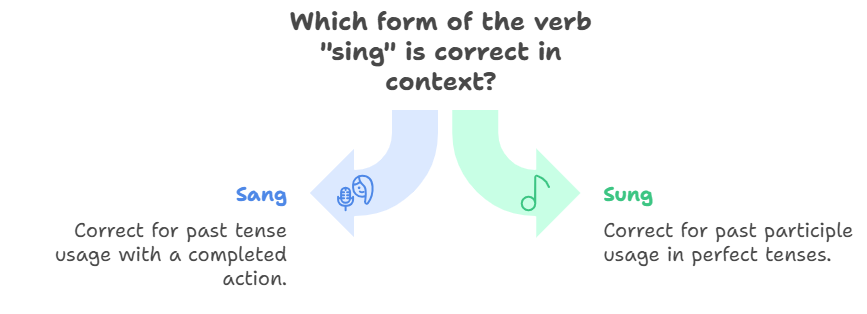
Use sang when the action happened in the past. It stands on its own — no helping word needed.
- We sang happy birthday at the party.
- The birds sang outside my window this morning.
Use sung when there is a helping word before it — have, has, or had.
- I have sung this song a hundred times.
- She has sung at three weddings this year.
- They had sung the national anthem before the game started.
Easy way to remember: Look for have, has, or had. If you see one of those words, use sung. If not, use sang.
The Rule in One Line: Sang = alone. Sung = with have, has, or had.
Real-Life Examples With Sing, Sang, and Sung
Here are sentences you might hear or say every day:
- My daughter sang her favourite song in the car. (= she did it in the past)
- Have you ever sung in front of people? (= at any time in your life, with “have”)
- The choir sang beautifully at the church last Sunday. (= past, no helping word)
- She has sung on TV twice. (= with “has”)
- We sang along to the radio while driving home. (= past, no helping word)
You are doing great. Now let’s look at the mistakes many learners make.
Two Mistakes to Avoid With Sang and Sung
Even advanced learners mix up sang and sung sometimes — so if you get confused, you are not alone. These two words sound very similar, and many native speakers get them wrong too.
Mistake 1: Using “sung” without a helping word
✗ She sung a song at the party.
✓ She sang a song at the party.
Mistake 2: Using “sang” with have/has/had
✗ I have sang this song before.
✓ I have sung this song before.
✗ He has sang in the choir for years.
✓ He has sung in the choir for years.
How to remember: Think of it like a phone. You rang someone (past, alone). You have rung them (with have). The pattern is the same: sang / sung works like rang / rung.
Other verbs like this: ring (rang/rung), drink (drank/drunk), swim (swam/swum), sink (sank/sunk). They all follow the i → a → u vowel pattern.
Test Yourself: Sang or Sung?
Choose the correct answer for each sentence. Click Check to see if you are right.
1. She _______ a beautiful song at the concert last night.
2. Have you ever _______ in front of a big crowd?
3. The children _______ happy birthday to their teacher.
4. He has _______ in the school choir for three years.
5. We _______ along to every song on the radio yesterday.
Keep Going — You Are Building Something
You just learned the difference between sang and sung. That is one more irregular verb you will never get wrong again.
But here is something interesting. The verb ring follows the exact same pattern: ring, rang, rung. Same vowel change — i, a, u. But do you know when to say “I rang the bell” and when to say “I have rung the bell”? The answer might surprise you.
Next lesson: Is It Rang or Rung? The Past Tense of Ring
Sources

My name is Khamis Maiouf. I am the creator of the English Teacher Site, dedicated to providing valuable resources and insights for students around the world. With a passion for education and a commitment to helping students enhance their skills, I aim to make English teaching more effective and enjoyable for both educators and students.