Why the Past Tense of Shut Confuses So Many People?

Quick Answer
The past tense of shut is shut. It does not change. There is no word “shutted” in English.
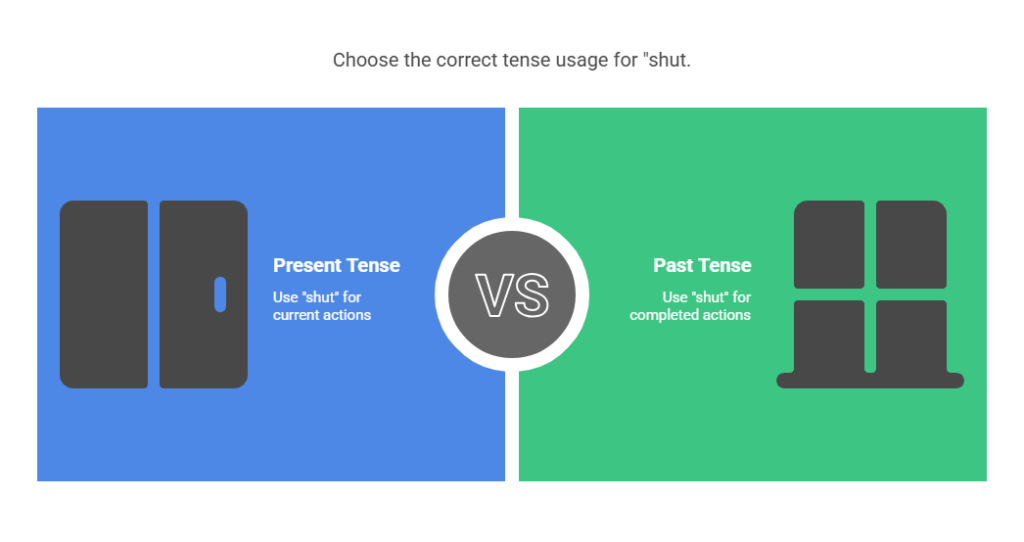
Today: I shut the door.
Yesterday: I shut the door.
Shut in the Past — It Stays the Same
Read these sentences. Can you see the pattern?
- She shut the window because it was cold.
- He shut his book and went to sleep.
- We shut the shop early last night.
- The dog shut its eyes when the music started.
Did you notice? The word is always shut — in the present and in the past. It never changes.
Why Shut Does Not Change
Most verbs in English add -ed to make the past tense:
- open → opened
- close → closed
- lock → locked
But shut is different. It is an irregular verb. It stays the same in every form:
| Form | Example |
|---|---|
| Present | I shut the door every night. |
| Past | I shut the door last night. |
| Past participle | I have shut the door already. |
The word shut looks the same every time. The other words in the sentence tell you if it is present or past.
The Rule in One Line: Shut never changes. Present, past, past participle — always shut.
How to Use Shut in Everyday English
Here are more examples you might use every day:
- I shut down my laptop before bed. (= I turned it off)
- The café shut at 9pm last night.
- She shut the gate so the dog could not run out.
- He shut the curtains and turned on the lamp.
- The wind shut the door with a loud bang.
You are doing great. Now let’s look at a mistake that many learners make.
The Most Common Mistake With Shut
Many learners say “shutted.” That is actually a smart guess — you know that most verbs add -ed for the past. Even native speakers’ children make this mistake when they are learning to talk. But “shutted” is not a real English word.
✗ I shutted the door.
✓ I shut the door.
✗ She shutted the shop early.
✓ She shut the shop early.
✗ They have shutted the windows.
✓ They have shut the windows.
How to remember: Think of the word cut. You say “I cut the bread yesterday” — not “I cutted it.” The word shut works the same way. Some verbs just do not change.
Other verbs like this: cut, put, let, set, hit, hurt. They all stay the same in the past.
Test Yourself: Shut or Shutted?
Choose the correct answer for each sentence. Click Check to see if you are right.
1. He _______ the front door before he left for work.
2. The shop has _______ for the holiday.
3. She _______ her eyes and made a wish.
4. We _______ the windows because of the rain.
5. The bank _______ early yesterday.
Keep Going — You Are Building Something
You just learned that shut never changes. That is one more irregular verb you will never get wrong again.
But not all irregular verbs stay the same. Some change a lot. For example, do you know the past tense of swing? Is it swang, swung, or just swinged? (The answer is more interesting than you might think.)
Next lesson: Confused by the Past Tense of Swing? Get the Facts Here
Source
Harper, Douglas. “Etymology of shut.” Online Etymology Dictionary.

My name is Khamis Maiouf. I am the creator of the English Teacher Site, dedicated to providing valuable resources and insights for students around the world. With a passion for education and a commitment to helping students enhance their skills, I aim to make English teaching more effective and enjoyable for both educators and students.