Hid or Hidden Which One Should You Use and Why?

Quick Answer
The past tense of hide is hid. With “have,” “has,” or “had,” use hidden.
Every day: I hide my diary.
Yesterday: I hid my diary.
Many times: I have hidden my diary before.
Hide, Hid, Hidden — See the Pattern
Read these sentences. Look at how the verb changes:
- I hide my phone before bed every night. (now — it happens often)
- She hid the present under the bed yesterday. (past — it is finished)
- He has hidden the key somewhere safe. (past with “has”)
Did you see the pattern? There are three forms:
| When? | Form | Example |
|---|---|---|
| Now / every day | hide | I hide my diary at home. |
| In the past | hid | I hid my diary last night. |
| With have / has / had | hidden | I have hidden my diary many times. |
When to Use Hid and When to Use Hidden
This is easier than you think. Here is the simple rule:
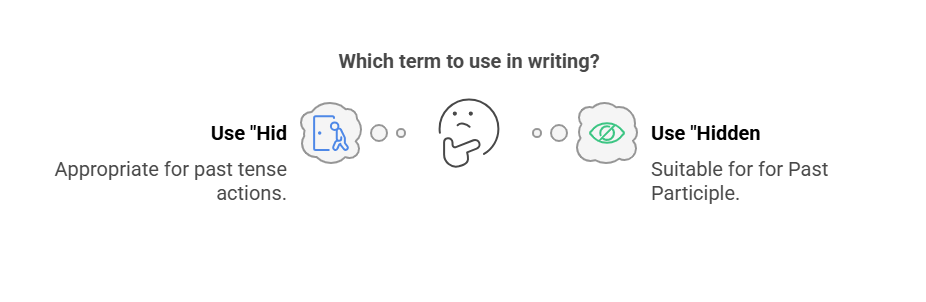
Use “hid” when you talk about the past — something that is finished:
- She hid the letter in her bag.
- The dog hid under the table.
- We hid the surprise before he came home.
Use “hidden” when there is a helping word before it — have, has, had, was, or were:
- She has hidden the letter.
- The dog had hidden under the table before.
- The present was hidden in the cupboard.
Easy way to remember: Look for have, has, had, was, or were before the verb. If you see one, use hidden. If there is no helping word, use hid.
The Rule in One Line: Alone → hid. With have/has/had/was → hidden.
How to Use Hid and Hidden in Everyday English
Here are sentences you might use every day:
- I hid the chocolate so nobody would eat it. (past — no helping word)
- The children hid behind the door to surprise their mum. (past — no helping word)
- Someone has hidden my keys and I cannot find them. (with “has” — use hidden)
- The money was hidden inside a book for years. (with “was” — use hidden)
- He hid his feelings and did not tell anyone. (past — no helping word)
You are doing great. Now let’s look at the mistakes many learners make.
The Most Common Mistake With Hid and Hidden
Even advanced learners mix up “hid” and “hidden” sometimes — so if you get confused, you are not alone. Some people also say “hided,” but that is never correct!
Mistake 1: Using “hid” with have/has/had
✗ She has hid the passport.
✓ She has hidden the passport.
Mistake 2: Adding “-ed” to make the past tense
✗ He hided behind the tree.
✓ He hid behind the tree.
Mistake 3: Using “hidden” without a helping word
✗ The cat hidden under the sofa.
✓ The cat hid under the sofa.
How to remember: Think of hidden as a team player — it always needs a teammate (have, has, had, was). Hid works alone. And hided? That word does not exist — forget it!
Other verbs like this: ride → rode → ridden, write → wrote → written, bite → bit → bitten.
Test Yourself: Hid or Hidden?
Choose the correct answer for each sentence. Click Check to see if you are right.
1. The children _______ behind the curtain during the game.
2. She has _______ her diary in a safe place.
3. The dog _______ under the table when it heard the thunder.
4. The present had been _______ for weeks before the party.
5. My brother _______ my shoes this morning, and I was late for school.
Keep Going — You Are Building Something
You just learned hide, hid, hidden. That is one more irregular verb you will never get wrong again.
But here is a fun question: you know how to hide — but what about seek? “Hide and seek” is a game every child knows. But what is the past tense of seek? Is it “seeked” or “sought”? Most people get this one wrong.
Next lesson: Seeked or Sought? The Past Tense of Seek Explained
Source
1. Harper Douglas, “Etymology of hide,” Online Etymology Dictionary, https://www.etymonline.com/word/hide
2. “Hide.” Farlex Dictionary of Idioms. https://idioms.thefreedictionary.com/hide

My name is Khamis Maiouf. I am the creator of the English Teacher Site, dedicated to providing valuable resources and insights for students around the world. With a passion for education and a commitment to helping students enhance their skills, I aim to make English teaching more effective and enjoyable for both educators and students.