What’s the Plural of Referendum: Understanding Language Nuances

Quick Answer
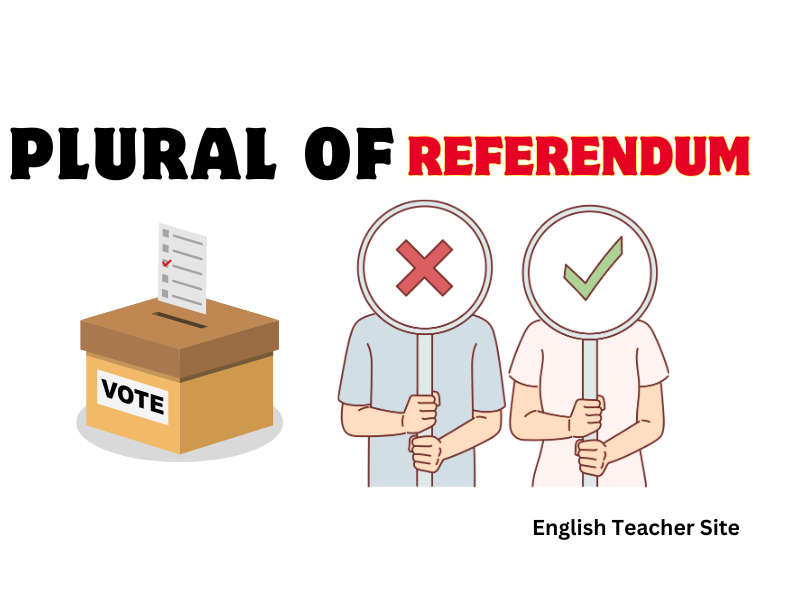
The plural of referendum is referenda (the Latin way) or referendums (the English way). Both are correct. Most news writers today use referendums.
Referendum, Referenda, Referendums — See the Pattern
A referendum is a public vote on one big question. The people of a country vote “yes” or “no” on it. Look at how the plural works:
- The country held one referendum last year.
- Switzerland holds many referendums every year.
- The judge studied several old referenda before the decision.
- There will be a referendum on Sunday about the new law.
Did you see the pattern? There are two correct plurals:
| Singular | Plural (Latin) | Plural (English) |
|---|---|---|
| referendum | referenda | referendums |
When to Use Referenda and When to Use Referendums
The word “referendum” comes from Latin. In Latin, words that end in -um change to -a in the plural. That is why “referendum” becomes “referenda.”
But in modern English, we also just add -s to make “referendums.” Both forms are correct. Here is when to use each one:
- Referendums — use this in everyday English: news, school work, normal writing. It is the most common form today.
- Referenda — use this in formal writing: law books, government reports, academic essays
Easy way to remember: If you are writing for a newspaper or a teacher, referendums is safe. If you are writing a legal paper, referenda sounds more formal. You cannot really go wrong with either one.
Other Latin words follow the same -um → -a pattern:
| Singular | Latin Plural |
|---|---|
| memorandum | memoranda |
| curriculum | curricula |
| datum | data |
| bacterium | bacteria |
The Rule in One Line: referendum → referendums (everyday) or referenda (formal) — both are correct.
Real-Life Examples With Referendum and Referenda
- My country will have a referendum next month. (one vote — singular)
- The newspaper reported on the last three referendums in Europe. (more than one — English plural)
- The professor wrote a book about famous referenda in history. (more than one — Latin plural, formal)
- People sometimes vote in a referendum to change the country’s flag.
- How many referendums has your country had?
You are doing great. Now let’s look at the mistakes many learners make.
The Most Common Mistake With the Plural of Referendum
Even native English speakers and journalists argue about Latin plurals — so if you find this tricky, you are not alone. The biggest mistake is mixing the two forms and writing “referendas.” This is not a real word.
✗ The country held three referendas last year.
✓ The country held three referendums last year.
✓ The country held three referenda last year.
✗ We need to organise a referendums on this question.
✓ We need to organise a referendum on this question.
How to remember: You have two choices for the plural — the Latin way (change -um to -a) or the English way (add -s). Never mix them together. And when you only mean one vote, always use referendum.
Test Yourself: Referendum, Referenda, or Referendums?
Choose the correct answer for each sentence. Click Check to see if you are right.
1. The country held four _______ on different laws last year.
2. There will be one _______ next Sunday about the new road.
3. The law book lists all the formal _______ from the 19th century.
4. A _______ is a vote where everyone says “yes” or “no” to one big question.
5. Switzerland holds many _______ every year — more than any other country.
Keep Going — You Are Building Something
You just learned the plural of referendum. That is one more Latin plural you will never get wrong again.
Now here is a question many learners get wrong: is bacteria singular or plural? It follows the same Latin -um → -a pattern as referendum — but most people use it the wrong way every day. Do you know which form is “one” and which form is “many”?
Next lesson: Is Bacteria Plural or Singular?
Sources

My name is Khamis Maiouf. I am the creator of the English Teacher Site, dedicated to providing valuable resources and insights for students around the world. With a passion for education and a commitment to helping students enhance their skills, I aim to make English teaching more effective and enjoyable for both educators and students.